


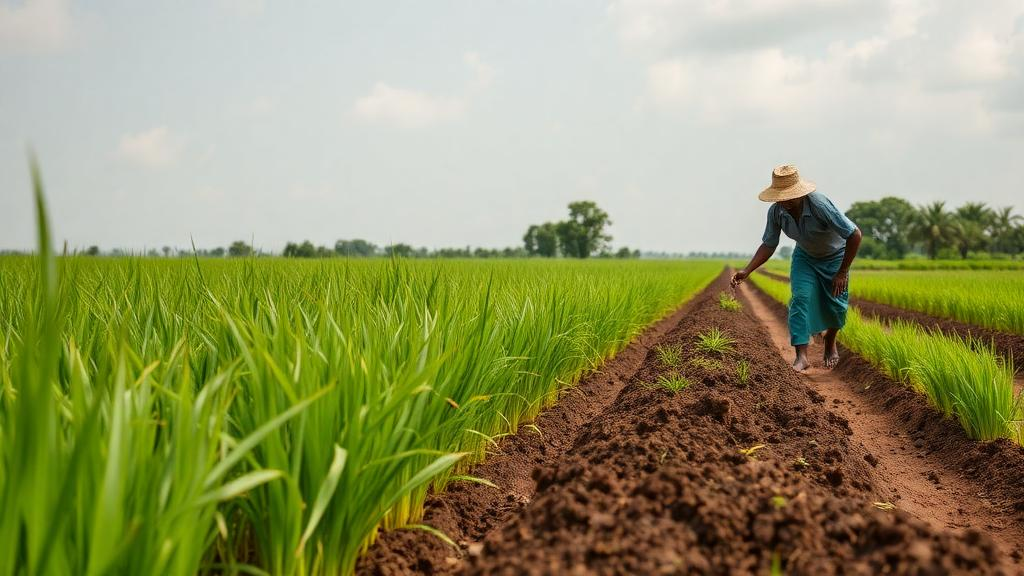
Smallholder rice farmers in Tanzania’s Kilombero valley floodplain are reporting widespread deterioration of the soils they depend on, and they link the decline directly to the region’s shift toward market-driven, agrochemical-intensive agriculture. A new study published in Frontiers in Sustainable Food Systems documents how farmers in this ecologically sensitive floodplain perceive soil health change, what indicators they use to diagnose it, and how their long-standing management practices are being displaced by commercial pressures. The research, led by Gerison Saddick Stephen of Sokoine University of Agriculture with colleagues at the University of Dar es Salaam and the University of Cape Town, combined focus group discussions, key informant interviews and a household survey across six villages in the valley.
The Kilombero valley floodplain, located in southeastern Tanzania within the Morogoro Region, is one of East Africa’s largest floodplains, covering roughly 7,900 square kilometres of wetlands within a catchment of more than 30,000 square kilometres. Designated a Ramsar site in 2002 for its ecological importance, the valley supports large mammals, migratory birds, aquatic resources and around half a million people whose livelihoods rest primarily on farming. In 2010 the area became part of the Southern Agricultural Growth Corridor of Tanzania, an initiative designed to transform smallholder subsistence production into commercial farming. According to the paper, SAGCOT has attracted agricultural investments worth more than six billion US dollars and improved market access for more than 13 percent of smallholders, changes that have pushed farmers toward greater reliance on agrochemicals and technology to meet economic targets.
The study focused on smallholder paddy farmers, defined by the Food and Agriculture Organization as those cultivating between less than one hectare and up to ten hectares. The researchers conducted 18 focus group discussions involving 129 participants and 20 key informant interviews with agricultural officers, village leaders, elderly community members, pesticide sprayers, a SAGCOT representative and agrochemical dealers. A household survey of 240 households, drawn from an estimated population of 9,502 rice-farming households using Slovin’s formula at a five percent level of precision, complemented the qualitative work. Transect walks across farmers’ fields allowed the team to observe land-use patterns and to collect and identify plant species that farmers themselves treat as signals of soil condition.
The results reveal a rich body of experiential soil knowledge passed down through generations. Farmers judge soil health by tracking crop yield trends, soil color, crop appearance, soil texture, the presence or absence of earthworms, soil workability, and the responsiveness of crops to applied inputs. In the survey, nearly 23 percent of household heads assessed soil condition primarily by tracing yield trends, 14 percent used soil color and 12 percent relied on crop appearance. More than half said such knowledge was transmitted informally across generations, while roughly 30 percent attributed it to long-term farming experience. One elderly informant from Chita recalled that dark soil rich in earthworms, known locally as chamvi, was considered healthy because the worms mix crop residues into the soil and sustain fertility, a condition under which harvests were high even without fertilizer.
The transect walks documented 16 plant species that farmers use as living indicators of soil condition. Species such as Cyperus odoratus, Ammannia coccinea and Aeschynomene indica were regarded as signs of fertile, well-watered soils suitable for paddy cultivation, because their residues improve fertility and water retention. Others, including Echinochloa species, Cynodon dactylon and Marsilea minuta, were read as warnings of poor soils, since they are highly invasive, resistant to common herbicides and deplete fertility. Farmers described how this botanical literacy guides decisions about where to cultivate, which areas to rest and when to intervene, knowledge acquired through observation and participation within farming households rather than through formal training.
Traditional management practices still dominate but are eroding. About 65 percent of surveyed farmers continued to use traditional soil management approaches, with roughly 31 percent using crop residues, 30 percent practicing crop rotation, 4.5 percent leaving land fallow and a small fraction building terraces. By contrast, nearly 35 percent of households relied solely on industrial fertilizers for soil management. Farmers explained that fallowing and rotation sustained soil health for generations, but that these practices are increasingly abandoned. Land pressure means fallowed plots may simply be cultivated by relatives, and within irrigation schemes the waterlogged conditions make legumes difficult to grow while mechanized tillage struggles with crop residues left on fields. Fertilizers have, in the words of one elder farmer from Mkula, become an alternative to traditional soil management.
Perceptions of soil decline were widespread and specific. The majority of farmers reported reduced crop yields, loss of soil organisms, increased compaction, new insect and weed pests, salinization, acidification and a visible shift from dark black soils to whitish ones. Overall, about 41 percent of respondents rated their soil health as average, 28 percent as good, 19 percent as poor, with the remainder split between very poor and very good ratings. Farmers attributed the changes primarily to intensified agrochemical use, cited by about 31 percent, followed by uncontrolled agricultural expansion and continuous cultivation, each at roughly 19 percent, and climate variability at 16 percent. A herbicide sprayer in Mkula described an escalating spray regime involving multiple herbicides applied before land preparation, after sowing and again after crop emergence, with chemicals sometimes mixed together, while insecticides are applied whenever pests appear.
The perceived consequences extend into production and livelihoods. Farmers reported that agrochemicals, initially effective, have progressively lost their punch, with poor fertilizer response, declining yields and growing pest and weed resistance. District-level yield data traced by the researchers from the 2019/2020 to the 2023/2024 cropping seasons show rice yield falling from 2.6 tonnes per hectare to 1.85 tonnes per hectare, an overall reduction of nearly 30 percent, even as cultivated area expanded substantially. The 2022/2023 season showed a slight recovery, which the authors suggest may reflect expansion into newly opened, more fertile land, but yields remained about 20 percent below the 2019/2020 level. Households described unstable harvests, rising production costs and growing livelihood insecurity.
Statistical analysis of the survey data found that socioeconomic and demographic characteristics had only limited influence on which soil management practices farmers adopted. Gender showed a marginal association with adoption patterns, with female respondents slightly dominating the use of chemical fertilizers, crop residues and crop rotation while males were more represented in fallowing and terrace building. Age, education, residence status and occupation were not significantly associated with adoption. The authors interpret this weak patterning through a political ecology lens, arguing that soil health change in the valley cannot be understood as the result of individual farming decisions alone but reflects broader political-economic processes, including national development frameworks such as Kilimo Kwanza and AGCOT, that compel smallholders to intensify production beyond ecologically sustainable limits.
The authors are careful to note the study’s limitations. It did not establish causal relationships between management practices and measured soil change, relying instead on farmers’ experiential accounts rather than direct scientific measurement of soil properties, and it did not comprehensively quantify the interacting biophysical, climatic and socioeconomic factors shaping crop production. Scientific measurement across the landscape would be needed to validate and spatially map the changes farmers perceive. Nevertheless, the convergence between farmers’ narratives and existing empirical evidence from the valley, including documented declines in soil organic matter, rising acidification and reduced nutrient availability, lends weight to their testimony. The paper concludes that profit-led agricultural interventions have undermined farmers’ long-standing adaptive strategies and are widely perceived to compromise the habitability of the floodplain, and it recommends integrating farmers’ knowledge and management practices into agricultural policies and institutional frameworks as a foundation for sustainable soil health and productivity.
Subject of Research: Farmers' knowledge, perceptions and management practices regarding soil health change under agricultural commercialisation in the Kilombero valley floodplain, Tanzania
Article Title: Diversity of smallholder rice farmers’ knowledge, perceptions and management practices for soil health in the growing market and agrochemicals-led agriculture in Tanzania
Article References: Stephen, G. S., Noe, C., & Green, L. (2026). Diversity of smallholder rice farmers’ knowledge, perceptions and management practices for soil health in the growing market and agrochemicals-led agriculture in Tanzania. Frontiers in Sustainable Food Systems, 10, Article 1936765. https://doi.org/10.3389/fsufs.2026.1936765
Image Credits: AI Generated
DOI: 10.3389/fsufs.2026.1936765
Keywords: soil health, smallholder farmers, rice, Tanzania, Kilombero valley, agrochemicals, agricultural commercialisation, political ecology, traditional knowledge, crop yield decline, soil management, floodplain agriculture
Cite Scienmag News
Alan Morgan. (October 27, 2026). Tanzanian rice farmers say soils are failing as commercial farming intensifies. Scienmag. https://scienmag.com/tanzanian-rice-farmers-say-soils-are-failing-as-commercial-farming-intensifies/
Alan Morgan. "Tanzanian rice farmers say soils are failing as commercial farming intensifies." Scienmag, 27 October 2026, https://scienmag.com/tanzanian-rice-farmers-say-soils-are-failing-as-commercial-farming-intensifies/. Accessed 27 October 2026.
Alan Morgan. "Tanzanian rice farmers say soils are failing as commercial farming intensifies." Scienmag. October 27, 2026. https://scienmag.com/tanzanian-rice-farmers-say-soils-are-failing-as-commercial-farming-intensifies/


