


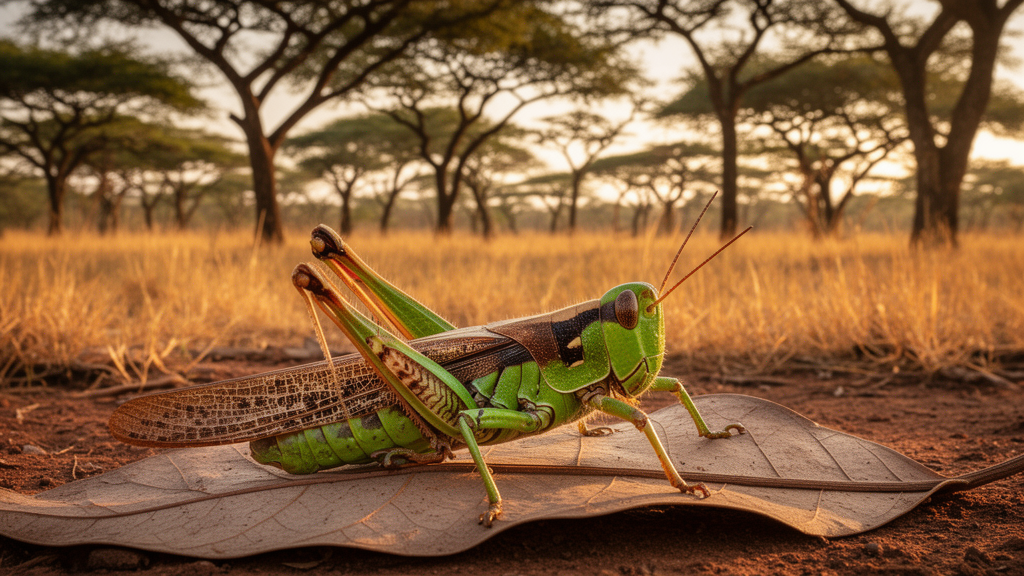
A previously unknown species of grasshopper has been described from the Mpwapwa District of Central Tanzania, and it is a record-breaker within its genus. The insect, named Neoleva magna, belongs to the subfamily Gomphocerinae within the short-horned grasshoppers and was collected in miombo woodlands south of Dodoma. According to the taxonomic description, published in the Journal of Orthoptera Research, the new species is the largest known member of the genus Neoleva, with males reaching a total length of about 18.5 to 22 millimeters when measured from the frons to the tips of the folded posterior femora. All other known species of Neoleva are smaller, and the females of the new species, at 24.5 to 29.5 millimeters, also exceed the females of the other species in the genus, although the author notes that the means overlap between species.
The genus Neoleva was erected by Jago in 1996 with N. mega from Ethiopia as the type species, and three further species from Kenya were included at that time. These are stocky, brachypterous grasshoppers in which the antennae are longer than the head and the pronotum together. Males have a rounded subgenital plate and simple cerci, and the genus shows marked sexual dimorphism, with females considerably larger than males. Males display a contrasting color pattern with an orange dorsal abdomen and orange parts on the hind femora, while females are duller in color. In males, a pair of white spots at the anterior margin of the pronotum is present, along with a pair of angulate cream to white bands on the meso- and metanotum. The epiphallus, a structure of the male genitalia, has a strong bridge and a narrow interspace. Neoleva species are geophilous, meaning ground-dwelling, and have been found in habitats ranging from semi-desert to savanna woodlands.
The new species was identified from specimens collected in the field and compared against all available material of the four previously known species of Neoleva, including the type specimens held in the Natural History Museum in London. The holotype is a male collected in March 2015 at Changalawe Hill in the Mpwapwa District, at roughly 750 meters elevation in miombo woodlands, and is deposited in the Natural History Museum. Paratypes include a female from the same locality and date, two males and two females in the collection of Claudia Hemp, and three males and one female collected at Msaze village near Gulwe at 1000 meters elevation in March 2017 and March 2020. For the study of genital morphology, specimens were relaxed in water, the phallus extracted manually, macerated in 5 percent potassium hydroxide, and then neutralized in 5 percent acetic acid, with the macerated epiphallus photographed using a compact camera and focus-stacking software.
The male of N. magna shows a speckled pattern of gray, dark, and white patches, with the abdomen, the inner sides of the hind femora, and the apical parts of the tibiae orange. The tegmina, the modified forewings of grasshoppers, are light brown in the costal area and darker brown above, with some dark spots around the media area. The pronotum carries a well-developed pair of white spots at its anterior margin and angulate white lines on the meso- and metazona, while the ventral parts of the lateral pronotal lobes are white or creamy. The lunules of the hind femora are dark, with a postgenicular white band on both femur and tibia. The remaining outer side of the hind femur is greyish or creamy with three dark fasciae on the dorsal ridge, and these fasciae extend into the inner parts of the hind femora. The fore and mid legs are speckled white, greyish, and black.
Further anatomical details distinguish the new species. The antenna is about 1.5 times longer than the head and pronotum together, at about 13 millimeters, and the frontal ridge is flat and coarsely punctate on its upper part, with a medial ocellus at about the middle of the ridge. The pronotum is crossed by three deep sulci, the posterior one separating the mesozona from the metazona and continuing deep into the lateral pronotal lobes with an abrupt angle about in the middle of the lobes before running anteriorly almost to the anterior margin. A medial carina is faint on the pro- and mesozona but well developed on the metazona. Notably, the tegmina reach to about the middle of the abdomen and are tectate, meaning folded like a roof, with elevated veins along their whole length. The supra-anal plate is triangular and appendiculate at the tip, and the cerci are short and slightly laterally compressed. In the internal genitalia, the ancorae of the epiphallus are very weakly sclerotized and comparatively small, the bridge is narrow, and the inner and outer lophi are described as typical for the genus.
The female is larger and stouter than the male, with a color pattern that is duller but generally similar, retaining the pair of white dots at the anterior pronotal margin and the angular white lines at the posterior part of the pronotum. Some females are uniformly brown, while others also have orange hind femora. The ovipositor valves are short; the dorsal surfaces of the upper valves are concave, forming an almost cup-like structure with dark sclerotized margins, and the ventral valves have a slightly undulating margin that is also darkly sclerotized with more acute tips. Measurements taken from four males and six females document the size difference between the sexes: head width ranges from 4.2 to 4.4 millimeters in males versus 5.7 to 6.1 millimeters in females, posterior femur length from 13.0 to 12.8 millimeters versus 17.5 to 18.8 millimeters, tegminal length from 7.1 to 7.6 millimeters versus 10.1 to 10.9 millimeters, and body length from 17.7 to 18.5 millimeters versus 26.2 to 26.5 millimeters.
The differential diagnosis rests on a combination of size, coloration, wing shape, and genital morphology. Male N. magna resemble N. bufoides and N. robertsoni in having a white or creamy ventral margin of the pronotal lobes, but in those two species the outer sides of the hind femora are more or less uniformly orange to red, whereas in N. magna only the ventral and inner sides of the hind femora are vivid orange, the outer side being light grey or whitish. N. mega and N. kevani appear to have much duller coloration, although living specimens of these taxa have not been seen, and for N. mega only the male holotype is known. N. magna also has an appendiculate supra-anal plate, as described by Jago for N. kevani and N. mega. In contrast to the other known species of Neoleva, which have lobe-like wings more evenly shaped and more closely appressed to the abdomen, N. magna has tectate folded tegmina. Internally, the male epiphallus differs from the other three species in its relative size, the distance between the ancorae, and the orientation and size of the lophi.
Alongside the species description, the paper presents an updated identification key to the males of Neoleva, adapted from Jago’s earlier work. In the key, N. magna is separated first by its tectiform, or roof-shaped, tegmina and a male body length greater than 18.5 millimeters, combined with its occurrence in the Mpwapwa District of Central Tanzania. The remaining species, with lobe-like tegmina and smaller males, are then distinguished by the coloration of the ventral lateral pronotal lobes and by details of the inner lophi, the supra-anal plate, and abdominal coloration. N. robertsoni, from the Meru Region of Kenya, has widely spaced inner lophi and a weakly tapered supra-anal plate lacking a transverse sulculus, while N. bufoides, from the Lysamais area of Kenya, has comparatively closely spaced inner lophi and a strongly tapered supra-anal plate with a clear transverse sulculus. N. kevani from southern Kenya has comparatively small inner lophi with constricted lateral margins and a vivid orange-red abdomen at maturity, and N. mega from Ethiopia has comparatively large inner lophi, a dark brown to red and black abdomen, and a small apical appendix on the supra-anal plate.
The song of the new species is unknown, and the name magna derives from the Latin magnus, meaning big, a reference to its status as the largest species of the genus so far. Ecologically, N. magna is a ground dweller found on open patches within miombo woodlands and along forest margins with sparse vegetation. It was recorded at two localities: at the edge of Changalawe Hill south of Dodoma, covered with sparse miombo forest, and at a similar hill near Gulwe, not far from the district city of Mpwapwa. The other Neoleva species were caught in savanna woodlands on patches with sparse vegetation or in semi-desert areas, with N. bufoides in Acacia shrub and thickets and on the banks of dry riverbeds, N. robertsoni in thicket and herbs, and N. kevani in desert grass and thorn bush. No habitat information is available for the holotype male of N. mega from Ethiopia.
The description also carries a conservation note. Miombo woodlands are vanishing rapidly, mostly due to recurrent burning and transformation into agricultural fields, a trend already documented in earlier work on the Orthoptera of these localities. Because N. magna appears to be bound to thickets and forest edges of miombo woodlands, the author concludes that the species is probably also under pressure from this ongoing habitat loss. The known distribution of the new species currently rests on specimens from the Mpwapwa District in Tanzania, and the paper’s distribution map places the Neoleva species across their East African range from Ethiopia through Kenya to the new Tanzanian records.
Subject of Research: Taxonomic description of a new grasshopper species, Neoleva magna, from Central Tanzania
Article Title: A new species of Neoleva ( Caelifera , Acridoidea , Acrididae , Gomphocerinae ) from Central Tanzania
Article References: Hemp, C. (2023). A new species of Neoleva (Caelifera, Acridoidea, Acrididae, Gomphocerinae) from Central Tanzania. Journal of Orthoptera Research, 32(2), 127-131. https://doi.org/10.3897/jor.32.91581
Image Credits: AI Generated
DOI: 10.3897/jor.32.91581
Keywords: Neoleva magna, new species, Gomphocerinae, grasshoppers, Tanzania, miombo woodlands, taxonomy, Mpwapwa District, Orthoptera, Acrididae, sexual dimorphism, habitat loss
Cite Scienmag News
Margaret Porter. (October 27, 2026). Large New Grasshopper Species Discovered in Central Tanzania’s Vanishing Miombo Woodlands. Scienmag. https://scienmag.com/large-new-grasshopper-species-discovered-in-central-tanzanias-vanishing-miombo-woodlands/
Margaret Porter. "Large New Grasshopper Species Discovered in Central Tanzania’s Vanishing Miombo Woodlands." Scienmag, 27 October 2026, https://scienmag.com/large-new-grasshopper-species-discovered-in-central-tanzanias-vanishing-miombo-woodlands/. Accessed 27 October 2026.
Margaret Porter. "Large New Grasshopper Species Discovered in Central Tanzania’s Vanishing Miombo Woodlands." Scienmag. October 27, 2026. https://scienmag.com/large-new-grasshopper-species-discovered-in-central-tanzanias-vanishing-miombo-woodlands/


