


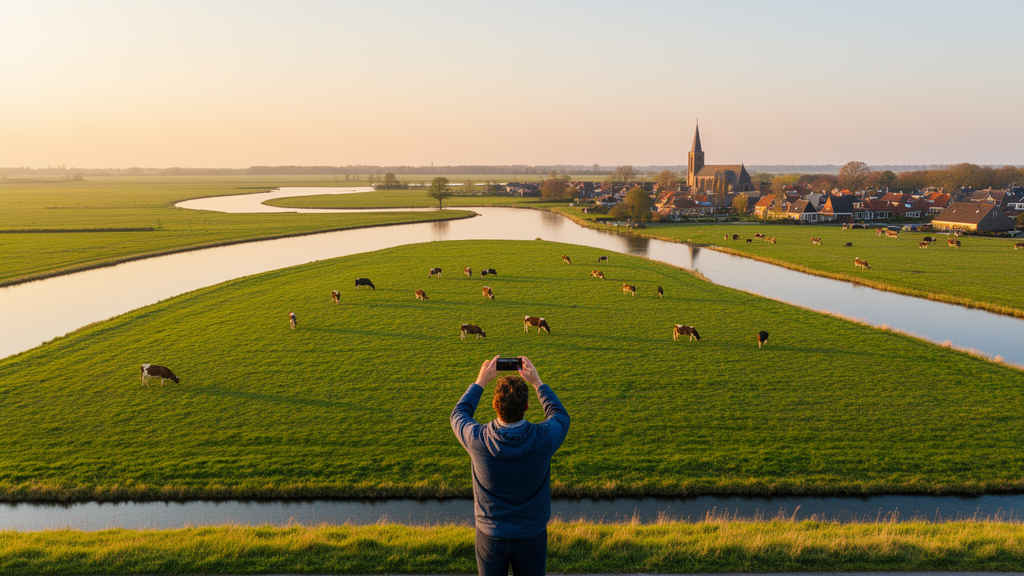
Photographs that holidaymakers, cyclists and locals upload to Flickr can be used to map where a river landscape delivers cultural ecosystem services, according to a case study of the Lower Rhine near Wageningen in the Netherlands. The study, published in the journal One Ecosystem, downloaded more than ten thousand images taken between January 2010 and January 2021, filtered them down to 659 usable geotagged photographs, and combined their locations with land-cover maps and an in-person photographic survey to test whether social media data can stand in for traditional questionnaires.
Cultural ecosystem services are the non-material benefits people obtain from nature, including recreation, aesthetic enjoyment, spiritual satisfaction and intellectual development. The research team, working across a 75.16 square kilometre study area that includes the towns of Rhenen, Wageningen, Renkum, Randwijk, Zetten, Opheusden and Kesteren, set out to answer three questions: where cultural ecosystem services are distributed in space, whether Flickr users represent the cultural identity of the community and its visitors, and which land-cover types are most appreciated and what aesthetic preferences visitors and experts hold.
The method followed four stages. First, the researchers used the photosearcher package in R to query the Flickr API and download metadata for every geo-tagged image in the study area, including latitude, longitude, view counts, likes and image URLs. Images that were incorrectly positioned, lacked geotags, showed close-ups of people, plants or animals, contained brands or logos, or were of poor quality were excluded. The surviving photographs were then classified by an expert into eight cultural ecosystem service categories based on frameworks drawn from the Millennium Ecosystem Assessment and later classification schemes.
Second, the geotagged photographs were converted into point data in ArcMap 10.3 and analysed with kernel density estimation, a geographic information system technique that identifies where points cluster and how their density changes with distance. The resulting density surfaces were compared against the CORINE 2018 land-cover classification, obtained from PDOK, the Dutch national geographic data platform, using both first-level and third-level classes to determine which service categories aligned with which land-cover types.
Third came the ground-truthing exercise. In a photographic survey, 250 randomly selected Flickr photographs were shown to 50 local people and visitors, who were asked to assign each of five randomly presented photos to the most appropriate cultural ecosystem service category and to rate its aesthetic appeal on a scale of one to ten. The participants were also asked how long they stayed in the areas depicted. Finally, the researchers compared the classifications and ratings of the experts, the surveyed public and the online Flickr users, running statistical analyses in SPSS 15.0, R 3.6.3 and ArcGIS 10.3.
The density analysis revealed clear hotspots. The northern part of the study area offered the most places where several cultural ecosystem services were valued simultaneously, and almost all spots with higher service diversity lay between Wageningen city centre and the Lower Rhine. Categories one, Landscape Appreciation, and four, Natural Structures, were densely clustered in the port area of Wageningen close to the city centre, while the lowest aggregation for those categories and for Artistic and Cultural Interactions appeared in Renkum, the city centre, the area around the paper mill, the Utrecht/Gelderland border and agricultural zones. Across all categories, natural structures stood out.
The land-cover comparison showed that pastures, meadows and other permanent grasslands under agricultural use, together with natural grassland, held the highest density of service-related Flickr images. At a finer level of detail, forest and semi-natural areas and agricultural areas were the most common land-cover type in every service category. The survey results mirrored this pattern: participants rated natural grassland areas highest and industrial or commercial units and public facilities lowest. Among service categories, photographs in the Natural Structures class were the most preferred and those in the Research and Education class the least. When the five basic CORINE classes were examined separately, agricultural areas drew the highest aesthetic ratings from both participants and experts, and the highest-scoring photographs in the city and artificial zones belonged to the Landscape Appreciation and Natural Structures categories.
Agreement between the data sources was statistically significant but modest in strength. The service selections of experts correlated positively with those of survey participants, with a Pearson correlation of 0.14 and a p-value below 0.001, and the aesthetic perceptions of the two groups showed a great deal of similarity, with both giving high scores especially in the Landscape Appreciation, Natural Structures and Recreation categories.
The study also probed who is actually behind the photographs. It is difficult to access the full details of Flickr user profiles, but the researchers found that the profiles belonged largely to young people, with a small number of retired nature enthusiasts. In the field surveys, the audience visiting the region consisted mostly of university-aged younger people and nature-loving pensioners. The authors note that this age pattern likely reflects the fact that older groups either do not know the Flickr platform or do not use such internet environments actively, and they caution that users sharing on these platforms may not fully represent the cultural identity of the community in the region. Earlier literature has similarly flagged that Flickr users are biased towards older white males. Nevertheless, the photographs captured points reflecting both the natural landscape and the cultural and artistic identity of the area, such as churches and artistic activity, suggesting the images carry information about local cultural identity as well as tourist information for visitors.
The study area itself helps explain the findings. The Lower Rhine and its surrounding natural areas include the Blauwe Kamer Nature Reserve, where the summer dyke was lowered in 1992 so that the area now floods regularly and willow and wetlands have formed; over 200 bird species and 300 plant varieties are found there. The landscape also contains historical and touristic features such as a Historical Brick Factory, ironwork remains and an actively used car ferry. The researchers report that the highest cultural ecosystem service potential appears to be concentrated around the Lower Rhine and the nature reserve, and they attribute the homogeneous spatial distribution around the river in part to the adequate transportation network in the study area, although the research did not focus on access or accessibility to service values.
Subject of Research: Mapping cultural ecosystem services in a Dutch river landscape using Flickr photographs and survey validation
Article Title: Investigation of cultural ecosystem services supply in a river landscape: a case study in the Lower Rhine area using social media images
Article References: Tulek, B. (2023). Investigation of cultural ecosystem services supply in a river landscape: a case study in the Lower Rhine area using social media images. One Ecosystem, 8, Article e97259. https://doi.org/10.3897/oneeco.8.e97259
Image Credits: AI Generated
Keywords: cultural ecosystem services, Flickr, social media data, Lower Rhine, Wageningen, kernel density estimation, CORINE land cover, landscape aesthetics, photographic survey, river landscape, GIS, One Ecosystem
Cite Scienmag News
Gavin Prescott. (October 27, 2026). Flickr photos map the cultural benefits of a Dutch river landscape. Scienmag. https://scienmag.com/flickr-photos-map-the-cultural-benefits-of-a-dutch-river-landscape/
Gavin Prescott. "Flickr photos map the cultural benefits of a Dutch river landscape." Scienmag, 27 October 2026, https://scienmag.com/flickr-photos-map-the-cultural-benefits-of-a-dutch-river-landscape/. Accessed 27 October 2026.
Gavin Prescott. "Flickr photos map the cultural benefits of a Dutch river landscape." Scienmag. October 27, 2026. https://scienmag.com/flickr-photos-map-the-cultural-benefits-of-a-dutch-river-landscape/


