

Tuesday, October 27, 2026
Science
No Result
View All Result
  • Login
  • HOME
  • SCIENCE NEWS
  • CONTACT US
  • HOME
  • SCIENCE NEWS
  • CONTACT US
No Result
View All Result
Scienmag
No Result
View All Result
Home Science News Space

X1.8 Solar Flare Shows Four-Minute Pulsations in New SDO and Aditya-L1 Study

October 27, 2026
in Space
Grant Pearson
By Grant Pearson Scienmag Editorial Profile - Observational Astronomy
Reading Time: 2 mins read
0
X1.8 Solar Flare Shows Four-Minute Pulsations in New SDO and Aditya-L1 Study

X1.8 Solar Flare Shows Four-Minute Pulsations in New SDO and Aditya-L1 Study

65
SHARES
587
VIEWS
Share on FacebookShare on Twitter
ADVERTISEMENT

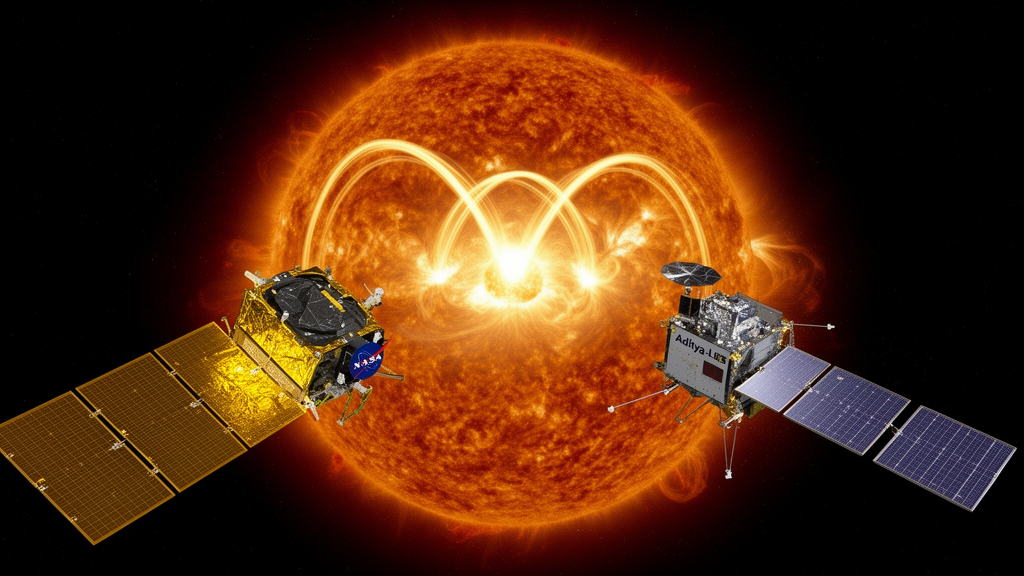
Solar physicists have analysed an X1.8-class solar flare that erupted on 9 October 2024 from NOAA active region 13848, combining observations from NASA’s Solar Dynamics Observatory (SDO) with data from India’s Aditya-L1 mission. The study, published in Solar Physics, reconstructs the magnetic conditions in the corona before the flare ignited and links them to both the flare’s onset and a striking pattern of quasi-periodic pulsations (QPPs) seen during its impulsive phase.

The multi-wavelength analysis revealed a sigmoidal brightening appearing at the onset of the flare. As the event approached its peak, the flare brightenings and ribbons evolved into a complex morphology, reflecting the tangled magnetic geometry of the active region as reconnection proceeded.

One of the most notable findings came from the hard X-ray light curve: quasi-periodic pulsations with a dominant period of approximately four minutes were detected during the impulsive phase.

To understand how the flare was triggered, the team constructed the coronal magnetic field at a pre-flare stage using a non-force-free-field (NFFF) extrapolation model.

The extrapolated field revealed several significant magnetic features within the flaring region: a magnetic flux rope, a three-dimensional magnetic null point, a sheared arcade, and quasi-separatrix layers (QSLs).

The authors propose that recurrent reconnection occurring at these features played a role in initiating the flare and in producing the associated quasi-periodic pulsations. In this interpretation, repeated episodes of reconnection at the null, flux rope and QSLs could naturally generate the quasi-regular modulation observed in the hard X-ray emission.

The event, catalogued as SOL2024-10-09T0125, offers a well-observed case study of how complex magnetic topology translates into observable flare behaviour.

Because the analysis is based on a single flare, the findings describe one event rather than a statistical trend, and the proposed link between the extrapolated magnetic structures and the QPPs remains a model-based interpretation.

Subject of Research: Multi-wavelength analysis of an X1.8 solar flare and its quasi-periodic pulsations using SDO and Aditya-L1 data with non-force-free-field magnetic extrapolation.

Article Title: Exploring an X1.8 Flare and Associated Quasi-Periodic Pulsations Using SDO and Aditya-L1 Observations, Alongside NFFF Extrapolation

Article References: Kumar, P., Kumar, S., Sadashiv, Kanaujiya, S. R., & Maurya, Y. K. (2026). Exploring an X1.8 Flare and Associated Quasi-Periodic Pulsations Using SDO and Aditya-L1 Observations, Alongside NFFF Extrapolation. Solar Physics, 301(10), Article 164. https://doi.org/10.1007/s11207-026-02760-9

Image Credits: AI Generated

DOI: 10.1007/s11207-026-02760-9

Keywords: solar flare, quasi-periodic pulsations, SDO, Aditya-L1, magnetic reconnection, flux rope, magnetic null, quasi-separatrix layers, NFFF extrapolation, hard X-rays, active region 13848, Solar Physics

Cite Scienmag News

Grant Pearson. (October 27, 2026). X1.8 Solar Flare Shows Four-Minute Pulsations in New SDO and Aditya-L1 Study. Scienmag. https://scienmag.com/x1-8-solar-flare-shows-four-minute-pulsations-in-new-sdo-and-aditya-l1-study/


Grant Pearson. "X1.8 Solar Flare Shows Four-Minute Pulsations in New SDO and Aditya-L1 Study." Scienmag, 27 October 2026, https://scienmag.com/x1-8-solar-flare-shows-four-minute-pulsations-in-new-sdo-and-aditya-l1-study/. Accessed 27 October 2026.

Grant Pearson. "X1.8 Solar Flare Shows Four-Minute Pulsations in New SDO and Aditya-L1 Study." Scienmag. October 27, 2026. https://scienmag.com/x1-8-solar-flare-shows-four-minute-pulsations-in-new-sdo-and-aditya-l1-study/

Tags: active region 13848Aditya-L1Aditya-L1 mission solar observationcoronal magnetic field reconstructionflux ropefour-minute pulsation patterns in solar flhard X-raysimpulsive phase of solar flaresmagnetic flux ropes in solar eruptionsmagnetic nullmagnetic reconnectionNFFF extrapolationnon-force-free-field magnetic modelingquasi-periodic pulsationsquasi-separatrix layersquasi-separatrix layers QSLs in solar physicsSDOsigmoidal brightening in solar flaressolar Dynamics Observatory SDO solar flare analysissolar flaresolar flare magnetic reconnectionsolar flare magnetic topologysolar physicsX1.8 solar flare quasiperiodic pulsations
Share26Tweet16
Previous Post

Global tracking study reveals how delays ripple through bird migration schedules

Next Post

Mid-Cretaceous amber reveals a flourishing island cradle of Southeast Asian plants

Related Posts

Cosmologists Weigh the CMB Lensing Anomaly with Planck, ACT and DESI Data
Space

Cosmologists Weigh the CMB Lensing Anomaly with Planck, ACT and DESI Data

October 27, 2026
Constraining magnetized black-bounce spacetime from HFQPOs data and selecting resonance models via information criteria and Bayesian analysis
Space

Constraining magnetized black-bounce spacetime from HFQPOs data and selecting resonance models via information criteria and Bayesian analysis

October 27, 2026
Axions Could Grow Giant Quark Cores Inside Neutron Stars, Theoretical Study Finds
Space

Axions Could Grow Giant Quark Cores Inside Neutron Stars, Theoretical Study Finds

October 27, 2026
Linear Polarimetry Maps Complex Solar Corona Structure During 2024 Eclipse
Space

Linear Polarimetry Maps Complex Solar Corona Structure During 2024 Eclipse

October 27, 2026
Giant impacts may help rocky planets keep their primordial atmospheres
Space

Giant impacts may help rocky planets keep their primordial atmospheres

October 27, 2026
New aerospace journal xAerospace opens applications for editorial board roles
Space

New aerospace journal xAerospace opens applications for editorial board roles

October 26, 2026
Next Post
Mid-Cretaceous amber reveals a flourishing island cradle of Southeast Asian plants

Mid-Cretaceous amber reveals a flourishing island cradle of Southeast Asian plants

  • Mothers who receive childcare support from maternal grandparents show more optimized

    Mothers who receive childcare support from maternal grandparents show more parental warmth, finds NTU Singapore study

    27656 shares
    Share 11059 Tweet 6912
  • University of Seville Breaks 120-Year-Old Mystery, Revises a Key Einstein Concept

    1061 shares
    Share 424 Tweet 265
  • Bee body mass, pathogens and local climate influence heat tolerance

    682 shares
    Share 273 Tweet 171
  • Researchers record first-ever images and data of a shark experiencing a boat strike

    546 shares
    Share 218 Tweet 137
  • Groundbreaking Clinical Trial Reveals Lubiprostone Enhances Kidney Function

    531 shares
    Share 212 Tweet 133
Science

Embark on a thrilling journey of discovery with Scienmag.com—your ultimate source for cutting-edge breakthroughs. Immerse yourself in a world where curiosity knows no limits and tomorrow’s possibilities become today’s reality!

RECENT NEWS

  • Mitofusin-blocking peptides shrink heart attack damage in mice
  • Mid-Cretaceous amber reveals a flourishing island cradle of Southeast Asian plants
  • X1.8 Solar Flare Shows Four-Minute Pulsations in New SDO and Aditya-L1 Study
  • Global tracking study reveals how delays ripple through bird migration schedules

Categories

  • Agriculture
  • Anthropology
  • Archaeology
  • Athmospheric
  • Biology
  • Biotechnology
  • Blog
  • Bussines
  • Cancer
  • Chemistry
  • Climate
  • Earth Science
  • Editorial Policy
  • Marine
  • Mathematics
  • Medicine
  • Pediatry
  • Policy
  • Psychology & Psychiatry
  • Science Education
  • Science News
  • Social Science
  • Space
  • Technology and Engineering

Subscribe to Blog via Email

Enter your email address to subscribe to this blog and receive notifications of new posts by email.

Join 5,151 other subscribers

© 2025 Scienmag - Science Magazine

Welcome Back!

Login to your account below

Forgotten Password?

Retrieve your password

Please enter your username or email address to reset your password.

Log In
No Result
View All Result
  • HOME
  • SCIENCE NEWS
  • CONTACT US

© 2025 Scienmag - Science Magazine

Discover more from Science

Subscribe now to keep reading and get access to the full archive.

Continue reading