


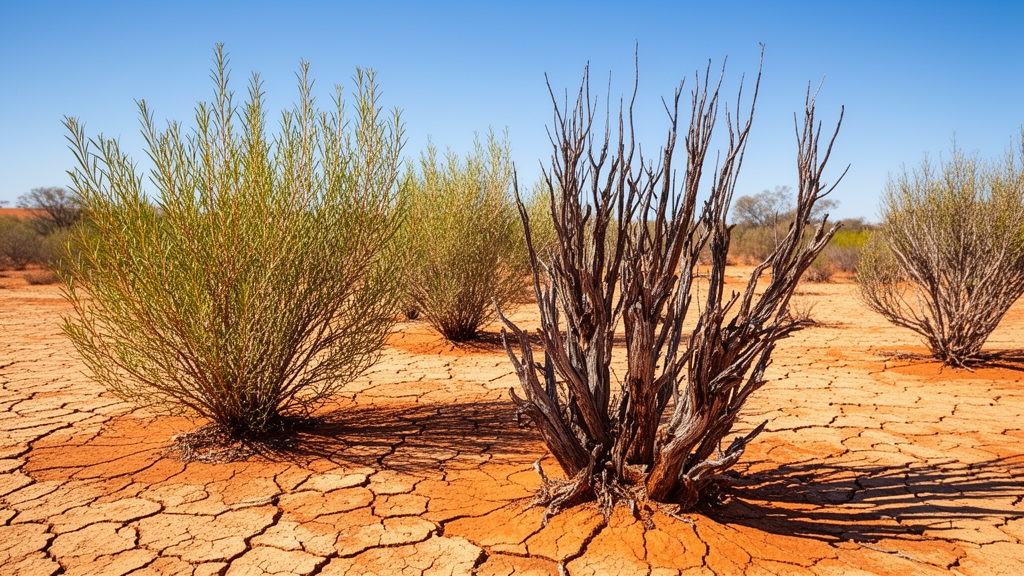
A pioneering collaborative research project, uniting Anangu Traditional Owners of Uluru with plant scientists, has successfully uncovered the specific physiological traits that determined the survival of certain desert plant species during a devastating mass dieback event in Australia. This research provides critical insights into the survival mechanisms of keystone species within the Australian desert ecosystem, offering a scientific framework to understand how these plants respond to increasing climatic extremes, particularly extreme heat and drought. The study focused on the unique ecological and cultural landscape of Uluru-Kata Tjuta National Park, an area profoundly significant to the Anangu people, whose deep knowledge of the land and its flora informed the research design and interpretation of the findings.
The context for this investigation arose from a record-breaking hot drought that spanned from 2018 to 2019, which resulted in widespread plant mortality across the Uluru-Kata Tjuta National Park. Recognizing the profound impact of these environmental stressors on the living cultural landscape that Anangu have stewarded for millennia, the research team sought to understand the underlying biological reasons for the differential survival rates among various plant species. This collaboration bridged the gap between traditional Anangu knowledge of Country and a rigorous Western plant physiology framework, allowing researchers to examine how culturally significant desert plants respond to unprecedented environmental challenges.
To address this complex ecological question, the team conducted an experimental study, surveying nine distinct species of desert plants across two distinct climatic periods: a mild-temperature spring season and an extreme-temperature summer season. For each species, a comprehensive suite of physiological traits was meticulously measured and analyzed. The focus was placed on several keystone species chosen by the Anangu for their vital role in providing food, habitat, and materials for traditional tools, including wanari (*Acacia aneura*, commonly known as mulga), tjanpi (*Triodia pungens*, or spinifex), and kurkara (*Allocasuarina decaisneana*, or desert oak). The specific physiological parameters analyzed included detailed leaf measurements, leaf water content, and the leaf carbon-nitrogen ratio, all of which are crucial indicators of a plant’s health and resilience under stress.
The core of the investigation centered on determining why certain species exhibited higher survival rates than others when faced with extreme weather conditions. By analyzing these physiological traits, the researchers were able to distinguish between two primary drought-response strategies employed by desert flora: drought-tolerance and drought-avoidance. These strategies represent fundamentally different biological approaches to coping with water scarcity. Drought-tolerating plants are characterized by their ability to maintain active growth and metabolic functions even when water availability is severely limited. However, this resilience comes with a significant biological trade-off: these plants are susceptible to severe dehydration when confronted with extreme drought conditions that push beyond their adaptive limits.
Conversely, drought-avoiding plants employ a strategy of water conservation by proactively reducing their growth rate and overall metabolic activity during dry periods. This mechanism allows them to minimize water loss, a critical survival mechanism in arid environments. Nevertheless, this avoidance strategy is not without its risks. Prolonged periods of drought can lead to the exhaustion of stored carbon reserves within the plant tissues, which in turn increases the overall risk of mortality even if the plant manages to conserve water effectively in the short term. The study, therefore, highlighted that neither strategy offers a guaranteed pathway to survival when faced with the combined pressures of extreme drought and high temperatures.
The findings of the study provided a clear distinction regarding the predictive power of specific physiological markers. The research revealed that the maintenance of leaf-relative water content, a key component of the drought-avoidance strategy, emerged as the trait that most accurately predicted the severity of plant dieback. Species that experienced large, rapid reductions in their leaf water content were identified as the most vulnerable to mass dieback. This finding underscores the critical importance of maintaining internal hydration levels, even among plants that are actively conserving water through growth suppression.
Furthermore, the research highlighted that the desert environment, often perceived as inherently robust, is highly susceptible to complex climate change impacts. The assumption that desert plants are naturally equipped to withstand heat and drought alone is insufficient. The study demonstrated that even species highly adapted to arid conditions can become vulnerable when extreme heat and drought occur simultaneously. This realization is crucial for conservation efforts, as it suggests that the failure of both drought-tolerant and drought-avoiding strategies under compounded extreme stress can lead to widespread mass mortality events.
The implications of this research extend far beyond the realm of plant physiology, directly informing culturally appropriate approaches to the care of Country. By studying ecologically and culturally important species—those vital to the Anangu way of life—this research offers new insights into how these plants respond to hotter droughts. The knowledge gained can help guide local communities in implementing conservation strategies that respect both scientific understanding and traditional ecological knowledge. Opportunities for mitigating the impact of drought-driven dieback were identified, including the utilization of Anangu cultural burning practices and the establishment of community plant nurseries for local propagation and restoration of culturally significant plants.
Ultimately, this work serves as a powerful testament to the invaluable benefits derived from scientific collaboration with Indigenous communities. The project was driven by Anangu aspirations, with the Anangu people co-developing the research aims, selecting the study species and locations, conducting fieldwork, and interpreting and discussing the findings. This synergistic approach allowed the team to weave the deep, holistic Anangu knowledge of Country, plants, fire, and landscape change with the precise analytical tools of Western plant physiology. While local efforts like community nurseries are vital for restoration and maintaining cultural connections, the research concludes that reducing the long-term impacts of hotter droughts will necessitate strong global measures aimed at halting and reversing anthropogenic climate change.
Subject of Research: Physiological traits of Australian desert plants explain survival differences during extreme drought events.
Article Title: Anangu Traditional Owners and scientists join forces to understand mass plant dieback at Uluru
Article References: Anangu Traditional Owners and scientists join forces to understand mass plant dieback at Uluru. Original publication (Bibliographic details unavailable.)
Image Credits: AI Generated
DOI: Not provided
Keywords: Desert Ecology, Climate Change, Plant Physiology, Anangu Knowledge, Uluru, Drought Tolerance, Keystone Species, Anangu, Traditional, Owners, scientists, join
Cite Scienmag News
Gavin Prescott. (October 27, 2026). Physiological Strategies Explain Mortality Differences in Australian Desert Plants Following Extreme Drought. Scienmag. https://scienmag.com/physiological-strategies-explain-mortality-differences-in-australian-desert-plants-following-extreme-drought/
Gavin Prescott. "Physiological Strategies Explain Mortality Differences in Australian Desert Plants Following Extreme Drought." Scienmag, 27 October 2026, https://scienmag.com/physiological-strategies-explain-mortality-differences-in-australian-desert-plants-following-extreme-drought/. Accessed 27 October 2026.
Gavin Prescott. "Physiological Strategies Explain Mortality Differences in Australian Desert Plants Following Extreme Drought." Scienmag. October 27, 2026. https://scienmag.com/physiological-strategies-explain-mortality-differences-in-australian-desert-plants-following-extreme-drought/


