


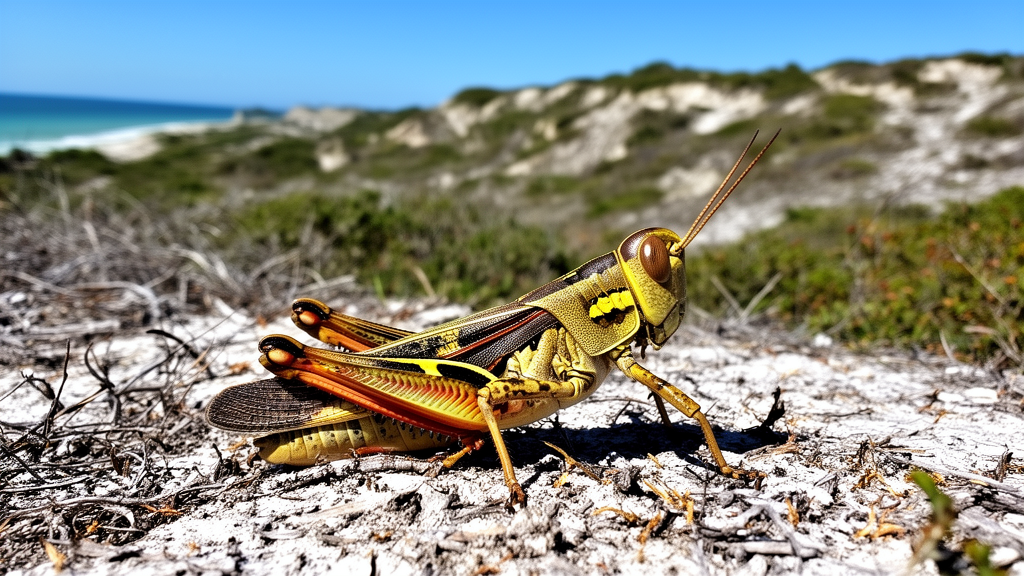
A new species of grasshopper, *Floritettix phlox*, has been described and identified as endemic to the Bombing Range Ridge in central Florida, representing a significant addition to the known biodiversity of the North American Coastal Plain. This discovery was made during field surveys conducted at Avon Park Air Force Range, where specimens were collected and subsequently examined for morphological and biogeographical characteristics. The new species belongs to the genus *Floritettix*, which is one of five acridid genera endemic to the southeastern United States, and is Floridian in distribution, meaning it is restricted to Florida and the southern portions of Alabama and Georgia. The discovery highlights the critical importance of the Bombing Range Ridge, a small landmass characterized by heavily burned scrub habitat, which appears to be a unique ecological refuge for this newly identified insect.
The identification of *Floritettix phlox* was based on a series of specimens collected during field expeditions, including one holotype from the Bombing Range Ridge itself, collected on June 16, 2015. Initial observations of specimens collected in 2015 did not align with the species described in a recent revision of Otte (2014). Subsequent comparative analysis, involving detailed microscopic examination and comparisons with other known *Floritettix* species, led to the conclusion that this was a distinct, new species. The habitat of *F. phlox* appears highly restricted, suggesting it may be endemic to this specific scrub community on the Bombing Range Ridge, which, if confirmed, would make it the first animal known to be endemic to the ridge.
Taxonomically, *Floritettix* belongs to the family Acrididae, subfamily Melanoplinae. Species within this genus are differentiated primarily by specific characters associated with the male genitalia, which have long been utilized for species delineation within the Melanoplinae and are further supported by molecular evidence. The description of *F. phlox* relies heavily on these intricate morphological features. The male genitalia of *F. phlox* are characterized by a sheath produced over the dorsal valves of the aedeagus that consists of two large, adjacent, rounded-subquadrate lobes, possessing a decided concavity caudad. Furthermore, the ventral valves exhibit a slight dorsal curvature and possess broadly rounded apices. These specific genital structures, along with its unique geographic distribution, allow it to be separated from other closely related species.
Distinguishing *F. phlox* from other local species is crucial for accurate biodiversity assessment. It can be separated from *F. nigropicta* based on its green body coloration (whereas *F. nigropicta* is grayish), the absence of black-colored body sutures, and the distinct shape of its male genitalia. It is also differentiated from *Floritettix holotamico* by the color of its dorsal lateral pronotal stripe—white in *F. phlox* versus orange in *F. holotamico*—and the shape of the apices of its ventral valves, which are rounded in *F. phlox* and falcate in *F. holotamico*. Furthermore, *F. phlox* is distinct from *F. hubbelli*, which typically inhabits the hyperseasonal Florida dry prairies surrounding the Bombing Range Ridge, based on the coloration of its post-ocular and dorsal stripes (yellow in *F. hubbelli* versus white with a pink border in *F. phlox*), as well as the profound differences in the shape of their internal male genitalia.
The physical description of *Floritettix phlox* reveals a medium-sized insect. The body is generally greenish in life, though it can fade to yellow in specimens. The head is moderately large in proportion to the body, featuring a strongly oblique face and a broad fastigium produced anterior to the eyes. The eyes are large and prominent, described as elongate-oval. The antennae are filiform and slender. The pronotum is covered in dense shallow punctures and widens distinctly from apex to base. The abdomen is compressed and carinate. Males possess a short, triangular supra-anal plate with weakly convergent lateral margins and a short basal median groove. The cerci are simple, triangular, and approximately twice as long as they are broad, tapering to an acute apex. The furcula are minute divergent lobes, slightly longer than they are wide. The pallium is a large, fleshy, rounded flap resting over the base of the male genitalia, and the sub-genital plate is short and not tuberculate, featuring a narrow chitinous ring that is thicker medially.
Measurements taken on male specimens (n=14) provide quantitative data for the species. The body length ranged from 16.6 to 19.6 mm, with a mean of 18.1 mm. Pronotum length was measured between 3.3 and 3.7 mm (mean 3.5 mm). The hind femur length ranged from 8.6 to 9.8 mm (mean 9.1 mm). Cerci length measured between 0.6 and 1.0 mm (mean 0.8 mm), with a basal width of 0.3 to 0.5 mm (mean 0.5 mm), a mid-cercal width of 0.2 to 0.3 mm (mean 0.2 mm), and a cerci apex width of 0.1 mm (mean 0.3 mm). Female measurements (n=3) were larger, with a body length ranging from 21.4 to 24.0 mm (mean 22.5 mm), and a pronotum length of 4.4 to 5.1 mm (mean 4.7 mm).
The ecological context of *F. phlox* is closely tied to the unique landscape of the Bombing Range Ridge. This ridge rises from the Osceola Plain, reaching elevations of 38.1–44.2 meters above sea level, and is hypothesized to be a relict marine sand bar. The habitat is restricted to low oak scrub and scrubby flatwoods, which are maintained by frequent fires. These fires originate from both military training exercises—where Air Force personnel practice firing aircraft mounted explosive ordinances—and prescribed burns. Florida scrub is a fire-maintained community, characterized by low, evergreen sclerophyllous oaks, shrubs, palmettos, and sand pine. The presence of frequent fires is essential for maintaining the scrub habitat, as in the absence of fire, the oaks would grow dense and tall, potentially reducing grasshopper diversity and abundance. The Bombing Range Ridge, while separated from the larger Lake Wales Ridge by as little as two kilometers, maintains distinct floras and faunas, suggesting that the Arbuckle Creek lowlands likely serve as a dispersal barrier for flightless scrub-inhabiting insects.
The discovery of *Floritettix phlox* underscores the ongoing need for biodiversity exploration within the scrub communities of the Florida peninsula. Given that *Floritettix* is Florididan in distribution, future phylogenetic and biogeographic studies involving this genus are expected to yield results of significant scientific interest. The detailed morphological and biogeographical evidence presented in this study provides a crucial baseline for understanding the evolutionary divergence within the endemic genera of the North American Coastal Plain, which have historically been less studied compared to larger genera like *Melanoplus*. The study confirms that specific, localized habitats, such as the fire-maintained low oak scrub on the Bombing Range Ridge, function as critical islands of endemism, supporting unique life forms like *F. phlox*.
Subject of Research: Discovery and detailed description of the new endemic grasshopper species, *Floritettix phlox*, restricted to the Bombing Range Ridge in central Florida.
Article Title: A new Floritettix ( Orthoptera , Acrididae , Melanoplinae ) from the Bombing Range Ridge, Florida, U.S.A.
Article References: Hill, J. G. (2023). A new Floritettix (Orthoptera, Acrididae, Melanoplinae) from the Bombing Range Ridge, Florida, U.S.A.. Journal of Orthoptera Research, 32(2), 133-142. https://doi.org/10.3897/jor.32.94990
Image Credits: AI Generated
DOI: 10.3897/jor.32.94990
Keywords: Orthoptera, Grasshopper, Floritettix, Florida, Endemism, Bombing Range Ridge, Acrididae, Melanoplinae, Biogeography, Entomology, Bombing, Range
Cite Scienmag News
Margaret Porter. (October 27, 2026). New Grasshopper Species Discovered in Florida’s Bombing Range Ridge. Scienmag. https://scienmag.com/new-grasshopper-species-discovered-in-floridas-bombing-range-ridge/
Margaret Porter. "New Grasshopper Species Discovered in Florida’s Bombing Range Ridge." Scienmag, 27 October 2026, https://scienmag.com/new-grasshopper-species-discovered-in-floridas-bombing-range-ridge/. Accessed 27 October 2026.
Margaret Porter. "New Grasshopper Species Discovered in Florida’s Bombing Range Ridge." Scienmag. October 27, 2026. https://scienmag.com/new-grasshopper-species-discovered-in-floridas-bombing-range-ridge/


