


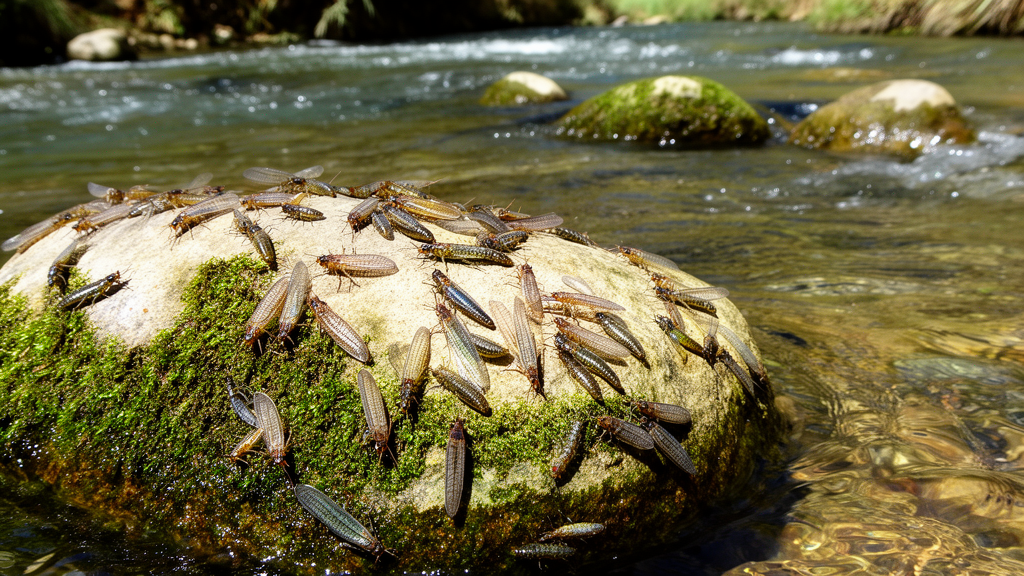
A comprehensive ecological survey of the Ephemeroptera, or mayfly, fauna across the Draa river basin in southern Morocco has provided critical insights into the distribution patterns of these aquatic insects and the environmental parameters governing their survival. This study, which covered six field campaigns spanning from June 2019 to October 2021, successfully identified thirteen species belonging to ten genera and five families within the basin’s three sub-basins: the Upper, Middle, and Lower Draa. Crucially, the research documented seven taxa for the first time in the Upper Draa sub-basin, including species such as *Baetis maurus*, *Baetis rhodani*, *Cheleocloeon dimorphicum*, *Cloeon simile*, *Procloeon stagnicola*, *Labiobaetis neglectus*, and *Oligoneuriopsis skhounate*.
Mayflies, belonging to the order Ephemeroptera, possess a worldwide distribution, being absent only in Antarctica and certain remote oceanic islands. This order encompasses approximately 3,700 species across 450 genera and 42 families. Their larvae inhabit diverse freshwater and aquatic environments, including streams, rivers, and wetlands. Due to their essential reliance on water, Ephemeroptera are highly valued in ecological studies for their ability to serve as bioindicators of freshwater biological quality and for biomonitoring purposes. These insects play a vital role in energy flow within aquatic ecosystems, participating in the transfer of carbon and energy, and are consumed by various riparian species such as bats, spiders, and birds. The Draa basin, situated south of the High Atlas Mountain range, presents a unique ecological setting, positioned in a transition zone between the southern Atlas Mountains and the Saharan desert region, a landscape increasingly affected by climate change.
The study meticulously surveyed seventeen specific sites distributed across the Upper, Middle, and Lower Draa sub-basins. The Upper Draa, which is characterized by streams draining the Atlas Mountains, proved to be the most diverse region, yielding 13 species, representing all species found in the entire basin. The Middle Draa showed lower diversification with six species, while the Lower Draa exhibited the poorest diversity, recording only two species. The sampling methodology involved using a Surber sampler with a net mesh size of 500 µm, with twenty spots sampled per site to cover all microhabitats over a length approximately ten times the width of the riverbed. Samples were preserved in airtight bottles with 70% ethanol, and identification was performed in the laboratory using morphological criteria and various taxonomic keys.
The investigation went beyond simple inventory, focusing heavily on the environmental factors shaping the distribution of Ephemeroptera. Physicochemical parameters measured at the sites included water temperature, electrical conductivity, and pH. Analysis of this data revealed several significant correlations. Water temperature was found to be negatively correlated with altitude and also negatively correlated with pH. Conversely, electrical conductivity exhibited a negative correlation with altitude and a positive correlation with water temperature. Notably, no correlation was identified between pH and either water temperature or electrical conductivity. These findings, detailed in Table 2, provide a quantitative basis for understanding the environmental pressures exerted on the mayfly communities across the basin.
To visualize the complex relationships between species composition and environmental variables, the researchers employed Correspondence Analysis (CA) based on species presence/absence data. The first two axes of this CA explained 47.2% of the total variation observed across the sites. The CA plot revealed distinct clustering of sites based on their species composition and environmental characteristics. For instance, one cluster of sites was associated with the correlated variables of lower altitude and higher temperature, and this cluster contained species such as *Cheleocloeon dimorphicum* and *Cloeon simile*. Conversely, sites St1, St2, St7, St9, St11, and St12 could be clustered based on their altitudes, showing the presence of species adapted to those specific elevations, including *Ecdyonurus rothschildi*, *Rhithrogena* sp., *Caenis pusilla*, and *Baetis maurus*.
Further analysis of species richness revealed that it was negatively correlated with electrical conductivity. While water temperature was negatively correlated with altitude, it did not predict species richness within this basin. The family Baetidae proved to be the most diverse family, accounting for seven species, with *Baetis pavidus* and *Caenis luctuosa* being the most widespread species, found at 100% and 88.2% of the surveyed sites, respectively. The distribution of species across the sub-basins also showed clear ecological segregation. The Upper Draa, with its cold, high-altitude environment, supported species like *Ecdyonurus rothschildi* and *Rhithrogena* sp., which are confined to high altitudes in the Draa Basin. In contrast, the third Saharan zone, characterized by high conductivity and high summer temperatures, was dominated by the euryhaline species *Caenis luctuosa* and *Baetis pavidus*.
The Draa basin is ecologically segmented into three distinct zones based on its topography, climate, and hydrology. The first zone is at high altitude, situated in the southern slopes of the High Atlas. Here, three rivers—Ounilla, Mgoune, and Dades—flow with strong currents, low conductivity, and low water temperatures, supporting cold water species. The second, intermediate zone lies in the valley of the Ouarzazate basin. This area has a climate less severe than the high mountains, with moderate conductivity, supporting species such as *Cheleocloeon dimorphicum*, *Cloeon simile*, and *Procloeon stagnicola*. The third zone is the Saharan zone, characterized by high conductivity and high summer temperatures, which favors resistant, euryhaline species. The study also highlighted the profound impact of human activities and climate change on these delicate populations. The Middle Draa, in particular, has seen its river flow become almost entirely dependent on releases from the El Mansour Eddahbi dam due to rainfall scarcity and excessive water use in agriculture, leading to the drying up of several previously rich sites.
The research underscores the vulnerability of Ephemeroptera to environmental stressors. The distribution of Ephemeroptera in this area was primarily limited by electrical conductivity, with fewer species found in highly saline sites. Furthermore, the authors noted a nearly significant negative correlation between species richness and water temperature, suggesting that future increases in salinity and temperature could lead to the loss of stenotherm species. The absence of *Oligoneuriopsis skhounate* during certain sampling periods, for example, can be explained by diapause triggered by low winter temperatures. However, the study also noted that some species, such as *Ecdyonurus rothschildi*, which was reported in the Ounilla river in 1989, was no longer found in that specific river but was instead collected further east in the Dades and Mgoune Rivers, indicating shifts in species distribution patterns across the basin.
In summary, this inventory contributes significantly to the knowledge of Ephemeroptera distribution in the Draa river basin, completing the inventory for Morocco by adding streams south of the High Atlas.
Subject of Research: An ecological study of Ephemeroptera distribution and environmental factors across the Draa river basin in southern Morocco.
Article Title: Inventory and pattern of distribution of mayflies ( Insecta , Ephemeroptera ) in the Draa river basin, southern Morocco
Article References: Benlasri, M., Kaczmarek, N., El Alami, M., Ghamizi, M., & Berger, E. (2023). Inventory and pattern of distribution of mayflies (Insecta, Ephemeroptera) in the Draa river basin, southern Morocco. Alpine Entomology, 7, 13-20. https://doi.org/10.3897/alpento.7.96436
Image Credits: AI Generated
Keywords: Mayflies, Ephemeroptera, Morocco, River Ecology, Biodiversity, Environmental Science, Draa Basin, Aquatic Macroinvertebrates, Inventory, pattern, distribution, Insecta
Cite Scienmag News
Gavin Prescott. (October 27, 2026). Mayfly Diversity Mapping Reveals Environmental Controls in Morocco’s Draa River Basin. Scienmag. https://scienmag.com/mayfly-diversity-mapping-reveals-environmental-controls-in-moroccos-draa-river-basin/
Gavin Prescott. "Mayfly Diversity Mapping Reveals Environmental Controls in Morocco’s Draa River Basin." Scienmag, 27 October 2026, https://scienmag.com/mayfly-diversity-mapping-reveals-environmental-controls-in-moroccos-draa-river-basin/. Accessed 27 October 2026.
Gavin Prescott. "Mayfly Diversity Mapping Reveals Environmental Controls in Morocco’s Draa River Basin." Scienmag. October 27, 2026. https://scienmag.com/mayfly-diversity-mapping-reveals-environmental-controls-in-moroccos-draa-river-basin/


