


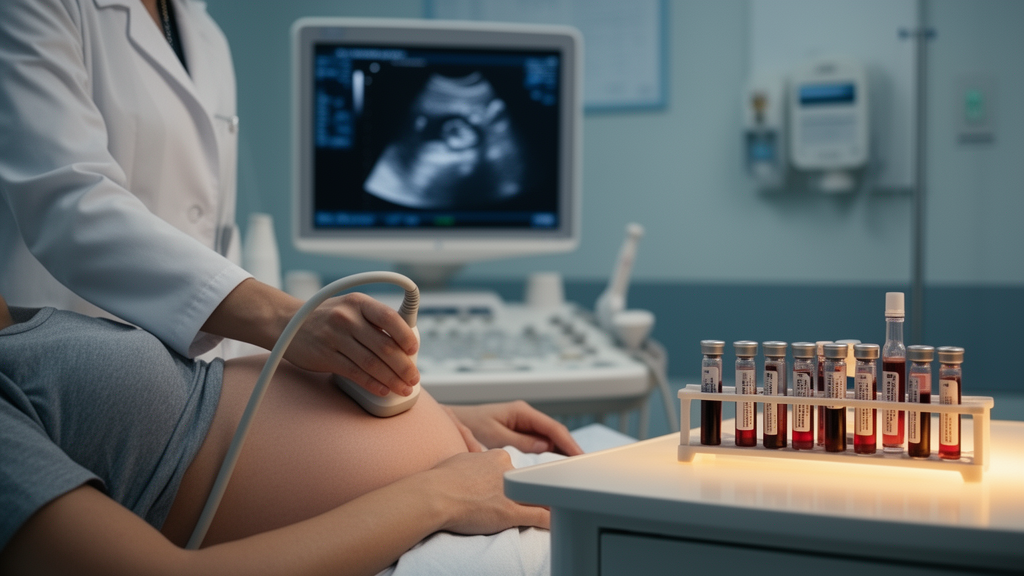
Placental abruption is one of obstetrics’ most feared emergencies: the placenta shears away from the uterine wall before the baby is delivered, cutting off oxygen and nutrients within minutes. Diagnosing it quickly is difficult, because the standard imaging tool, ultrasound, misses a large share of cases, particularly when the placenta sits on the back wall of the uterus or when bleeding remains hidden behind the placenta. A new retrospective study from China suggests that adding two blood proteins to ultrasound could sharpen the diagnostic picture, at least among women already suspected of having the condition.
Researchers at Shandong Provincial Maternal and Child Health Care Hospital Affiliated to Qingdao University analyzed records from 138 pregnant women who attended antenatal check-ups between July 2022 and July 2025 and met clinical criteria for suspected placental abruption. The clinical suspicion criteria, drawn from WHO guidance, required at least two features such as sudden persistent abdominal pain, vaginal bleeding, a tender or rigid uterus, an abnormal fetal heart rate pattern, or unexplained preterm labor. After applying exclusion criteria that removed women aged 35 or older, those with multiple pregnancies, and those with cancer, autoimmune disease, severe infection, or incomplete records, the final cohort comprised 88 women in whom placental abruption was confirmed and 50 in whom it was not.
The reference standard was strict: pathological examination of the placenta after delivery. Abruption was diagnosed only when at least two of three pathological features were present, including a blood clot mark of at least 5 square centimeters on the maternal side of the placenta, detachment involving at least a quarter of the placental surface, and microscopic evidence of hemorrhage, necrosis, and fibrinoid deposition in the basal decidua. Importantly, all blood samples and ultrasound examinations were performed on admission, before delivery and before the pathological assessment, satisfying the timing requirement for a diagnostic accuracy study.
The two blood markers were midkine (MK), a heparin-binding growth factor produced by placental trophoblast cells that participates in angiogenesis and trophoblast invasion, and thrombospondin-1 (TSP-1), an extracellular matrix protein secreted mainly by platelets, endothelial cells, and macrophages that inhibits new blood vessel formation and promotes platelet aggregation. Both were measured by validated sandwich ELISA kits with careful pre-analytical handling: blood was drawn in the morning after an overnight fast before any therapeutic intervention, processed within two hours, visibly hemolyzed samples were excluded because hemolysis artificially elevates TSP-1, and serum was stored in aliquots at minus 20 degrees Celsius to avoid repeated freeze-thaw cycles.
Serum levels of both proteins were significantly higher in women with confirmed abruption. Mean MK was 1.03 plus or minus 0.38 nanograms per milliliter in the abruption group versus 0.71 plus or minus 0.13 in the non-abruption group, and mean TSP-1 was 7.72 plus or minus 2.24 versus 4.86 plus or minus 1.19 nanograms per milliliter (both P < 0.001). In a multivariable logistic regression model adjusting for age, body mass index, preeclampsia, chronic hypertension, and gestational diabetes, MK remained independently associated with abruption with an adjusted odds ratio of 3.756 (95% confidence interval 1.928 to 7.318) and TSP-1 with an adjusted odds ratio of 2.489 (95% confidence interval 1.383 to 4.501). All variance inflation factors were below 2, indicating no problematic collinearity.
Ultrasound alone performed modestly. Characteristic findings, including increased placental thickness, hematoma at the placental edge, irregular dark areas at the placental base, and strong mixed echoes, were all significantly more common in the abruption group, but the overall sensitivity of ultrasound in this cohort was only 52.27 percent, consistent with the 25 to 50 percent range reported in the literature. When ultrasound findings are positive, specificity can reach 96 percent, but posterior-wall placentas, small hematomas, and early detachment frequently evade detection. In this study, ultrasound alone yielded an area under the ROC curve (AUC) of 0.671, MK alone 0.731, and TSP-1 alone 0.695.
The researchers then built a binary logistic regression model combining ultrasound findings with serum MK and TSP-1 levels, using the model-derived probability as a combined diagnostic index with a cutoff of 0.286 chosen to maximize the Youden index. The combined approach achieved an AUC of 0.819 (95% confidence interval 0.749 to 0.889), significantly higher than each individual test by DeLong’s pairwise comparison with Bonferroni correction (all P < 0.001), while the individual methods did not differ significantly from one another. The combined model reached a sensitivity of 79.55 percent, specificity of 70.00 percent, accuracy of 76.09 percent, and a Youden index of 0.496, outperforming every single-marker approach on sensitivity, accuracy, and Youden index.
Because performance estimates derived from the same dataset tend to be optimistic, the team performed internal validation using bootstrap resampling with 500 iterations. The optimism-corrected AUC was 0.809 (95% confidence interval 0.738 to 0.881), with corrected sensitivity of 76.69 percent and specificity of 67.17 percent at the optimal cutoff. Calibration was good, with a calibration slope of 0.94, a calibration intercept of 0.06, and a mean absolute error of 0.09, indicating only slight overfitting and no systematic over- or underestimation of risk. Decision curve analysis showed a positive net benefit compared with treat-all and treat-none strategies across threshold probabilities of roughly 5 to 60 percent, with a net benefit of approximately 0.04 at a 20 percent threshold.
The study also documented the stark consequences of abruption. Cesarean section occurred in 86.36 percent of the abruption group versus 72.00 percent of the non-abruption group (P = 0.038); perinatal death in 28.41 percent versus 2.00 percent (P < 0.001); uteroplacental apoplexy in 15.91 percent versus 4.00 percent (P = 0.036); postpartum hemorrhage in 13.64 percent versus 2.00 percent (P = 0.032); and preterm birth in 71.59 percent versus 38.00 percent (P < 0.001). Disseminated intravascular coagulation was numerically more frequent, 12.50 percent versus 2.00 percent, but did not reach statistical significance (P = 0.055). In China, reported abruption incidence ranges from 0.46 to 2.1 percent, with perinatal mortality as high as 10 to 20 percent, underscoring why faster diagnosis matters.
The authors are careful to frame these findings as exploratory. This was a single-center retrospective study with an imbalanced sample of 88 versus 50, identified through electronic medical record review rather than prospective enrollment. Only women under 35 were included, limiting generalizability to older mothers, and the biomarkers were measured once at admission, so their value for detecting abruption before symptoms appear remains unknown. The strict pathological reference standard may have misclassified mild or early abruptions as non-cases, a verification bias that could inflate apparent performance, and the cutoff was derived in the same dataset without external validation. Subclinical hemolysis and long-term TSP-1 stability at minus 20 degrees Celsius also warrant further evaluation. The authors conclude that ultrasound combined with serum MK and TSP-1 may serve as an adjunctive tool when ultrasound is inconclusive in clinically suspected cases, but prospective external validation in independent cohorts is mandatory before any clinical application.
Subject of Research: Diagnostic value of ultrasound combined with serum midkine and thrombospondin-1 for placental abruption
Article Title: A study on the diagnostic value of ultrasound combined with serum MK and TSP-1 in diagnosing placental abruption
Article References: Cui, Y., & Han, H. (2026). A study on the diagnostic value of ultrasound combined with serum MK and TSP-1 in diagnosing placental abruption. Frontiers in Medicine, 13, 1906391. https://doi.org/10.3389/fmed.2026.1906391
Image Credits: AI Generated
DOI: 10.3389/fmed.2026.1906391
Keywords: placental abruption, midkine, thrombospondin-1, ultrasound, diagnostic accuracy, biomarkers, pregnancy complications, retrospective study, ELISA, bootstrap validation, obstetrics, ROC analysis
Cite Scienmag News
Ophelia Keating. (October 27, 2026). Ultrasound plus blood markers MK and TSP-1 improve placental abruption detection. Scienmag. https://scienmag.com/ultrasound-plus-blood-markers-mk-and-tsp-1-improve-placental-abruption-detection/
Ophelia Keating. "Ultrasound plus blood markers MK and TSP-1 improve placental abruption detection." Scienmag, 27 October 2026, https://scienmag.com/ultrasound-plus-blood-markers-mk-and-tsp-1-improve-placental-abruption-detection/. Accessed 27 October 2026.
Ophelia Keating. "Ultrasound plus blood markers MK and TSP-1 improve placental abruption detection." Scienmag. October 27, 2026. https://scienmag.com/ultrasound-plus-blood-markers-mk-and-tsp-1-improve-placental-abruption-detection/


