


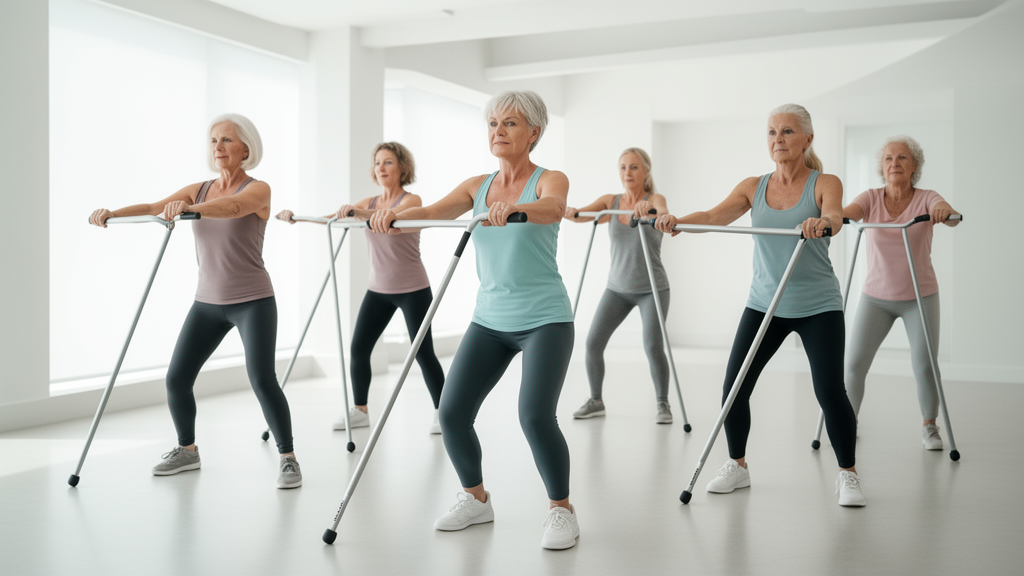
An eight-week program of Flexi-bar vibration exercise improved several markers of cardiovascular health in middle-aged and elderly women, according to a randomized controlled trial conducted by researchers at Guangzhou Sport University and The Chinese University of Hong Kong.
The study enrolled thirty middle-aged and elderly women, who were randomly divided into two groups: one performing the Flexi-bar vibration exercise, abbreviated FE, and a control group. The researchers set out to examine the impact of eight weeks of this training on cardiovascular health and to explore associations involving gut microbiota and its metabolites.
Body composition was assessed with a body composition analyzer. Over the intervention period, the exercise group preserved water, inorganic salts, muscle mass, and fat-free mass, while preventing the accumulation of body weight and body fat.
To evaluate central hemodynamics and cardiac autonomic function, the team measured heart rate, augmentation index, the subendocardial viability ratio, and heart rate variability. Arterial stiffness was assessed through carotid-femoral pulse wave velocity, which reflects central arterial stiffness, and brachial-ankle pulse wave velocity, which reflects systemic stiffness. Serum biochemical factors were measured by enzyme-linked immunosorbent assay.
The exercise intervention significantly decreased resting heart rate, central systolic and diastolic blood pressure, carotid-femoral pulse wave velocity, and right brachial-ankle pulse wave velocity. Reduced central blood pressure and heart rate further point to a favorable hemodynamic profile after training.
Heart rate variability analysis showed that the exercise group increased SDNN and NN50, two time-domain indices of heart rate variability, along with an increase in the high-frequency band and a decrease in the low-frequency band. In this context, higher time-domain variability and a stronger high-frequency component are interpreted as enhanced parasympathetic activity, while a reduced low-frequency component is consistent with less sympathetic overactivity. The authors conclude that the intervention improved cardiovascular function by enhancing parasympathetic activity, reducing sympathetic overactivity, and mitigating arterial stiffness.
The serum biomarker measurements added a molecular dimension to these findings.
The gut microbiota analysis, performed with 16S rRNA gene sequencing of fecal samples, revealed that the exercise group had increased abundance of Bacteroidota and decreased abundance of Firmicutes. Gas chromatography-mass spectrometry of fecal samples showed elevated levels of the short-chain fatty acids acetic acid, propionic acid, and caproic acid following the intervention.
The authors emphasize that the microbial and metabolite changes occurred in parallel with the cardiovascular improvements, and the study was designed to explore correlational associations rather than to prove that the microbiota changes caused the cardiovascular benefits. With thirty participants, all women, and an eight-week window, the trial’s scope is limited, and the findings apply to the population studied. The article, accepted on 30 September 2026 after submission on 1 July 2026, appears in the Cardiovascular Epidemiology and Prevention section of Frontiers in Cardiovascular Medicine, with Dong-Dong Gao and Weiji Deng among the authors and Junhao Huang as corresponding author.
The authors describe the intervention as an effective approach for cardiovascular health in this population, while noting that the observed microbiota and metabolite changes accompany, and may in future studies help explain, the cardiovascular effects of vibration-based training.
Subject of Research: Effects of eight-week Flexi-bar vibration exercise on cardiovascular function, autonomic activity, and gut microbiota in middle-aged and elderly women
Article Title: Eight-week flexi-bar vibration exercise improves cardiovascular function accompanied by altered gut microbiota and metabolites in middle-aged and elderly women: a randomized controlled trial
Article References: Gao, D., Deng, W., Hu, M., Mai, Y., Liang, G., Wu, J., Wu, Y., Guo, J., & Huang, J. (2026). Eight-week flexi-bar vibration exercise improves cardiovascular function accompanied by altered gut microbiota and metabolites in middle-aged and elderly women: a randomized controlled trial. Frontiers in Cardiovascular Medicine, 13, 1925079. https://doi.org/10.3389/fcvm.2026.1925079
Image Credits: AI Generated
DOI: 10.3389/fcvm.2026.1925079
Keywords: Flexi-bar vibration exercise, arterial stiffness, heart rate variability, gut microbiota, short-chain fatty acids, blood pressure, eNOS, ICAM1, Bacteroidota, Firmicutes, randomized controlled trial, middle-aged and elderly women
Cite Scienmag News
Ophelia Keating. (October 27, 2026). Eight Weeks of Flexi-Bar Vibration Exercise Improves Cardiovascular Health in Middle-Aged and Older Women. Scienmag. https://scienmag.com/eight-weeks-of-flexi-bar-vibration-exercise-improves-cardiovascular-health-in-middle-aged-and-older-women/
Ophelia Keating. "Eight Weeks of Flexi-Bar Vibration Exercise Improves Cardiovascular Health in Middle-Aged and Older Women." Scienmag, 27 October 2026, https://scienmag.com/eight-weeks-of-flexi-bar-vibration-exercise-improves-cardiovascular-health-in-middle-aged-and-older-women/. Accessed 27 October 2026.
Ophelia Keating. "Eight Weeks of Flexi-Bar Vibration Exercise Improves Cardiovascular Health in Middle-Aged and Older Women." Scienmag. October 27, 2026. https://scienmag.com/eight-weeks-of-flexi-bar-vibration-exercise-improves-cardiovascular-health-in-middle-aged-and-older-women/


