


The global poultry industry, a cornerstone of international food security, is undergoing a radical transformation driven by the integration of advanced Internet of Things (IoT) and Artificial Intelligence (AI) systems into intensive broiler farms. Traditional methods of environmental regulation, which rely on reactive, threshold-based microclimate control, are proving insufficient for the demands of modern, high-density agricultural operations. These legacy systems, which simply activate fans or heaters when parameters exceed pre-set limits, are inherently incapable of addressing the spatial variability within a single farm shed, the dynamic environmental conditions outside, or the complex behavioral responses of the flocks. This reactive nature often leads to significant physiological stress in birds, manifesting as compromised immunity, system disruptions, and reduced production indicators such as Feed Conversion Ratio (FCR) and Daily Weight Gain (DWG). To overcome these limitations, a paradigm shift toward precision poultry farming (PPF) is gaining traction, moving from manual, reactive practices to sophisticated automation and data science frameworks.
The core of this revolution lies in the ability of contemporary intelligent poultry farms to establish non-invasive monitoring networks. These networks utilize specialized sensors deployed across a heterogeneous grid to measure microclimatic and atmospheric parameters in real-time. By integrating these sensors with powerful AI capabilities, data can be translated into valuable predictive analytics, allowing climate control devices to make pre-emptive and homeostatic adjustments to the microclimate. This transition from simple threshold management to predictive climate management is the defining characteristic of climate-smart precision poultry farming. The systems reviewed in recent systematic analyses combine IoT and AI technologies with environmental sensors, leveraging communication protocols such as LoRaWAN, ZigBee, and NB-IoT. These technologies are not merely monitoring tools; they form the foundation of a multi-layered architecture designed to ensure optimal animal welfare and production effectiveness.
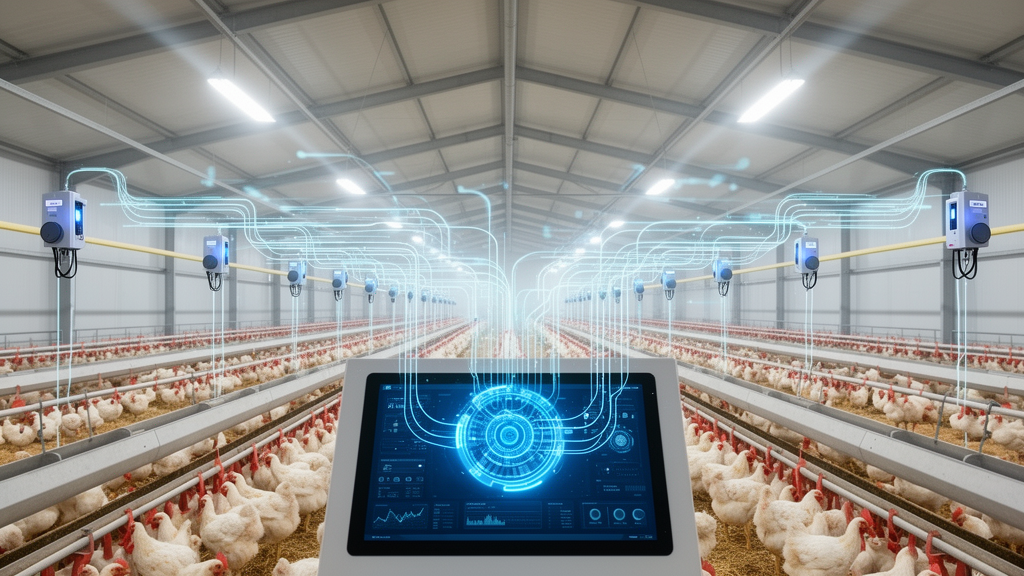
The technical architecture of these intelligent poultry houses is organized into three distinct functional layers. The first is the perception or sensing layer, which utilizes a heterogeneous space grid to collect real-time microclimatic, atmospheric, visual, and bio-acoustic data. Sensors are employed to target specific parameters: DHT22 and SHT31 sensors monitor temperature and relative humidity to regulate environmental parameters via dynamic control of variable-speed ventilation fans and radiant heaters, thereby achieving optimal thermal comfort. Air quality is managed using MQ-135 and TGS826 sensors to detect ammonia (NH3), enabling high-volume air exchange to prevent excessive levels caused by litter decomposition. Furthermore, MH-Z19 and MQ-2 sensors track carbon dioxide (CO2) and methane (CH4) to calculate the minimum ventilation required, ensuring sufficient oxygen without inducing thermal stress from drafts. Bio-visual monitoring, employing CMOS and infrared (IR) cameras, works in conjunction with computer vision software to detect behavioral abnormalities, such as crowding caused by cold or wing flapping due to heat. Finally, omnidirectional condenser microphones capture bio-acoustic data to recognize abnormal noise, such as distress calls or coughing, allowing the control system to take immediate action.
Network layer coordination is critical for backhaul, where the selection of the communication protocol is dictated by the specific farm topography. LoRaWAN is utilized in large-scale facilities with structural insulation because its SubGHz radio frequency range provides extended distance and superior penetration capabilities through thick materials like concrete and metallic insulation, allowing multiple poultry houses to be interconnected. ZigBee is deployed for high-density indoor sensor mapping due to its power-efficient mesh network topology, which supports dynamic multi-hopping and data routing across dispersed sensor nodes. For remote management systems, Cellular IoT (NB-IoT) is used to establish direct, point-to-point connectivity to cloud services, simplifying integration with centralized, cloud-based database management systems. All these diverse data streams then converge at the processing layer, where edge processors and sophisticated machine learning models perform real-time risk and distress indicator analysis.
The processing layer showcases the revolutionary capabilities of integrating multi-modal AI technology. Algorithms such as Long Short-Term Memory (LSTM) networks are employed for time-series forecasting, enabling the prediction of environmental parameters like temperature and humidity variations over short time horizons, such as two hours, based on past sensor values and external weather data. Deep computer vision methods, specifically Convolutional Neural Networks (CNN) and YOLO architectures, are used for the extraction of real-time image features, allowing for the non-intrusive monitoring of flock behavior by assessing spatial distribution, clustering, and posture-based thermal comfort status. Furthermore, expert systems utilizing Fuzzy Logic inference are employed for multi-objective adaptive control. Fuzzy logic is particularly adept at resolving conflicting environmental control tasks—for instance, balancing the need to maximize air circulation to reduce ammonia while simultaneously preventing strong drafts. This fusion of data types—environmental, visual, and bio-acoustic—provides a context-based understanding of the flock’s state, far surpassing the capabilities of sensors alone.
The practical benefits of shifting to these predictive, homeostatic environments are substantial and quantifiable. Furthermore, the consistent distribution of heat across at least 90% of the floor area eliminates issues like huddling, thereby reducing stress and preventing injury from microclimates. Bioacoustic sensing adds another layer of risk management by enabling real-time ventilation changes to decrease levels of toxic gases like NH3 and CO2, conserving energy that would otherwise be wasted on thermal regulation.
Despite these impressive technological and biological advancements, the widespread adoption of AI-based precision poultry farming faces significant engineering and socio-economic barriers. One major technical challenge is the rapid deterioration of sensors in the harsh environment of poultry barns. Electrochemical and optical sensors can experience rapid fouling and calibration issues within 3 to 6 months due to corrosive gases like NH3, moisture, and biological dust. Connectivity in rural production areas also presents a major hurdle, as insufficient high-speed communication networks can lead to unreliable data transmission and latency in video analytics, which is critical for timely environmental response. Power infrastructure inadequacy, particularly in rural areas, poses a risk of blackouts during critical ventilation processes. To mitigate these hardware issues, researchers propose using hydrophobic and IP67-rated modular casings, implementing air purification techniques, and shifting toward more durable solid-state and non-dispersive infrared (NDIR) sensors. For connectivity, edge computing frameworks are suggested to allow for instantaneous control actions at the site level, reducing reliance on bandwidth-limited cloud synchronization.
From an economic standpoint, the high initial cost of the required technology is a significant barrier. The deployment of automated sensors, computer vision systems, and decision-support systems requires substantial investment in equipment, software, network infrastructure, and specialized expertise. While large corporations can potentially offset these costs through increased productivity and improved animal health, smaller producers often struggle with the prohibitive initial investment, which can exceed $15,000 per unit. However, mitigation strategies are being developed, including modular subscription models, hardware-as-a-service (HaaS) approaches, and retrofitting existing facilities using plug-and-play models. Long-term roadmaps suggest a transition to robust edge computing clusters and standardized open communication protocols to make these sophisticated systems more scalable and economically viable for small- to medium-scale producers.
In conclusion, the integration of IoT and AI represents a profound paradigm shift in livestock management, moving poultry farming toward a state of climate-smart precision. This shift allows for predictive, adaptive, and welfare-oriented approaches to microclimate control, ensuring significant stability in environmental parameters and demonstrating clear bio-economic advantages, such as improved FCR and DWG. While the current state of the technology is constrained by issues like sensor lifespan, rural connectivity, and financial restrictions, the ongoing research into solid-state sensors, edge computing, and modular deployment models offers a clear pathway toward sustainable and highly efficient poultry production systems globally.
Subject of Research: The application of IoT and AI technologies for predictive microclimate control in intensive broiler farming.
Article Title: Climate-smart precision poultry farming: artificial intelligence and sensor-based microclimate control for enhancing welfare and production efficiency
Article References: Ngongolo, K., & Abass, K. S. (2026). Climate-smart precision poultry farming: artificial intelligence and sensor-based microclimate control for enhancing welfare and production efficiency. Frontiers in Artificial Intelligence, 9, 1972681. https://doi.org/10.3389/frai.2026.1972681
Image Credits: AI Generated
DOI: 10.3389/frai.2026.1972681
Keywords: IoT, Artificial Intelligence, Precision Agriculture, Poultry Farming, Microclimate Control, LoRaWAN, LSTM, Fuzzy Logic, Animal Welfare, Smart Farming, Climate-smart, precision
Cite Scienmag News
William Thompson. (October 27, 2026). AI and IoT Transform Poultry Farming with Predictive Microclimate Control. Scienmag. https://scienmag.com/ai-and-iot-transform-poultry-farming-with-predictive-microclimate-control/
William Thompson. "AI and IoT Transform Poultry Farming with Predictive Microclimate Control." Scienmag, 27 October 2026, https://scienmag.com/ai-and-iot-transform-poultry-farming-with-predictive-microclimate-control/. Accessed 27 October 2026.
William Thompson. "AI and IoT Transform Poultry Farming with Predictive Microclimate Control." Scienmag. October 27, 2026. https://scienmag.com/ai-and-iot-transform-poultry-farming-with-predictive-microclimate-control/


