


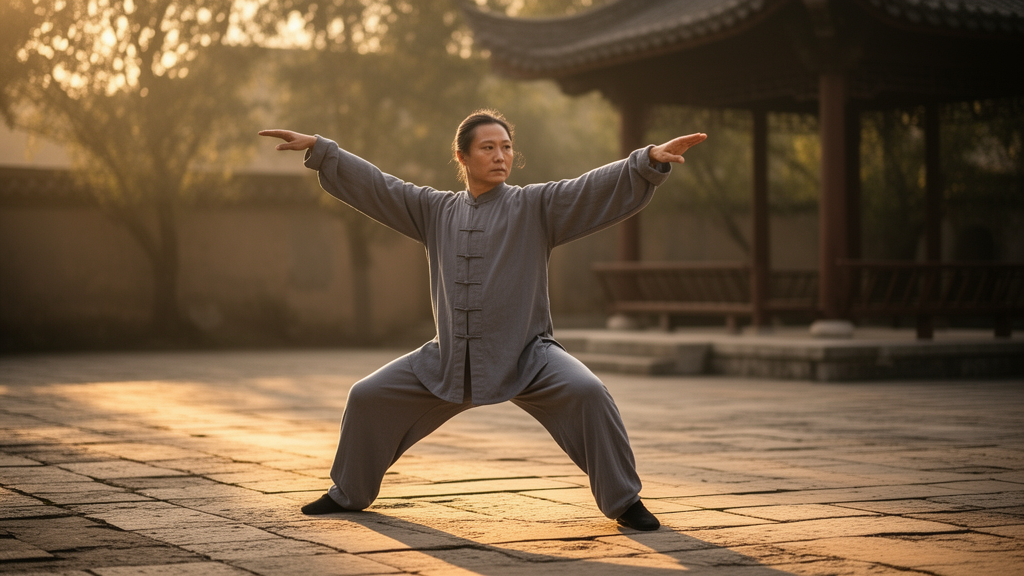
Tai Chi has been practised for centuries as a martial art, a meditation and a path to health, but a new paper argues that its movements can be studied the way linguists study language. In a Hypothesis and Theory article published in Frontiers in Communication on 27 October 2026, Arianna Maiorani of Loughborough University and Jing Shi of Shanxi Agricultural University introduce the first version of a Functional Grammar of Tai Chi, an analytical model designed to describe how the discipline’s codified movements construct meaning at several levels at once.
The framework draws on the Functional Grammar of Dance, itself built on M.A.K. Halliday’s Functional Grammar, and on Hartmut Stöckl’s socio-semiotic approach to multimodal texts. Stöckl argued in 2009 that multimodal texts become legible only when transcribed, and that social semiotics examines how semiotic resources are used in specific social practices. Maiorani and Shi take that methodological architecture, originally developed for texts involving visual materials, and apply it to a practice in which the communicating medium is the moving human body itself.
The authors situate their proposal against the way Tai Chi has travelled. Originated in China hundreds of years ago, the practice has undergone transformations through migration in space and time, and in the West it is often reduced to physical exercise in gyms and wellbeing contexts, stripped of its connection to a philosophical tradition in which practitioners manage vital energies. The article notes that Tai Chi has suffered from contemporary orientalism, being promoted as ancient and exotic, while the two terms Tai Chi and Qigong are frequently used as synonyms, the former foregrounding the combat aspect and the latter wellbeing and a healthier physical and mental self.
The proposed grammar, abbreviated FGT, is explicitly a tool for scholars who need no prior knowledge of Tai Chi. It offers a basic reading strategy applied to units segmented according to core movement principles inherent to the discipline’s philosophy, and it captures what the authors describe as the practice’s dual nature: an outer performance in which action always embodies combat with an imaginary opponent, and an inner performance in which interaction always involves an exchange with the individual Qi, or life force. These two dimensions manifest simultaneously in the same physical performance.
Like the dance grammar, the FGT treats space as both physical and contextual, but the two spaces differ in kind. In the FGT, space is physical, the place where combat with a present or imagined opponent is carried out, and meditative, the internal space where the practitioner interacts with Qi through negotiation with invisible energies. Both grammars work with the notion of projection, the interactive connection between body parts and space that generates movement-based communication. Projections visualise how articulators such as arms, hands, legs, feet, head and torso extend to or withdraw from meaningful areas of space, for example by stretching or bending.
Following Systemic Functional Linguistics theory, projections realise three types of meaning corresponding to Halliday’s metafunctions: Experiential, Interpersonal and Textual, activated respectively by the Field, what happens in the context, the Tenor, who takes part, and the Mode, how communication takes place. In the FGT model, the context of practice is a transformational flow of energy that enables the parallel encoding of a combat narrative, the Field, and a spiritual harmonisation of the Self aimed at good health and wellbeing, the Tenor. Physically-oriented projections encode combat while metaphysically-oriented projections encode meditation, and both are realised at the same time by the same body structures.
A key departure from the dance model lies in the basic unit of analysis. The dance grammar’s Move assumes movement across space, which is not necessarily fundamental to a transformational phase in Tai Chi. The authors instead define the Minimal Kinetic Transition Unit, or MKTU, marked by changes in torso direction with the waist-hips block as the core reference. They argue that the most visible changes in Tai Chi, such as stepping, opening and closing the hands, and torso rotation, do not occur independently but are jointly governed by a mechanism centred on the waist and hips, consistent with traditional theory that emphasises the waist’s leading role in governing body movement. The boundaries of a transformation phase are grounded in observable shifts rather than arbitrary observer decisions.
To demonstrate the model, the authors analyse White Crane Spreads Its Wings from the 24-Form Simplified Tai Chi Routine, a representative sequence composed of three MKTUs: a Preparation Unit, an Execution Unit and a Completion Unit, reflecting phases of gathering potential, expansion and reorganisation. Each unit carries a starting set of projections and an arrival set, with each arrival set also serving as the starting set for the following unit. The coding was performed in parallel by the two authors, combining expertise in SFL theory and the dance grammar with knowledge of Tai Chi theory and long-term practice.
The worked example illustrates how a single bodily structure realises multiple layers of meaning simultaneously. The rising right hand is read both as a martial ward-off action and as a gesture guiding energetic flow; waist-hips rotation organises force transmission while facilitating internal energy integration; and the focused gaze contributes both to tactical orientation and to mental concentration. In the preparation unit, for instance, the forward-projecting torso and targeting head are annotated as gathering force and inviting the opponent, while the same configurations are simultaneously annotated as collecting and channelling energy between the legs and to the ground.
The authors are candid about the status of the proposal. The FGT model, they write, has just been created and needs to be tested with more examples and possibly through empirical work, so the framework remains a hypothesis rather than a validated instrument. They argue, however, that because it is based on the principle of projection, the model can capture modifications made to original Tai Chi forms in terms of movement structures, meanings and discursive strategies, making it potentially useful for both diachronic and synchronic investigations of the discourses enacted by practitioners worldwide, and they suggest the approach has considerable potential for the systematic analysis of all martial arts as multimodal semiotic practices.
Subject of Research: A proposed semiotic framework for analysing Tai Chi movement as multimodal communication
Article Title: Revealing culture through movement: an introduction to the Functional Grammar of Tai Chi
Article References: Maiorani, A., & Shi, J. (2026). Revealing culture through movement: an introduction to the Functional Grammar of Tai Chi. Frontiers in Communication, 11, 1910149. https://doi.org/10.3389/fcomm.2026.1910149
Image Credits: AI Generated
DOI: 10.3389/fcomm.2026.1910149
Keywords: Tai Chi, semiotics, multimodality, Functional Grammar, kinesemiotics, martial arts, movement analysis, Systemic Functional Linguistics, Qi, cultural heritage, communication studies, MKTU
Cite Scienmag News
Gavin Prescott. (October 27, 2026). New ‘Grammar’ Reads Tai Chi as a Language of Movement, From Combat to Qi. Scienmag. https://scienmag.com/new-grammar-reads-tai-chi-as-a-language-of-movement-from-combat-to-qi/
Gavin Prescott. "New ‘Grammar’ Reads Tai Chi as a Language of Movement, From Combat to Qi." Scienmag, 27 October 2026, https://scienmag.com/new-grammar-reads-tai-chi-as-a-language-of-movement-from-combat-to-qi/. Accessed 27 October 2026.
Gavin Prescott. "New ‘Grammar’ Reads Tai Chi as a Language of Movement, From Combat to Qi." Scienmag. October 27, 2026. https://scienmag.com/new-grammar-reads-tai-chi-as-a-language-of-movement-from-combat-to-qi/


