


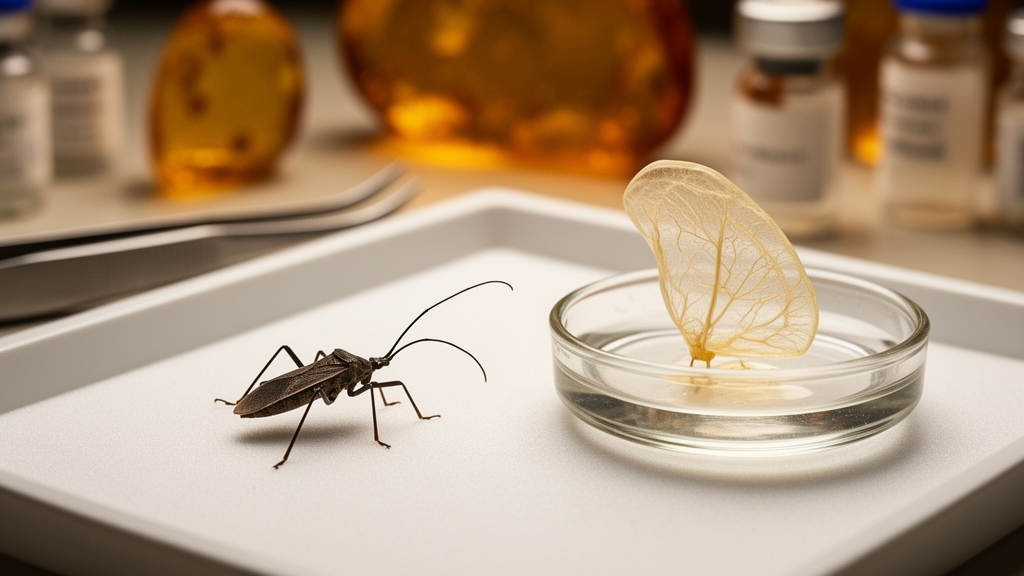
A slender, rod-shaped assassin bug collected by sweeping grass in central Myanmar’s arid Dry Zone has turned out to be a species new to science. Named Rhaphidosoma paganicum, after the medieval Kingdom of Pagan that once ruled the region where it was found, the insect was described by Dmitry Gapon of the Zoological Institute of the Russian Academy of Sciences, together with cytogenetic analyses carried out with colleagues. The discovery marks the first record of the genus Rhaphidosoma not only for Myanmar but for the whole of Indochina, and it comes bundled with an unusually rich set of anatomical and chromosomal data.
The new species belongs to the subfamily Harpactorinae, the largest branch of the assassin bug family Reduviidae, which encompasses roughly 2,330 described species in about 320 genera worldwide. Within this subfamily sits the tribe Rhaphidosomatini, a group whose boundaries have long been murky. Different authorities have recognised anywhere from three to five genera in the tribe, and one recent reviewer described it bluntly as a ‘dumping ground’ for any long, slender Old World harpactorine assassin bug. The genus Rhaphidosoma itself contains about 50 species, most of them Afrotropical; twelve are known from the Palaearctic, in North Africa and Western Asia, and only three had previously been recorded from the Indian and Ceylonese subregions of the Oriental Realm.
The type series was gathered near Nyaung-U Town in Myanmar’s Mandalay Region in October 2019. The habitat fits the ecological profile of the genus: species of Rhaphidosoma are known to live in deserts and savannas, hiding in grass or low bushes. The collection site lies in a herb-grass steppe dotted with thorny shrubs and low trees, including Acacia, interspersed with farmland and Buddhist religious buildings. The local climate is dry, steppe-like and hot, with less than 1,000 millimetres of annual rainfall and a dry season lasting nine months or longer. The holotype and paratypes are deposited at the Zoological Institute in St Petersburg.
Morphologically, Rhaphidosoma paganicum is a strongly elongated insect with subparallel body margins, long thin antennae and legs, and vestigial fore and hind wings in both sexes. Its body is dark reddish-brown, often with blackish sides, and is cloaked in dense, adpressed, whitish scale-like setae over a waxy coating that is especially thick on the ventral surface. Males measure 19.04 to 19.89 millimetres in body length and the single studied female 20.23 millimetres. The species is set apart from its Oriental and Western Asian relatives by a combination of characters, including the absence of distinct tubercles on the abdominal tergites of males and, in females, the presence of just two long finger-like tubercles on tergite VII and small rounded ones on tergite VI. Because the eight related species were all described superficially, often from one or two specimens of a single sex, the author compared every character in their original descriptions with the new material.
The genital anatomy received exceptional attention. The male and female terminalia were examined in wet preparations, and the aedeagus was studied not only in repose but also fully inflated, using a technique that inflates the organ with glass microcapillaries. This yielded the first description of a completely inflated endosoma in any reduviid. The structure proved rich in taxonomic characters: a basal part bearing large basolateral lobes with three branches each, and a large obovoid apical part studded with lobes, tubercles and sclerites, much of it covered in fine microspines. The ductus seminis is divided into five parts and terminates in a voluminous seminal chamber that opens through a wide secondary gonopore. The author suggests that this chamber may be where spermatophores form or complete their formation, a hypothesis consistent with the known occurrence of spermatophore insemination in reduviids, though the functional interpretation remains an inference from structure rather than an observation of mating.
The female internal genitalia were examined in comparable detail. The gynatrium, or bursa copulatrix, is a voluminous, longitudinally elongated sac reaching the anterior margin of the seventh ventrite, equipped with a large funnel-shaped gynatrial cone, a semicircular fold on its dorsal wall, a ring sclerite on the ventral wall, and thin thread-like structures that the author tentatively interprets as pseudospermathecal ducts. No vermiform gland was found.
Beyond morphology, the study delves into chromosomes. Based on a single available male, Rhaphidosoma paganicum carries 12 pairs of autosomes and a multiple sex chromosome system, giving a male complement of 2n = 24A + X1X2X3Y. This matches the most common karyotype in Harpactorinae, in which most species have 24 autosomes and the X1X2X3Y system predominates. It contrasts with the only other Rhaphidosoma species whose karyotype was previously known, Rh. truncatum, which has the same 24 autosomes but a simple XY system. The author proposes that the multiple system in the new species arose through fragmentation of the X chromosome in an ancestral XY karyotype, an interpretation offered as a plausible scenario rather than a demonstrated event.
The second species studied, Polididus armatissimus, a harpactorine collected at light near Pai Town in Thailand, tells a very different chromosomal story. Analysis of eight males confirmed a complement of just five pairs of autosomes with a simple XY system, 2n = 10A + XY, the lowest autosomal number ever recorded in Harpactorinae. Its autosomal bivalents are markedly larger than those of the new species, and its X and Y chromosomes pair up during meiosis to form a pseudo-bivalent. Males from Japanese and Indian populations had previously shown the same complement, although males from northwest India were once reported with 12 autosomes.
Fluorescence in situ hybridisation, or FISH, with probes for 18S ribosomal DNA and the telomeric repeat (TTAGG)n produced the first such data ever for the tribe Rhaphidosomatini and for the genus Polididus. In Rhaphidosoma paganicum, rDNA clusters appeared on the Y chromosome and on one of the three X chromosomes; in Polididus armatissimus, they sat on the largest pair of autosomes. Both species showed the canonical insect telomeric motif (TTAGG)n at both ends of every chromosome. This motif is considered ancestral for Heteroptera and hexapods generally, and it has been lost in several other cimicomorphan families, including bed bugs, lace bugs and their relatives, but appears characteristic of all assassin bugs studied so far. Summarising nine harpactorine species analysed to date, the authors identify four distinct patterns of rDNA location and conclude that the subfamily shows a diversity of rDNA positioning comparable to that of the far better studied kissing bugs.
The testes added a final comparative dimension. Males of Rhaphidosoma paganicum have seven elongated follicles per testis, arranged side by side and joined at their bases, while Polididus armatissimus has nine follicles folded onto one another and wrapped in a reddish peritoneal sheath, grouped into seven large and two smaller units. Seven follicles per testis is widespread across Reduviidae and Heteroptera as a whole and is thought to represent the ancestral condition, corresponding to the number of pre-genital segments in adult male insects. All three rhaphidosomatine species studied so far share this number. The authors note that only about three percent of harpactorine species have had their chromosomes described, and that no females were available for the new species, so the female karyotype remains unknown. They frame the work as a small step towards clarifying the circumscription of the poorly defined tribe Rhaphidosomatini, arguing that detailed morphological examination with new characters, karyological ones included, is exactly what this taxonomic puzzle needs.
Subject of Research: Description of a new assassin bug species from Myanmar and its chromosome complement
Article Title: A new species of the genus Rhaphidosoma Amyot et Serville, 1843 ( Heteroptera , Reduviidae ), with data on its chromosome complement
Article References: Gapon, D. A., Kuznetsova, V. G., & Maryańska-Nadachowska, A. (2021). A new species of the genus Rhaphidosoma Amyot et Serville, 1843 (Heteroptera, Reduviidae), with data on its chromosome complement. Comparative Cytogenetics, 15(4), 467-505. https://doi.org/10.3897/compcytogen.v15.i4.78718
Image Credits: AI Generated
DOI: 10.3897/CompCytogen.v15.i4.78718
Keywords: assassin bugs, Reduviidae, new species, Myanmar, karyotype, FISH, rDNA, telomeres, Harpactorinae, taxonomy, sex chromosomes, species
Cite Scienmag News
Gavin Prescott. (October 27, 2026). New assassin bug species from Myanmar reveals first fully inflated endosoma in reduviids. Scienmag. https://scienmag.com/new-assassin-bug-species-from-myanmar-reveals-first-fully-inflated-endosoma-in-reduviids/
Gavin Prescott. "New assassin bug species from Myanmar reveals first fully inflated endosoma in reduviids." Scienmag, 27 October 2026, https://scienmag.com/new-assassin-bug-species-from-myanmar-reveals-first-fully-inflated-endosoma-in-reduviids/. Accessed 27 October 2026.
Gavin Prescott. "New assassin bug species from Myanmar reveals first fully inflated endosoma in reduviids." Scienmag. October 27, 2026. https://scienmag.com/new-assassin-bug-species-from-myanmar-reveals-first-fully-inflated-endosoma-in-reduviids/


