


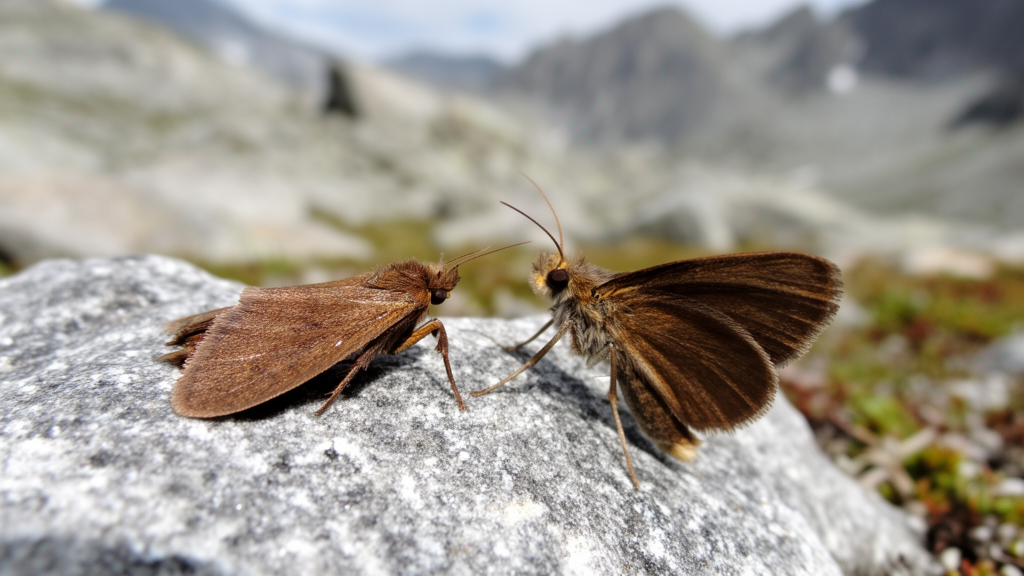
A hitherto unknown case of wing reduction has been documented in one of Europe's most enigmatic alpine moths. Researchers examining museum and freshly collected specimens of Megacraspedus peslieri, a small gelechiid moth described only in 2018, have identified and formally described the species' female for the first time — and it is strikingly different from the male. While the male carries fully developed wings, the female's forewings are drastically shortened and her hindwings are reduced to a minute flap, rendering her flightless.
The finding, published in the journal Alpine Entomology, adds a new entry to the short list of brachypterous Lepidoptera and resolves a long-standing puzzle about the species' biology. Wing reduction, known as brachyptery, and the complete loss of wings, termed aptery, are rare phenomena among moths and butterflies. Historically, these conditions have been reported for only about 35 families of Lepidoptera, with few recent additions scattered across otherwise fully winged groups such as the Notodontidae, Nymphalidae and Ethmiidae.
Complete aptery is rarely a consistent, group-wide trait; it occurs as such mainly in the bagworm moths of the family Psychidae and in the Heterogynidae. Far more commonly, wing reduction appears in gradations, affecting mainly the hindwings and predominantly the female sex, with the associated consequence that affected individuals cannot fly. Such tendencies are known particularly from climatically unfavourable regions — subantarctic islands and mountain ranges — but also from arid habitats and from species active in late autumn or winter.
The genus Megacraspedus, a diverse and largely Palaearctic group of twirler moths in the family Gelechiidae, is a textbook example of widespread wing reduction. Of the 89 described species in the genus, the females of the majority are probably brachypterous. Only in a few closely related taxa, such as the M. fallax species group, do females appear to be normally winged.
Despite this, more than half of the known species are recorded exclusively from males, and among the roughly 20 species with described females, more or less pronounced wing reduction — particularly of the hindwings — is common. The newly described female of M. peslieri, a species placed in a species group of its own, now adds a further, previously undocumented case. The identification of the female was far from trivial.
Because the female differs so markedly from the male — much smaller in size, with shorter, relatively broader and pointed forewings, largely reduced hindwings, and a different forewing colour and pattern — the question of whether the two sexes truly belonged to the same species had to be settled with molecular evidence. The researchers examined sixteen males and two female specimens from France, including the holotype, and Italy, preserved in the research collections of the Tiroler Landesmuseum Ferdinandeum in Hall, Austria, and kärnten.museum in Klagenfurt. Males were initially identified on phenotypic characteristics such as wing markings, colour and size, using the holotype as a reference, and this was confirmed by genitalia dissection and DNA barcoding.
The molecular work relied on the standard DNA barcode: a 658 base-pair segment of the mitochondrial COI gene, cytochrome c oxidase subunit 1. Tissue samples from a single hind leg of eight specimens were processed at the Canadian Centre for DNA Barcoding at the University of Guelph using a high-throughput protocol. Full-length barcodes were obtained for all eight specimens of M. peslieri.
The intraspecific genetic distance was low, averaging 0.32 percent with a maximum of 0.48 percent, the slight variation being mainly due to minor deviation in the holotype's sequence. By contrast, the distance to the nearest neighbour, Megacraspedus ibericus, was 7.37 percent — a gap that clearly separates the two species. All sequenced specimens clustered together in a single Barcode Index Number, BIN BOLD:ADM8362, and crucially, both female specimens fell within the same cluster as the males, strongly supporting their conspecificity.
The morphological description of the female reveals just how extreme the reduction is. Her forewing length measures only 3.8 to 4.4 millimetres, compared with 7.2 to 9.0 millimetres in males, which are also more variable in size than originally described. The female's forewing is distinctly reduced, shorter than her abdomen, with a strongly convex dorsal margin and a cream-white ground colour intensely mottled with light brown, bearing a few darker brown spots in the middle and at the apex.
The wing fringes are reduced to a group of very long, bristle-like hairs around the apex. Most strikingly, the hindwing is reduced to a minute sub-oval flap with narrow, long scales near the apex and a frenulum carrying one to two well-developed bristles. The female genitalia, too, show distinctive features, including a simple subgenital plate without specialized sclerotizations and a peculiar spiny signum, which together support the species' isolated position within the genus.
The biology of M. peslieri fits the pattern of a cold-adapted mountain specialist with an unusual seasonal window. The species is on the wing late in the season, from late August to the last third of September, and remains active even at low temperatures of around 6 degrees Celsius. Both males and females were observed sitting on grass stems or other herbaceous plants and were detected by illumination with a headlamp during the first two to three hours of the night, while males were attracted to UV light in large numbers.
In the Cottian Alps of Italy, the habitat consists predominantly of xeromontane grassland intermixed with rock formations on siliceous soil at montane elevations of approximately 1,400 to 1,800 metres above sea level. In the Pyrenees, by contrast, the species has been collected at considerably lower altitudes, from roughly 250 to 900 metres. Brachyptery is a relatively widespread morphological adaptation in alpine Lepidoptera, and it is generally interpreted as an avoidance strategy against strong winds and the increased risk of being blown out of suitable habitat by wind drift.
Notably, in the Alps this phenomenon is limited exclusively to the female sex, whereas in other regions, such as subantarctic island faunas, both sexes can be flightless in extreme cases. In a few genera restricted to the alpine and subnival altitudinal zones of the Alps and other European high mountains — notably the gelechiid genus Sattleria and the tortricid genus Sphaleroptera — brachyptery is a consistent phenomenon across all species. In other genera, including Kessleria, Oxypteryx, Elophos and Agrotis, different stages of wing reduction occur, from nearly fully winged to strongly reduced in high-altitude taxa.
Brachyptery can also be confined to single species within a genus, as in the elachistid moth Elachista brachypterella, and in many fully winged mountain species the females are simply not very active flyers. Within Megacraspedus itself, the inability to fly does not necessarily reflect an adaptation to particular habitat conditions; rather, it seems to be related to morphologically defined species groups. A telling example comes from the Pannonic region of eastern Austria, where M. podolicus, a fully flying member of the M. fallax species group, cohabits with strongly brachypterous species of the M. dolosellus and M. binotella species groups.
Because M. peslieri is highly isolated, with no closely related species, the flight capability of its female could not previously be predicted. The new description also underscores how molecular methods continue to reveal hidden diversity: despite extensive revisionary work on the genus, new species have been discovered or recognized in the Alps in the recent past, and the female remains unknown for about half of all described Megacraspedus species. The known distribution of M. peslieri is extremely disjunct, spanning only a few localities in the Pyrenees of France and Spain and the Cottian Alps of Italy, and this pattern raises unresolved questions for a species whose females cannot fly.
The alternative scenario — that the species is much more widespread and simply overlooked in many places — seems unlikely, given the intensive collecting activities in southern France over a long period. Whether the flightless female's wing reduction is a wind-drift avoidance strategy shaped by alpine conditions, or an inherited trait of its isolated lineage, remains an open question that only further fieldwork and molecular sampling across the western mountain ranges of Europe can answer.
Subject of Research: Description of the brachypterous female of the alpine moth Megacraspedus peslieri confirmed by DNA barcoding
Article Title: The female of Megacraspedus peslieri Huemer & Karsholt, 2018 ( Lepidoptera , Gelechiidae ), a new case of brachyptery in alpine Lepidoptera
Article References: Huemer, P. (2023). The female of Megacraspedus peslieri Huemer & Karsholt, 2018 (Lepidoptera, Gelechiidae), a new case of brachyptery in alpine Lepidoptera. Alpine Entomology, 7, 37-44. https://doi.org/10.3897/alpento.7.103981
Image Credits: AI Generated
Keywords: Lepidoptera, Gelechiidae, Megacraspedus peslieri, brachyptery, DNA barcoding, alpine insects, Cottian Alps, Pyrenees, wing reduction, taxonomy, female description, COI barcode
Cite Scienmag News
Gavin Prescott. (October 27, 2026). Flightless female moth discovered in the Alps reveals new case of wing loss. Scienmag. https://scienmag.com/flightless-female-moth-discovered-in-the-alps-reveals-new-case-of-wing-loss/
Gavin Prescott. "Flightless female moth discovered in the Alps reveals new case of wing loss." Scienmag, 27 October 2026, https://scienmag.com/flightless-female-moth-discovered-in-the-alps-reveals-new-case-of-wing-loss/. Accessed 27 October 2026.
Gavin Prescott. "Flightless female moth discovered in the Alps reveals new case of wing loss." Scienmag. October 27, 2026. https://scienmag.com/flightless-female-moth-discovered-in-the-alps-reveals-new-case-of-wing-loss/


