


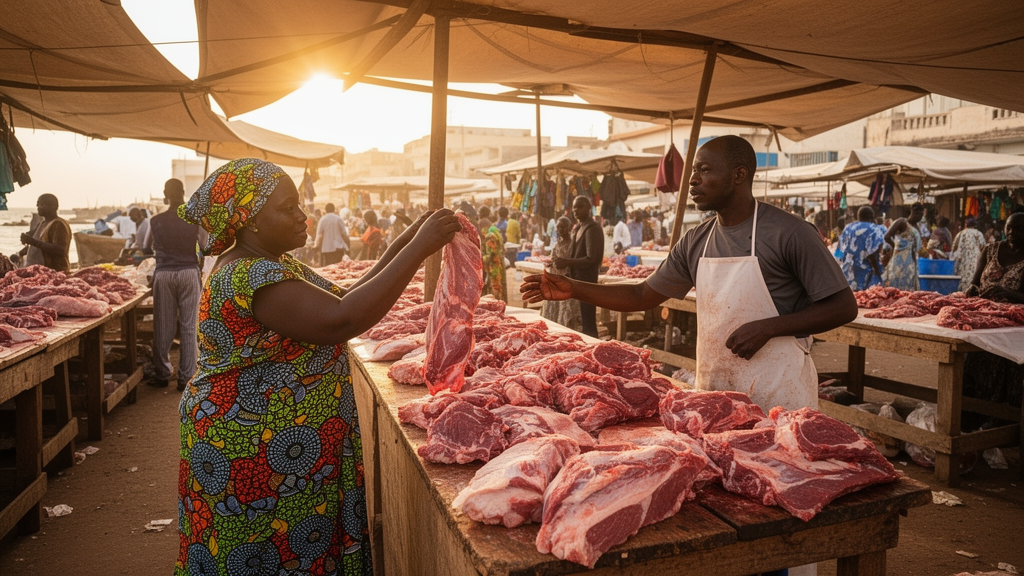
Urban meat consumers in Dakar, Abidjan and Abuja judge what they buy through a layered set of expectations that mixes taste and freshness with price, hygiene, trust in familiar sellers and a sense of loyalty to local production. That is the central finding of a qualitative study published in the journal Pastoralism, which applied Convention Theory to 49 focus group discussions across the capitals of Senegal, Côte d’Ivoire and Nigeria. The research, conducted by Serena Ferrari of CIRAD and SELMET and Abdrahmane Wane of the International Livestock Research Institute in Dakar, set out to determine whether coastal West African markets could become growing commercial outlets for meat from extensive Sahelian livestock systems, where a large share of the population depends on livestock farming and the export of live animals to countries including Mali, Mauritania, Burkina Faso, Niger and Chad.
The study sits within a broader regional research initiative on animal-source food consumption in West African urban hubs. While large-scale quantitative household surveys capture income elasticities, expenditure tiers and market shares, the authors used this qualitative component to uncover the subjective benchmarks and institutional trust mechanisms that drive consumer choices. Their starting hypothesis was that meat quality conventions in the urban markets of coastal West African countries would be dominated by domestic and industrial orders of justification, meaning that trust in familiar products and confidence in standardized practices would outweigh other considerations.
Convention Theory, developed from the 1980s primarily in France and the United States, holds that economic exchange is impossible without a common framework of shared understanding. Because buyers cannot perceive or measure every characteristic of a product, a gap always exists between objective attributes and the qualities people actually perceive. Quality conventions reduce that uncertainty: they are behavioral structures of coordination, built gradually through repeated social interactions and imitation, that tell consumers what a trustworthy product looks like. The framework distinguishes an industrial convention based on compliance with external standards, a domestic convention rooted in lasting relationships and trust in people or brands, a civic convention grounded in common societal principles, and a market convention in which price and observable characteristics govern the transaction. These are ideal types that appear in reality only in composite form, and they can evolve, persist among some population segments, or collapse under suspicion.
The fieldwork involved 15 focus groups per country, held at consumption sites such as households and groups of colleagues or friends, each with at least five participants to stimulate dialogue and reduce the bias of an outside researcher. Sampling combined two variables: area of residence, which in West African cities is tightly linked to food environment access and socioeconomic status, and socioeconomic class, proxied through housing conditions, furnishings and education level. In the Dakar region, 17 focus groups were distributed across the four departments according to population size, with six each in the low- and middle-income classes and five in the high-income class. Abidjan also hosted 17 groups, spread across communes such as Abobo and Yopougon, four peripheral sub-prefectures and the remaining city communes, with the same class distribution. In Abuja, 15 groups followed population-weighted allocation across the six area councils of the Federal Capital Territory, five per socioeconomic class.
Interviews lasted between one and one-and-a-half hours and unfolded in phases covering sociodemographic characteristics and purchasing habits, photo-based comparisons of meat products, reactions to images of production, processing and sales situations, and a listing and ranking of safety-related knowledge, attitudes and practices. The scope covered red meat, white meat and fish, which households treat as substitutes, but excluded eggs and dairy because consumers do not consider them interchangeable with meat in meal preparation. Transcripts were coded in QDA Miner Lite, assigning each relevant segment a code corresponding to a quality convention, so that the number of occurrences could serve as a proxy for the importance of each choice criterion.
Nine conventions emerged from the analysis, and their frequency counts reveal a clear hierarchy. The organoleptic convention, covering taste, aroma, texture, freshness and visual appearance, dominated with 1,114 occurrences across the three countries, followed by the market convention at 750, the industrial convention at 388, the domestic convention at 254 and the nutritional convention at 216. Civic, religious, opinion-based and inspiration-related criteria trailed behind at 75, 65, 39 and 20 occurrences respectively, out of 2,921 coded segments in total. Côte d’Ivoire contributed the most coded material at 1,240 occurrences, Senegal 1,053 and Nigeria 628. Consumers described meat with a rich vocabulary of tasty, fresh, soft, tender, fatty or bland, and one Dakar participant dismissed chicken for grilling because, in his words, dibi made from chicken cannot be tasty, while an Abidjan participant praised braised mutton as mild and well done.
Price and accessibility formed the second pillar of decision-making. Consumers weighed not only the absolute price but whether a purchase could feed an entire household, and purchasing power shaped where people bought: an Abuja participant explained that market vendors resell meat because slaughterhouse hours are restrictive and buying a share of an animal requires sums around 40,000 or 50,000 naira, roughly 50 to 60 dollars, far beyond a buyer arriving with 4,000 or 10,000 naira. Limited variety also constrained choice, with one Senegalese consumer noting that duck meat could take days to find, and religious festivities such as Christmas sometimes forced purchases despite budgetary strain. The industrial convention ranked third and manifested mainly in attention to packaging and the point of sale rather than the product type itself: consumers praised clean, modern sales points, government slaughterhouses and health-service seals as signs of reliability.
Yet this enthusiasm for modernity was sharply qualified. Several participants suspected industrial methods, citing force-feeding, genetically modified feed, chemical preservation and opaque supermarket supply chains in which the origin of minced meat cannot be verified. A strong domestic convention favored local and traditional products, expressed through phrases like at home, our products and we Africans. Consumers rejected imported frozen liver as inferior even when cheaper, preferred local chickens and bush sheep for their varied diets, and distrusted smoked beef sold in supermarkets because they could not confirm it was beef. One Senegalese participant preferred to buy meat at the market and smoke it personally to be sure. Religious criteria reinforced this pattern, particularly among Muslim households who questioned whether imported meat met halal slaughter requirements, since the conditions of slaughter abroad are unknown.
The remaining conventions carried strategic weight despite their lower counts. Consumers praised the vitamin content of meat from extensively raised animals, described such meat as healing, linked liver to treating child anemia, and echoed media warnings that excessive red meat consumption harms older adults. Civic arguments surfaced especially in Senegal, where participants argued that supporting locally produced meat would strengthen the national economy, and animal welfare concerns appeared in criticisms of cramped transport and intensive farming, although one Nigerian participant countered that nomadic herds suffer stress and lack veterinary care. The authors conclude that urban West African meat markets are not moving in a linear transition from traditional to industrial but are demanding a modern-pastoral hybrid. For Sahelian meat to escape a commodity trap in which it competes on price against subsidized imports, the sector would need to professionalize hygiene standards while formalizing the interpersonal trust that currently defines the domestic convention, for example through labels verifying grass-fed production, and to invest in transparent urban slaughterhouses and refrigerated retail that preserve local identity. The study’s qualitative design, limited to three capital cities and relying on occurrence counts as proxies for convention importance, means the findings describe perceptions in these urban contexts rather than measured market outcomes across the region.
Subject of Research: Consumer perceptions of meat quality and market potential for Sahelian livestock products in coastal West African cities
Article Title: Balancing tradition and modernity: meat consumption trends in coastal West Africa
Article References: Ferrari, S., & Wane, A. (2026). Balancing tradition and modernity: meat consumption trends in coastal West Africa. Pastoralism: Research, Policy and Practice, 16, Article 15507. https://doi.org/10.3389/past.2026.15507
Image Credits: AI Generated
Keywords: meat consumption, West Africa, Convention Theory, food safety, pastoralism, urban consumers, Dakar, Abidjan, Abuja, quality conventions, livestock exports, focus groups
Cite Scienmag News
William Thompson. (October 27, 2026). Taste, trust and hygiene shape meat choices in coastal West African cities. Scienmag. https://scienmag.com/taste-trust-and-hygiene-shape-meat-choices-in-coastal-west-african-cities/
William Thompson. "Taste, trust and hygiene shape meat choices in coastal West African cities." Scienmag, 27 October 2026, https://scienmag.com/taste-trust-and-hygiene-shape-meat-choices-in-coastal-west-african-cities/. Accessed 27 October 2026.
William Thompson. "Taste, trust and hygiene shape meat choices in coastal West African cities." Scienmag. October 27, 2026. https://scienmag.com/taste-trust-and-hygiene-shape-meat-choices-in-coastal-west-african-cities/


