


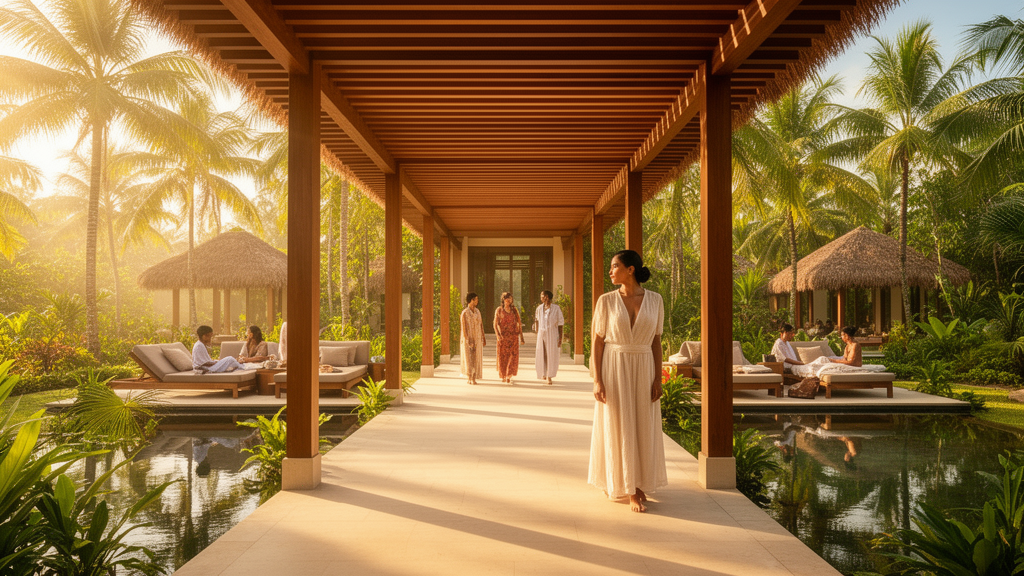
Therapeutic architecture, long studied in hospitals and clinics, is now being tested in an unlikely setting: the holiday resort. A new study from Nigeria reports that design principles borrowed from healing environments, especially connection to nature and aesthetic harmony, are strongly associated with how easily guests move between spaces at three wellness resorts, while artwork and colour schemes may actually make people more disoriented when placed carelessly. The research, published in Frontiers in Built Environment, offers some of the first quantitative evidence on how the pathways, corridors and transitions of a resort shape the very sense of calm they are meant to sell.
Researchers Anthony B. Sholanke and Jesunifemi O. Akingbade of Covenant University in Ota, Nigeria, surveyed 230 valid respondents, including guests, wellness practitioners and resort staff, across three purposively selected resorts in Southwest Nigeria: Ilaji Resorts in Ibadan, Oxygen Orbit Resort in Moniya, and Lakowe Lakes Golf and Country Estate near the Lekki-Epe Expressway in Lagos State. Of 297 questionnaires administered through purposive and convenience sampling, 230 were validly returned, a 77.4 percent response rate. The team then ran eight separate multiple regression models, each testing whether seven therapeutic architecture principles predicted one of eight user-perceived circulation qualities.
The seven principles examined were connection to nature, natural lighting, natural ventilation, multi-sensory design, privacy and control, aesthetics and emotional harmony, and integration of artwork and colour. The eight circulation outcomes ranged from privacy through spatial layout and ease of movement within and between spaces, to wayfinding effectiveness, accessibility of stairs, ramps and lifts, comfort during movement, reduction of disorientation, and legibility of pathways. All eight regression models were statistically significant at p < 0.01, with p values ranging from below 0.001 to 0.007, indicating that the principles, taken together, are meaningfully associated with how users experience moving through these resorts.
The strongest associations clustered around horizontal movement. Ease of movement between spaces was the circulation outcome most strongly explained overall, with aesthetics and emotional harmony returning a standardised coefficient of 0.347 and connection to nature 0.314, followed by natural ventilation at 0.250. Privacy through spatial layout was most strongly associated with the privacy and control principle, at 0.311, exactly as Ulrich’s Theory of Supportive Design would predict. Effectiveness of wayfinding and signage tracked most closely with natural lighting, at 0.223, while ease of movement within individual spaces was most strongly linked to multi-sensory design, at 0.187.
The study’s most striking result, however, was negative. Integration of artwork and colour returned the largest coefficient in the entire matrix, a strong negative association of −0.470 with the reduction of disorientation. In other words, as artwork and colour interventions increased, users’ ability to orient themselves tended to decrease. The authors interpret this as consistent with a caution in the design literature that so-called positive distractions, such as art, can compete with legibility when they obscure the sightlines, landmarks and contrast cues people rely on to navigate. Because the models are linear, the data cannot directly test whether a threshold exists, but the pattern suggests artwork may support wellbeing in spaces of repose while undermining orientation at decision points.
Equally telling was what the principles failed to explain. Accessibility, defined as the ease of locating vertical circulation elements such as stairs, ramps and lifts, was the outcome most weakly associated with the seven predictors, with a maximum absolute coefficient of only 0.163, for natural ventilation, and most coefficients in that column not reaching conventional statistical significance. The researchers conclude that vertical circulation in these resorts is still designed chiefly to functional and regulatory standards rather than therapeutic ones, an underexploited opportunity given that staircases and ramps involve changes in view, light and pace that could be sequenced restoratively.
Structured site observation, rated by a single observer in 2026, added texture to the survey findings. Lakowe Lakes Golf and Country Estate scored highest on all four observed circulation elements, with an overall 51 out of 60 and a mean of 4.25, reflecting a linear, well-structured layout with a clear hierarchy from main access roads to smaller internal paths, wide pedestrian walkways and cycling routes, explicit wayfinding elements, and clean separation of public and private zones. Ilaji Resorts scored 39 overall, with rectilinear buildings clustered around sports courts, activity-focused flow, unclear path segments in places and zoning that was not fully considered. Oxygen Orbit Resort scored 40, with a compact organic form, spaces that are easy to locate but limited relaxation areas, a car park that doubles as a walkway, and slippery tiles on the staircase to the gym.
The authors are careful about what these comparisons mean. Because the regression models pooled respondents across all three resorts, the study cannot establish whether the differences in layout caused differences in how guests evaluated circulation, and the observation ratings came from one observer. The findings are therefore best read as associations across the pooled sample and as case evidence transferable to comparable resorts, not as statistically generalisable to the wider Nigerian or Sub-Saharan African hospitality sector. The sample was also non-probabilistic, self-reported, and skewed toward respondents aged 31 to 45, who made up 41.7 percent of the 230 valid responses, 60 percent of whom were resort guests.
Theoretically, the results refine two foundational frameworks. Ulrich’s Theory of Supportive Design and Kaplan and Kaplan’s Attention Restoration Theory were developed largely around static environments such as hospital rooms, gardens and workstations, not the dynamic, sequential experience of moving through a building. The negative artwork coefficient suggests that a distraction which is restorative in a stationary space of repose may become disorienting in a space whose primary function is orientation and movement. The authors argue that future theory should distinguish between restorative qualities appropriate to spaces of repose and those appropriate to spaces of transition, rather than treating therapeutic principles as uniformly beneficial regardless of a space’s role in the circulation sequence.
For designers, the practical message is a differentiated strategy rather than a uniform checklist. The study recommends prioritising daylighting and biophilic connection along primary circulation spines, deploying artwork and colour selectively and in coordination with wayfinding so they do not compete with orientation cues at junctions, lobbies and floor changes, designing privacy as a graduated sequence from public to semi-private to private, and extending therapeutic thinking to stairs, ramps and lifts as restorative sequences in their own right. The authors also flag limitations: the cross-sectional design captures perceptions at a single point in time, and future work should use longitudinal designs, sample other Nigerian geopolitical zones and West African contexts, compare resorts individually, and pair surveys with space syntax analysis or behavioural observation.
Subject of Research: Therapeutic architecture principles and spatial circulation design in Nigerian wellness resorts
Article Title: Influence of therapeutic architecture principles on spatial circulation design in wellness resorts: evidence from selected case studies in Nigeria
Article References: Sholanke, A. B., & Akingbade, J. O. (2026). Influence of therapeutic architecture principles on spatial circulation design in wellness resorts: evidence from selected case studies in Nigeria. Frontiers in Built Environment, 12, 1983094. https://doi.org/10.3389/fbuil.2026.1983094
Image Credits: AI Generated
DOI: 10.3389/fbuil.2026.1983094
Keywords: therapeutic architecture, wellness resorts, spatial circulation, biophilic design, wayfinding, Nigeria, attention restoration theory, supportive design, natural lighting, privacy and control, hospitality design, regression analysis
Cite Scienmag News
Violet Maxwell. (October 27, 2026). Nature Views and Daylight Shape How Guests Move Through Nigerian Wellness Resorts. Scienmag. https://scienmag.com/nature-views-and-daylight-shape-how-guests-move-through-nigerian-wellness-resorts/
Violet Maxwell. "Nature Views and Daylight Shape How Guests Move Through Nigerian Wellness Resorts." Scienmag, 27 October 2026, https://scienmag.com/nature-views-and-daylight-shape-how-guests-move-through-nigerian-wellness-resorts/. Accessed 27 October 2026.
Violet Maxwell. "Nature Views and Daylight Shape How Guests Move Through Nigerian Wellness Resorts." Scienmag. October 27, 2026. https://scienmag.com/nature-views-and-daylight-shape-how-guests-move-through-nigerian-wellness-resorts/


