


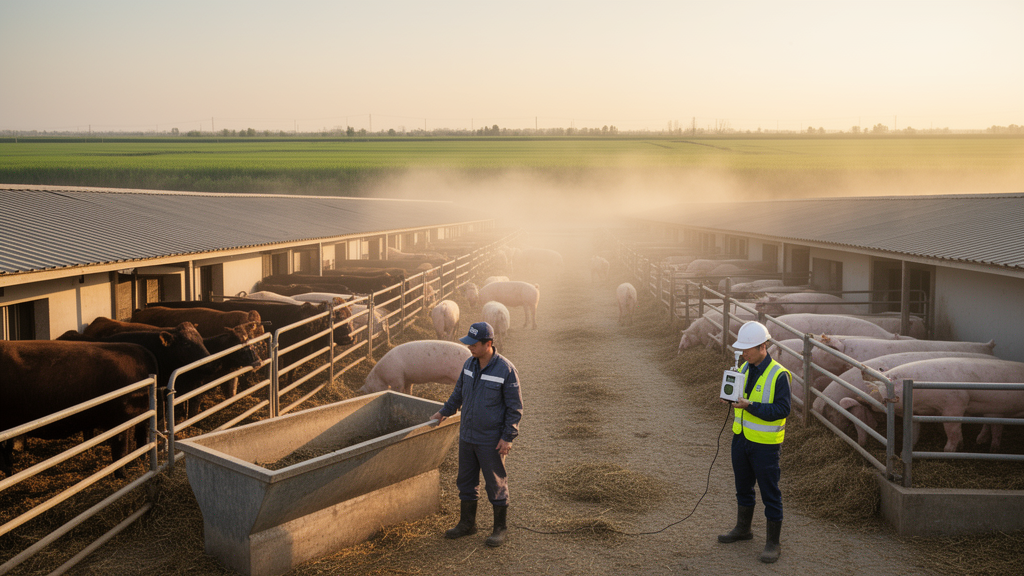
China’s livestock sector released roughly 19.53 percent less ammonia in 2024 than it did in 2005, according to a new twenty-year provincial analysis published in Frontiers in Environmental Science. That headline number, however, conceals a far more complicated picture. When researchers Wenjia Wu and Qi Qi applied a formal statistical trend test to the annual emission series, they found no statistically significant monotonic decline at the national level. Emissions dropped sharply between 2005 and 2007, recovered, hit their lowest point in 2018, rose again, and then fell once more by 2024. The national trajectory, in other words, is one of substantial interannual fluctuation rather than steady progress, and the authors caution that an endpoint comparison alone cannot describe how livestock-related ammonia has actually evolved across the country.
The study constructed what is known as a total ammoniacal nitrogen mass-flow inventory for all 31 provincial-level regions of China from 2005 to 2024. Rather than treating ammonia release as a single event, this approach tracks nitrogen through the entire manure-management chain: outdoor excretion, animal housing, manure storage and treatment, and the eventual application of manure to cropland. The logic matters because ammonia can volatilize at every stage, and nitrogen lost upstream is no longer available to escape downstream. The researchers drew their emission factors and parameters from the Technical Guidelines for the Compilation of Integrated Emission Inventories of Air Pollutants and Greenhouse Gases issued by China’s Ministry of Ecology and Environment, converting guideline percentages into decimal fractions and applying a molecular-weight conversion factor of 1.214 to translate ammoniacal nitrogen losses into tonnes of ammonia.
Ammonia itself is far more than a farmyard nuisance. It is a central component of the atmospheric reactive nitrogen cycle and a major pathway of nitrogen loss from agriculture. Once airborne, it reacts with sulfuric and nitric acids to form ammonium aerosols, contributing to secondary particulate matter that degrades air quality. It also drives nitrogen deposition, soil acidification, eutrophication of waterways, and broader ecosystem damage. As China and other countries have tightened controls on sulfur dioxide and nitrogen oxides, agricultural ammonia has attracted growing scrutiny as a continuing source of regional air pollution, and recent high-resolution evidence confirms that agricultural activities remain the dominant source of China’s national ammonia emissions.
The regional breakdown is where the study becomes genuinely striking. The 31 provinces were sorted into three groups of roughly equal size based on their long-run average livestock output value at comparable prices. Emissions in the high livestock-economic region, which includes Sichuan, Shandong, Henan, Hebei, Hunan, Liaoning, Hubei, Heilongjiang, Anhui, and Guangdong, fell 34.57 percent over the study period, from 2.53 million tonnes to 1.65 million tonnes, and the Mann-Kendall test confirmed a statistically significant downward trend with a Sen’s slope of roughly minus 18,200 tonnes per year. The medium region, containing provinces such as Yunnan, Inner Mongolia, and Xinjiang, moved in the opposite direction: a significant upward trend with a median increase of about 10,600 tonnes annually. The low region edged up by a nonsignificant 2,250 tonnes per year. By 2024, the medium region’s emissions had actually edged past those of the high region, signaling a redistribution of the national ammonia burden.
Inequality between provinces also widened, and the study’s decomposition reveals something counterintuitive about where that widening came from. The overall GE(0) index, a measure from the generalized entropy family that is particularly sensitive to low-emission provinces, rose from 0.366 in 2005 to 0.449 in 2024, a 22.70 percent increase. But the between-region component of that inequality shrank, from 0.116 to about 0.062, while the within-region component grew from 0.250 to roughly 0.387. Provinces within the same livestock-economic category were becoming increasingly different from one another, even as the average gap between categories narrowed. The low livestock-economic region was the most internally heterogeneous of all, with its internal index climbing from 0.452 to 0.822, reflecting the diversity of a group that spans highly urbanized areas with little livestock and extensive western plateau regions dominated by ruminant production.
Spatial analysis added another layer. Global Moran’s I statistics, computed under a geographical adjacency matrix with 9,999 random permutations for significance testing, were positive in every year and rose from 0.161 in 2005 to 0.268 in 2024, with statistically significant clustering from 2019 onward. Provinces with similar emission levels increasingly sit next to one another on the map. Yet the authors are careful to distinguish this unconditional clustering from conditional spatial dependence. When they estimated a two-way fixed-effects spatial Durbin model with province and year fixed effects, the spatial autoregressive coefficient came out at minus 0.032 and was statistically insignificant. Neighboring provinces may simply share climate, livestock structures, cropland resources, and economic conditions rather than transmitting emissions to one another, and the study explicitly declines to interpret its spatial patterns as evidence of a stable interprovincial emission-spillover mechanism.
The socioeconomic associations in the model proved surprisingly fragile once production scale was taken into account. In the baseline specification, the manure nitrogen supply-demand ratio, a measure of manure nitrogen relative to crop nitrogen demand, and the livestock share of agricultural output were both positively associated with total provincial emissions. But when the researchers added standardized livestock units as a control, the total-effect p-values for these two variables weakened to 0.078 and 0.969 respectively. When the outcome was switched to ammonia emissions per standardized livestock unit, the supply-demand ratio became insignificant while industrial structure showed a negative association with emission intensity. The authors interpret this as evidence that much of the baseline positive association reflects the livestock-scale component embedded in these indicators, not a scale-independent emission effect, and they stress that none of the model estimates should be read as causal effects.
Robustness testing was unusually thorough. A Monte Carlo analysis with 50,000 simulations perturbed excretion parameters, nitrogen contents, stage-specific emission factors, and fractional allocation parameters, and found that the key temporal and inequality findings held: the national endpoint decline had a median of minus 19.52 percent with a 95 percent uncertainty interval of minus 23.29 to minus 14.13 percent, and every simulation showed the widening within-region disparity. External benchmarking against independent published inventories showed strong provincial agreement, with a Pearson correlation of 0.849 and a Spearman rank correlation of 0.888 for 2006 estimates, and a 2005 to 2012 decline almost identical to an independent inventory’s figure. The reconstructed national totals were nonetheless about 16 to 36 percent below published inventories, which the authors attribute to simplified livestock subclassification and management assumptions producing conservative absolute levels.
What emerges is a study as much about the limits of inference as about emissions themselves. The authors note that their provincial aggregation cannot capture variation in housing systems, feed composition, storage technologies, or application practices, and that their spatial weight matrices are proxies rather than observations of manure transport or atmospheric movement. Environmental policy attention, measured from the frequency of environment-related terms in provincial government work reports, showed no robust total association with emissions, which the authors attribute to the proxy’s breadth rather than to policy ineffectiveness. The practical message is deliberately modest: region-specific assessment of manure nutrient balances and emission intensity may help inform mitigation priorities, but the study does not itself establish which interventions will work where. For a country whose livestock production continues to reorganize spatially, that caution may be the most important finding of all.
Subject of Research: Spatiotemporal evolution, regional disparities, and spatial associations of livestock-related ammonia emissions across Chinese provinces from 2005 to 2024
Article Title: Socioeconomic development, livestock industrial structure, and environmental pressure in China: spatiotemporal evolution and spatial associations of ammonia emissions
Article References: Wu, W., & Qi, Q. (2026). Socioeconomic development, livestock industrial structure, and environmental pressure in China: spatiotemporal evolution and spatial associations of ammonia emissions. Frontiers in Environmental Science, 14, 1978331. https://doi.org/10.3389/fenvs.2026.1978331
Image Credits: AI Generated
DOI: 10.3389/fenvs.2026.1978331
Keywords: ammonia emissions, livestock production, China, manure management, spatial Durbin model, regional inequality, Mann-Kendall test, total ammoniacal nitrogen, air quality, spatial clustering, emission intensity, environmental policy
Cite Scienmag News
William Thompson. (October 27, 2026). China’s Livestock Ammonia Emissions Fell Nearly 20 Percent, But the Story Is Far More Uneven. Scienmag. https://scienmag.com/chinas-livestock-ammonia-emissions-fell-nearly-20-percent-but-the-story-is-far-more-uneven/
William Thompson. "China’s Livestock Ammonia Emissions Fell Nearly 20 Percent, But the Story Is Far More Uneven." Scienmag, 27 October 2026, https://scienmag.com/chinas-livestock-ammonia-emissions-fell-nearly-20-percent-but-the-story-is-far-more-uneven/. Accessed 27 October 2026.
William Thompson. "China’s Livestock Ammonia Emissions Fell Nearly 20 Percent, But the Story Is Far More Uneven." Scienmag. October 27, 2026. https://scienmag.com/chinas-livestock-ammonia-emissions-fell-nearly-20-percent-but-the-story-is-far-more-uneven/


