


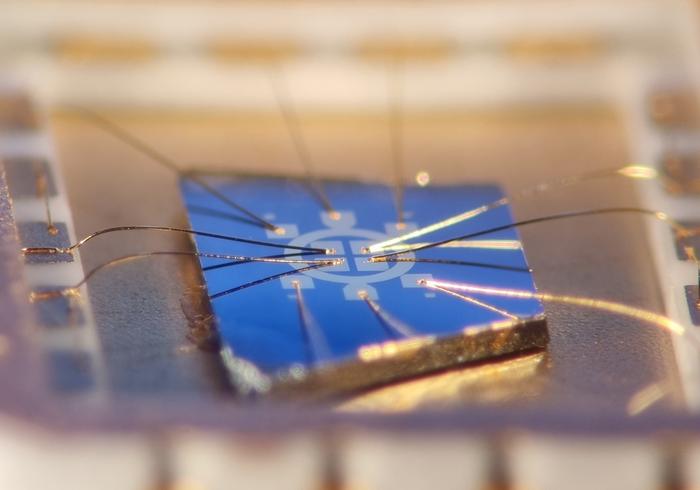
The precise measurement of electrical resistance is essential in industrial production or electronics – for example, in the manufacture of high-tech sensors, microchips and flight controls. “Very precise measurements are essential here, as even the smallest deviations can significantly affect these complex systems“, explains Professor Charles Gould, a physicist at the Institute for Topological Insulators at the University of Würzburg (JMU). “With our new measurement method, we can significantly improve the accuracy of resistance measurements, without any external magnetic field, using the Quantum Anomalous Hall Effect (QAHE).“

Credit: Fijalkowski/JMU
The precise measurement of electrical resistance is essential in industrial production or electronics – for example, in the manufacture of high-tech sensors, microchips and flight controls. “Very precise measurements are essential here, as even the smallest deviations can significantly affect these complex systems“, explains Professor Charles Gould, a physicist at the Institute for Topological Insulators at the University of Würzburg (JMU). “With our new measurement method, we can significantly improve the accuracy of resistance measurements, without any external magnetic field, using the Quantum Anomalous Hall Effect (QAHE).“
How the New Method Works
Many people may remember the classic Hall effect from their physics lessons: When a current flows through a conductor and it is exposed to a magnetic field, a voltage is created – the so-called Hall voltage. The Hall resistance, obtained by dividing this voltage by current, increases as the magnetic field strength increases. In thin layers and at large enough magnetic fields, this resistance begins to develop discreet steps with values of exactly h/ne2, where h is the Planck’s constant, e is the elementary charge, and n is an integer number. This is known as the Quantum Hall Effect because the resistance depends only on fundamental constants of nature (h and e), which makes it an ideal standard resistor.
The special feature of the QAHE is that it allows the quantum Hall effect to exist at zero magnetic field. “The operation in the absence of any external magnetic field not only simplifies the experiment, but also gives an advantage when it comes to determining another physical quantity: the kilogram. To define a kilogram, one has to measure the electrical resistance and the voltage at the same time,“ says Gould “but measuring the voltage only works without a magnetic field, so the QAHE is ideal for this“.
Thus far, the QAHE was measured only at currents which are far too low for practical metrological use. The reason for this is an electric field that disrupts the QAHE at higher currents. The Würzburg physicists have now developed a solution to this problem. “We neutralize the electric field using two separate currents in a geometry we call a multi-terminal Corbino device.“, explains Gould. “With this new trick, the resistance remains quantized to h/e2 up to larger currents, making the resistance standard based on QAHE more robust.”
On the Way to Practical Application
In their feasibility study, the researchers were able to show that the new measurement method works at the precision level offered by basic d.c. techniques. Their next goal is to test the feasibility of this method using more precise metrological tools. To this end, the Würzburg group is working closely with the Physikalisch-Technische Bundesanstalt (German National Metrology Institute, PTB), who specialize in this kind of ultra-precise metrological measurements. Gould also notes: “This method is not limited to the QAHE. Given that conventional Quantum Hall Effect experiences similar electric field driven limitations at sufficiently large currents, this method can also improve the existing state of the art metrological standards, for applications where even larger currents are useful”.
The research was funded by the Free State of Bavaria, the German Research Foundation DFG, the Cluster of Excellence ct.qmat (Complexity and Topology in Quantum Matter) and the European Commission.
About the Study
K.M. Fijalkowski, N. Liu, M. Klement, S. Schreyeck, K. Brunner, C. Gould and L.W. Molenkamp. “A balanced quantum Hall resistor”. Nature Electronics. DOI: 10.1038/s41928-024-01156-6 [Link: https://www.nature.com/articles/s41928-024-01156-6]
This experimental method is protected under a European Patent Filing no. EP23162996.5: K.M. Fijalkowski and C. Gould “Quantization breakdown protection for semiconductors and in particular topological insulators.”
Cluster of Excellence ct.qmat
The research team also participates in the Cluster of Excellence ct.qmat – Complexity and Topology in Quantum Matter, which has been jointly run by Julius-Maximilians-Universität (JMU) Würzburg and Technische Universität (TU) Dresden since 2019. Over 300 scientists from more than thirty countries and four continents study topological quantum materials that reveal surprising phenomena under extreme conditions such as ultra-low temperatures, high pressure, or strong magnetic fields. ct.qmat is funded through the German Excellence Strategy of the Federal and State Governments and is the only Cluster of Excellence in Germany to be based in two different federal states.
Journal
Nature Electronics
Method of Research
Experimental study
Article Title
A balanced quantum Hall resistor
Article Publication Date
15-Apr-2024
COI Statement
The authors declare no competing interests.
Cite Scienmag News
Katie Riggs. (April 15, 2024). Quantum precision: A new kind of resistor. Scienmag. https://scienmag.com/quantum-precision-a-new-kind-of-resistor/
Katie Riggs. "Quantum precision: A new kind of resistor." Scienmag, 15 April 2024, https://scienmag.com/quantum-precision-a-new-kind-of-resistor/. Accessed 4 September 2026.
Katie Riggs. "Quantum precision: A new kind of resistor." Scienmag. April 15, 2024. https://scienmag.com/quantum-precision-a-new-kind-of-resistor/

