


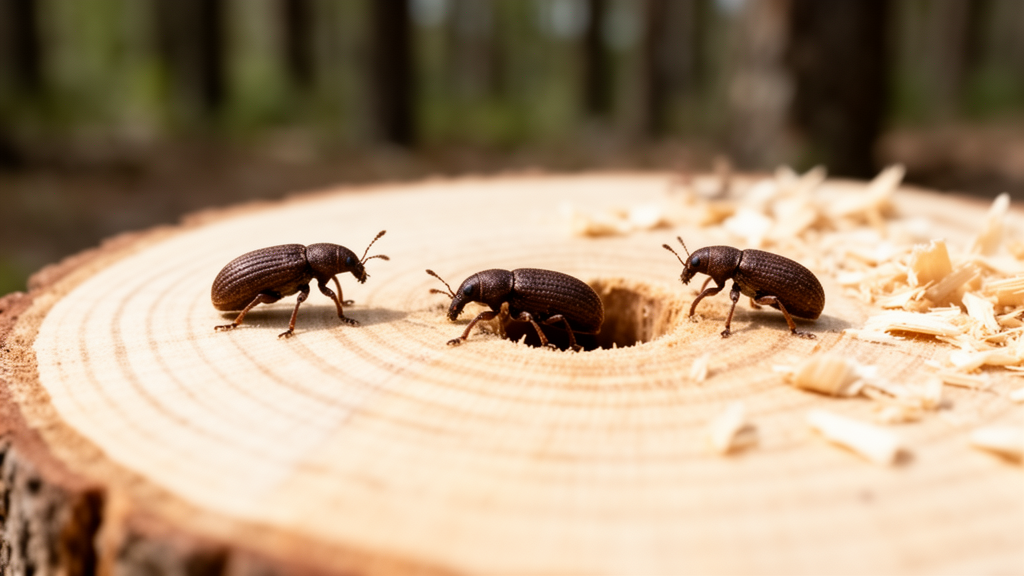
Three species of bark and ambrosia beetles never before recorded in Switzerland have been discovered in the southern Alpine canton of Ticino, following an intensive survey of saproxylic beetles carried out in 2022. The two ambrosia beetles Cyclorhipidion distinguendum and Cyclorhipidion pelliculosum, together with the bark beetle Hypothenemus eruditus, were caught in large numbers across the canton, bringing the national tally of alien Scolytinae to new highs. In total, 366 specimens of the three species were trapped among more than 28,000 beetles collected during the campaign, a level of abundance that suggests the arrivals are not isolated strays but populations that have likely been established for some time.
The discovery came from a comprehensive monitoring program covering all major forest typologies in Ticino along an altitudinal gradient running from 195 to 1,971 meters above sea level. The researchers deployed 114 unbaited Polytrap interception traps at 57 forest sites, suspending two traps per plot two meters above the forest floor with an intertrap distance of 20 to 30 meters. Trap contents, preserved in a saturated salt solution with neutral detergent, were collected every two weeks between early March and the end of September 2022. One additional specimen of Hypothenemus eruditus was captured by hand during a separate field campaign in a wetland forest dominated by poplars in the extreme south of the canton.
Among the specimens caught, 187 females belonged to C. distinguendum, 142 females to C. pelliculosum, and 37 specimens to H. eruditus. All were identified morphologically, and the identifications of the two Cyclorhipidion species were confirmed genetically. Two specimens of each species were sequenced for the COI barcode region, with the resulting sequences deposited in GenBank. For C. distinguendum, sequences of 650 and 589 base pairs showed 100 percent similarity to a voucher specimen sequence in the NCBI nucleotide database. For C. pelliculosum, fragments of 559 and 577 base pairs showed 99.6 percent identity to the reference COI sequence. Genetic analysis of H. eruditus failed despite repeated attempts, probably because the tiny beetles yielded insufficient DNA or because the trap preservation fluid had degraded what remained.
Cyclorhipidion distinguendum is an ambrosia beetle native to Asia, originally known from China’s Fujian province, India’s Uttar Pradesh, Japan, Nepal, Taiwan and Thailand. In Europe it was first detected in France in 2013, again through interception trapping, and it is now established there in a small geographic area. The circumstances of its introduction remain unknown, and until now it had not been reported in Germany, Austria or Italy, despite years of alien-species monitoring in northern Italy. Notably, 62 of the Swiss specimens were trapped in the extreme south of Ticino, less than 200 meters from the Italian border, leading the researchers to conclude that the species is almost certainly already present in northern Italy and may soon be detected there.
The species’ ecology is still poorly known, but it appears to develop preferentially on several Fagaceae, Dipterocarpaceae and Pinaceae, including chestnut and oak. In France it has been captured in moist alder mixed forest at low altitude and in low-altitude beech-fir forests. In Switzerland, all specimens came from deciduous forests between 195 and 676 meters above sea level, suggesting the beetle is restricted to low elevations. Because all individuals were caught in interception traps, no direct information on Swiss host plants is available. Activity peaked in spring: the beetles were caught regularly from March 10 to October 10, but more than 70 percent of specimens were trapped between April and June, a pattern matching the French observations. So far, no phytosanitary problems have been reported in connection with the species in France, the United States or Switzerland.
Cyclorhipidion pelliculosum, likewise native to Asia, is known from China, India, Nepal and Taiwan. Its first European detection also came in 2013, in the Karlsruhe region of Germany, where it has been found repeatedly since, most recently in 2022. It remained unknown in other countries neighboring Switzerland until the Ticino survey. The 142 Swiss specimens were all caught between March 10 and June 1 in deciduous forests between 291 and 620 meters above sea level, again pointing to spring activity and low-altitude preference. Because 214 specimens were trapped less than one kilometer from the Italian border, the researchers judge its presence in Italy to be near certain, and its discovery in France is considered very likely given its occurrence in Germany near the Franco-German border. The first European specimen was found on a poplar trunk, and later German records came from under the bark of a dead standing European beech and from oak trunks; literature records also list maple, alder, birch, chestnut, castanopsis and walnut as hosts. No phytosanitary issues have been attributed to the species in Germany or Switzerland so far.
Hypothenemus eruditus is a very different case. It belongs to one of the most species-rich scolytine genera in the world, with more than 220 described species, and carries more than 70 recognized synonyms, leading researchers to treat it as a complex of closely related species whose morphological identification is extremely difficult; genetic studies suggest several synonyms may be resurrected as valid species in the future. Originally from tropical and subtropical regions, the species, here treated in the broad sense, is now sub-cosmopolitan and may be the most widespread and abundant Scolytinae on Earth. It has been present in Italy since at least 1924 and is established in numerous European countries including Croatia, France, Georgia, Malta, Portugal, Russia, Spain, Turkey and Ukraine. It was detected in Britain in 2011, but only in a controlled tropical humid biome and it does not survive in the wild there.
The species is extraordinarily polyphagous, developing in small branches, in the bark of trunks and branches, in flowers, grasses, seeds, leaf petioles and twigs of plants across several dozen genera worldwide, both herbaceous and woody, as well as in manufactured products. In Europe it has often been found on fig trees in France and on mulberry in Italy. In Switzerland, the first specimen was found under the bark of a black poplar in a wetland forest in the extreme south of Ticino, and the remaining specimens were all trapped in wetland forests also dominated by poplars, a very probable host in the region. The 37 Swiss specimens were caught between April 11 and July 14, suggesting stronger spring activity, though in France the species is regularly caught in mid-summer and in Malta it has been found as late as October and in January. Because of the sheer variety of substrates it can exploit, the introduction pathway into Switzerland is difficult to reconstruct. The European and Mediterranean Plant Protection Organization lists many possible transport means, including round or sawn wood with bark, firewood, bark, wood chips, untreated wood packaging material, processed wood such as plywood and veneer, plants for planting, and cut branches of host plants. Given that many individuals were found at three localities tens of kilometers apart, the species is highly likely already naturalized. Although some authors consider it of potential economic importance, notably as a citrus pest, it does not appear to cause phytosanitary problems in Europe.
All three species were discovered in 2022, but their already wide distributions within Ticino suggest they have been present in the country for several years. For now they appear restricted to the canton, which consistently records the highest number of exotic species in Switzerland. The southern part of the canton is likely their gateway, a pattern seen before with insects, plants and fungi. Two factors probably explain this: the region is a major transit route between northern and southern Europe with important industrial areas through which large volumes of merchandise pass, and the mild insubric climate may facilitate the establishment and acclimatization of new arrivals. The canton also borders Italy, the European country with the highest number of exotic beetle species. Being hard to detect and highly polyphagous, the three beetles will probably spread, or be accidentally introduced, into northern Switzerland in the coming years, as previously happened with the related ambrosia beetle Cyclorhipidion bodoanum.
The three newcomers add to a list of alien Scolytinae already widely distributed in Switzerland, which includes seven species considered invasive plus the recently recorded Anisandrus maiche, caught in multiple specimens in the Ticino Alps. Four new alien scolytine species have now been discovered in the country within two years, and more are expected. Potential future arrivals include Xylosandrus compactus, first found in Europe in Italy in 2011 and now also in France but still confined to the Mediterranean, whose range may expand with climate change according to distribution models, and Xyloterinus politus, already present in northwestern France and in Bavaria. Not every introduction succeeds: species such as Coccotrypes dactyliperda, Dactylotrypes longicollis and Pagiocerus frontalis were accidentally introduced but show no evidence of reproducing in the wild. The Ticino results underline the value of intensive monitoring for early detection, ideally near borders, airports and urban areas, and national and cantonal institutions have been informed and will monitor the spread of the three species across the canton and the country.
Subject of Research: First records of three alien bark and ambrosia beetle species in Ticino, Switzerland
Article Title: Three alien bark and ambrosia beetles ( Coleoptera , Curculionidae , Scolytinae ) new to Switzerland
Article References: Sanchez, A., Chittaro, Y., Frey, D., Koch, B., Hölling, D., Brockerhoff, E. G., Ruffner, B., & Knížek, M. (2023). Three alien bark and ambrosia beetles (Coleoptera, Curculionidae, Scolytinae) new to Switzerland. Alpine Entomology, 7, 45-55. https://doi.org/10.3897/alpento.7.103269
Image Credits: AI Generated
Keywords: bark beetles, ambrosia beetles, Scolytinae, invasive species, Switzerland, Ticino, Cyclorhipidion, Hypothenemus eruditus, forest monitoring, interception traps, alien species, southern Alps
Cite Scienmag News
Drew Townsend. (October 27, 2026). Three Alien Bark and Ambrosia Beetles Detected for the First Time in Switzerland. Scienmag. https://scienmag.com/three-alien-bark-and-ambrosia-beetles-detected-for-the-first-time-in-switzerland/
Drew Townsend. "Three Alien Bark and Ambrosia Beetles Detected for the First Time in Switzerland." Scienmag, 27 October 2026, https://scienmag.com/three-alien-bark-and-ambrosia-beetles-detected-for-the-first-time-in-switzerland/. Accessed 27 October 2026.
Drew Townsend. "Three Alien Bark and Ambrosia Beetles Detected for the First Time in Switzerland." Scienmag. October 27, 2026. https://scienmag.com/three-alien-bark-and-ambrosia-beetles-detected-for-the-first-time-in-switzerland/


