


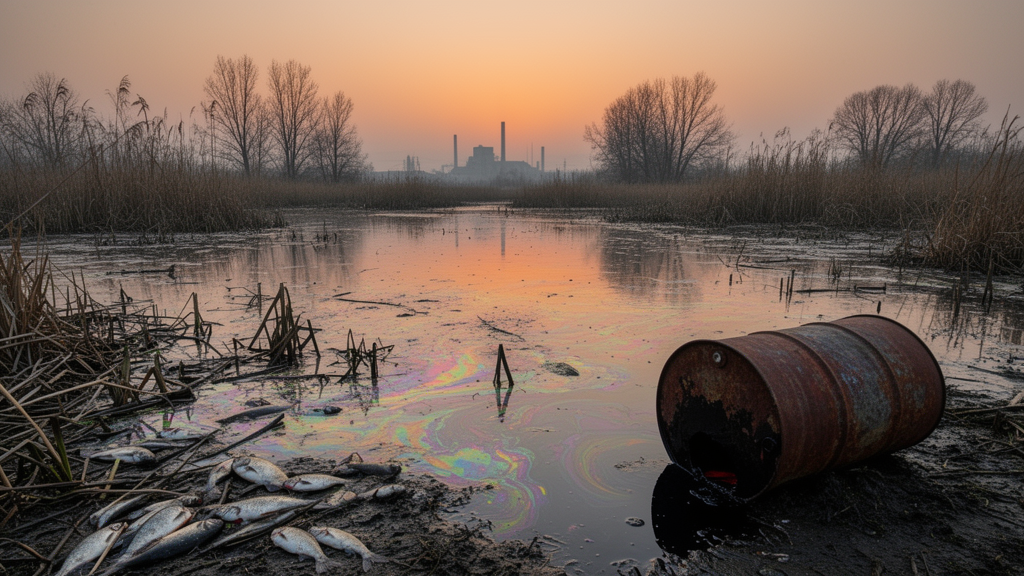
The word ecocide joins the ancient Greek ‘oikos’, meaning house or habitat, with the Latin ‘caedere’, to cut down or kill. It describes literally the killing of the environment: the destruction of large areas of the natural world as a consequence of human activity. Scientists argue that humanity has oversaturated its own habitat with harmful and often toxic waste, and that three classes of pollutants stand out as particularly dangerous drivers of environmental conflict. Pesticides, applied deliberately to protect crops, spread through freshwater systems and magnify along food chains. Radionuclides, released from nuclear accidents and weapons testing, bioaccumulate in terrestrial and aquatic biota. Petroleum products, spilled in enormous quantities, contaminate ocean ecosystems and shorelines with damage that can take decades to overcome. Ecocide becomes irreversible when an ecosystem is damaged beyond its capacity for self-repair, whether through the direct loss of enough species to disrupt structure and function, or through pollution such as high pesticide concentrations that decimate local biodiversity.
Pesticides remain the most serious weapon against agricultural pests since the discovery of DDT, yet they damage water and soil quality with dangerous effects on animals, birds, plants and humans. Their environmental behaviour determines their toxicity. Water-soluble compounds enter groundwater, streams, rivers and lakes, harming non-target species directly. Fat-soluble compounds are absorbed into fatty tissues and show a strong tendency towards biomagnification: persistent pollutants are transferred up the food chain faster than they are broken down or excreted, so higher trophic levels accumulate greater concentrations. Species at the top of food chains may then die from greater toxicity, disrupting the functioning of the entire ecosystem. Accumulation along food chains is of greatest concern because it directly affects terrestrial predators and raptors, while indirectly reducing the plants and primary consumers on which higher orders feed. Spraying with insecticides, herbicides and fungicides has also been associated with declines in rare species of animals and birds.
The technical evidence for collateral damage in soil and water is substantial. As early as 1977, Kelley and South noted that herbicides damage fungal species in soil by inhibiting symbiotic mycorrhizal fungi that assist plant nutrient uptake. Glyphosate, a broad-spectrum herbicide, reduces the growth and activity of nitrogen-fixing bacteria. Even low herbicide doses affect the productivity and diversity of natural plant communities. Beneficial insects such as bees and beetles suffer significant population declines from broad-spectrum insecticides, and synergistic effects between fungicides and neonicotinoids are particularly harmful to bees, altering feeding behaviour even at low doses. Since 2006, honeybee populations have reportedly dropped by 29 to 36 percent each year. Aquatic life is exposed through three routes: direct absorption via skin, uptake via gills during breathing, and drinking contaminated water. Contaminated water can affect aquatic plants, decrease dissolved oxygen and cause physiological and behavioural changes in fish, while pesticides also interact with stressors such as harmful algal blooms.
Perhaps the most striking statistic is efficiency: only about 10 percent of applied pesticides reach the target organisms in crops, according to several reports, while the majority reacts with non-target organisms. This unintended fraction moves through ecosystems, accumulates at lower trophic levels and reaches higher-level organisms by bioaccumulation, putting whole ecosystems at risk. The solution being pursued is biomonitoring, using non-target species as bioindicators whose choice depends largely on feeding habitat. Copepods and cladocerans have been reported as early bioindicators of endosulfan toxicity, and ecotoxicological risk to the copepods Acartia margalefi and A. latisetosa and the mysid Siriella clausi can serve as an early indicator of risk to marine ecosystems. Bees carry pesticides back to hives, and spraying during honey collection can adulterate honey and beeswax, making honey bees a potential bioindicator of pesticide levels in pollinator communities. Earthworms, central to soil health, show neurotoxic effects after exposure, with DNA damage, altered feeding activity and loss of vitality; their decline may alter nutrient cycling and availability to plants.
Bird feathers are among the best indicators of pesticide presence in the body, correlating significantly with contamination levels in seabirds’ food. Feather collection is easy and minimally invasive, important for conservation biology, and feathers indicate toxicant exposure across an annual cycle. Measured concentrations span a wide geographic range, from 6.49 plus or minus 5.95 micrograms per gram in birds from Patagonia to 870.48 plus or minus 614.48 nanograms per gram in birds from Spain, and penguin feathers are a very good tool for biomonitoring organochlorine pesticides in Antarctica. Herbivorous mammals, especially rodents, also fulfil the requirements of good bioindicators thanks to large populations, broad spatial and ecological representation, well-known physiology, high reproductive potential and known diets. Because pesticide use is unavoidable, researchers argue that early monitoring is essential, integrating toxicology, environmental chemistry, population biology, community ecology, conservation biology and landscape ecology, and combining chemical pesticides with natural treatments for more sustainable pest elimination, supported by remediation techniques such as adsorption and bioremediation, integrated pest management and stricter regulation.
Radionuclides are nuclides with excess nuclear energy that makes them unstable, releasing particles in radioactive decay. Natural radionuclides emit alpha, beta and gamma radiation. Alpha particles cause the strongest biological effects, twenty times more biological damage than an equivalent dose of beta or gamma radiation, but alpha and beta emitters are biologically relevant mainly when incorporated into living organisms, whereas gamma emitters matter both internally and externally. Some technogenic radionuclides emit other radiation types: medical PET isotopes such as fluorine-18 and carbon-11 are positron emitters, and californium-252 emits neutrons. Caesium-137 emits beta particles at 511 and 1173 kiloelectronvolts and gamma rays at 661.6 kiloelectronvolts. Radiation risk at low doses remains insufficiently understood; the prevailing Linear Non-Threshold model extrapolates risk linearly downward, while competing hypotheses of radiation hormesis, which holds small doses beneficial, and low-dose hypersensitivity, which holds them more mutagenic, remain outside protection calculations. Radiosensitivity varies enormously: the bacterium Deinococcus radiodurans withstands acute doses of 5000 gray with almost no loss of viability, tardigrades have an LD50 of 5000 gray, while the human LD50 is around 6 gray and that of goats only around 2.4 gray.
Bioaccumulation drives much of the concern in contaminated areas, as radioisotopes behave like their chemical analogues and concentrate in target organs. Strontium-90, an analogue of calcium, has a strong affinity for bone and hematopoietic tissue. Among the most significant anthropogenic radionuclides, caesium-137 has a half-life of 30.17 years, targets nerve and muscle tissue and is associated with different cancers; strontium-90, with a half-life of 28.8 years, is a pure beta emitter targeting bone and causing bone cancer and leukemia; and iodine-131, with a half-life of only 8.02 days, targets the thyroid and causes thyroid cancer. Caesium-137 and strontium-90 are the most significant environmental contaminants due to their long half-lives and persistence. Iodine-131 was a major risk only in the first year after Chernobyl, causing roughly 4000 excess thyroid cancers in the most affected populations of the former USSR. Natural radioactivity, including terrestrial gamma radiation, cosmic rays and radon and thoron progeny, accounts for about 95 percent of the annual radiation dose to terrestrial biota, and in high-background areas such as Guarapari in Brazil, Kerala in India and Ramsar in Iran, where annual doses average 35 to 40 millisieverts against 3.6 in Europe, epidemiological studies report no excess cancer risk.
Man-made contamination poses sharper risks. The Chernobyl accident is the most prominent example of technogenic environmental damage, causing significant chronic morbidity and mortality and enormous damage to European environments and economies, largely through iodine-131, caesium-137 and strontium-90 and their tendencies to bioaccumulate and biomagnify in terrestrial ecosystems. The 2011 Fukushima accident set a new precedent, since the reactors were nearing the end of their design life, a condition true of many operating reactors today, raising the spectre of crumbling nuclear infrastructure as a future hazard. High acute doses above 1 gray produce deterministic effects such as teratogenesis in developing embryos, stunted plant growth and visible damage to flora and fauna. More worrying are stochastic effects, which occur with small probability even at low doses, including mutagenesis and carcinogenesis. Based on mouse experiments and Hiroshima and Nagasaki survivor monitoring, the doubling dose for radiation-induced mutagenesis is estimated at 1 gray. Yet this picture is being challenged: chromosomal damage has been observed in the progeny of wild rodents near Chernobyl, indicating genomic instability; children of Chernobyl liquidators showed higher mini- and microsatellite mutation rates, a concern echoed in more recent studies; and the radiation-induced bystander effect, in which non-irradiated cells show cytotoxicity and genetic damage similar to irradiated neighbours, supports low-dose hypersensitivity and highlights molecular mechanisms for increased risk in the low-dose range.
Petroleum pollution completes the triad. Oil spills range from crude oil of various grades to refined products, from heavy fuel oil to light, less persistent but very toxic fuels, and the chemical composition of spilled oil and its weathering reactions determine its fate, behaviour and impact in marine environments. The tanker Sea Empress lost 72,000 tonnes of crude light oil and 370 tonnes of heavy fuel oil in the North Sea on 15 February 1996, affecting more than 100 kilometres of coastline, with estimates suggesting 200 kilometres affected overall and 25,000 tonnes of waste created by the clean-up itself. The 2010 Deepwater Horizon spill, the largest marine environmental disaster in North America, poured over 200 million gallons of oil into the Gulf of Mexico, contaminated the coast, required up to 170,000 cleanup workers and is considered the worst environmental disaster in US history, with drastic and longstanding ecological effects across all trophic levels, from microorganisms, algae and plankton to pelagic fish, marine invertebrates, seabirds and marine mammals from whales to otters.
Ten years on, Deepwater Horizon continues to harm wildlife. The spill affected 320 miles of shoreline, and damaged corals observed at a depth of 1,370 metres, 11 kilometres from the blowout, showed tissue loss, sclerite enlargement, excess mucus production, bleached commensal ophiuroids and brown flocculent covering, making deep-water colonial corals and their ophiuroid symbionts sensitive indicators of petroleum hydrocarbon impact. Shellfish digesting oil suffer changes in reproduction, growth or death; fish show reduced reproduction years later because residual oil remains toxic to larvae; at least 402,000 sea turtles were exposed, with juveniles found starving when petroleum residue blocked beak and oesophagus; oiled birds lost feather insulation and temperature regulation; and thousands of dolphins died in the months after ingesting toxins. Assessments rely on lethal concentration experiments and suites of sublethal indicators spanning immune function, genomic changes, reproductive success and organ impairment. Removal methods are expensive, labour-intensive, often ineffective and themselves degrading. With at least ten countries, including Vietnam since 1990, enacting national ecocide laws, the conclusion is sobering: even years after such accidents it remains too early to assess the full impact, and decontamination will probably continue for more than 40 years.
Subject of Research: Environmental consequences of pesticide, radionuclide and petroleum pollution as drivers of ecocide
Article Title: Ecocide – global consequences (pesticides, radionuclides, petroleum products)
Article References: Metcheva, R., Ostoich, P., & Beltcheva, M. (2022). Ecocide – global consequences (pesticides, radionuclides, petroleum products). BioRisk, 17, 7-18. https://doi.org/10.3897/biorisk.17.77438
Image Credits: AI Generated
Keywords: ecocide, pesticides, biomagnification, radionuclides, Chernobyl, Fukushima, oil spills, Deepwater Horizon, bioindicators, radioactive contamination, marine pollution, ecotoxicology
Cite Scienmag News
Reese Ellison. (October 27, 2026). Ecocide: How Pesticides, Radionuclides and Oil Push Ecosystems Past Repair. Scienmag. https://scienmag.com/ecocide-how-pesticides-radionuclides-and-oil-push-ecosystems-past-repair/
Reese Ellison. "Ecocide: How Pesticides, Radionuclides and Oil Push Ecosystems Past Repair." Scienmag, 27 October 2026, https://scienmag.com/ecocide-how-pesticides-radionuclides-and-oil-push-ecosystems-past-repair/. Accessed 27 October 2026.
Reese Ellison. "Ecocide: How Pesticides, Radionuclides and Oil Push Ecosystems Past Repair." Scienmag. October 27, 2026. https://scienmag.com/ecocide-how-pesticides-radionuclides-and-oil-push-ecosystems-past-repair/


