


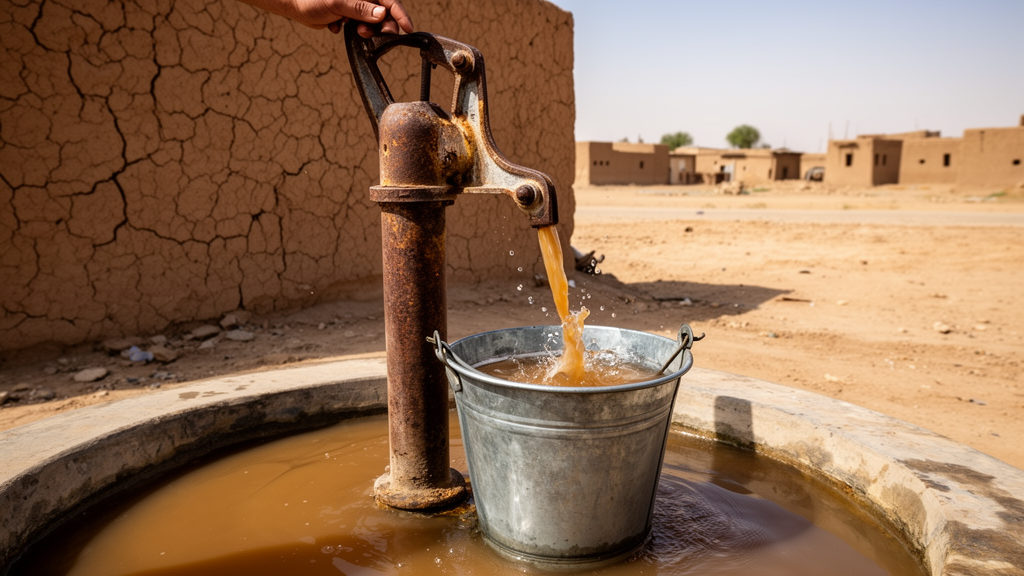
Groundwater across Dalbandin, an arid and mineral-rich district of Balochistan in Pakistan, is contaminated with heavy metals at concentrations far above international drinking water guidelines, according to the first comprehensive hydrochemical and health risk assessment of the area. The study, published in Environmental Monitoring and Assessment, analyzed fifty groundwater samples drawn from inhabited and agricultural zones and found that every sample fell into the "Unsafe" category on a Drinking Water Quality Index, with a mean score of 1,115.7. The researchers measured physicochemical parameters including pH, electrical conductivity and total dissolved solids with portable meters, and determined metal concentrations using atomic absorption spectroscopy.
The suite of analyzed constituents included manganese, cadmium, chromium, copper, lead, sodium, calcium, magnesium, bicarbonate, chloride and sulfate. Lead showed the most severe exceedance, with a mean concentration of 0.16 milligrams per liter, sixteen times the World Health Organization guideline. Cadmium averaged 0.03 milligrams per liter, ten times the limit, while copper averaged 4.39 milligrams per liter, twice the guideline.
To trace where the contamination originates, the team applied Positive Matrix Factorization, a receptor model that statistically decomposes measured concentrations into contributing source profiles. The model resolved four partially separated patterns: an manganese-rich signature, a lead-cadmium-copper-rich pattern, a mixed sulfate and major-ion pattern, and a sodium-chloride-calcium pattern associated with salinity. Principal component analysis and the APCS-MLR receptor technique provided some supporting evidence but were less successful than PMF at distinguishing individual sources, underscoring the value of the integrated modeling approach in geogenically influenced aquifers.
Because Dalbandin sits in a mineral-rich region, the authors frame the contamination as largely geogenic in character, meaning it arises from the natural geology of the area rather than from a single identifiable industrial discharge. The health implications were assessed with a probabilistic model rather than direct epidemiological measurement. Using Monte Carlo simulation, the team estimated hazard indices and total cancer risk under conservative assumptions, including the simplification that all measured total chromium was present as the more toxic hexavalent form.
In every simulated scenario, the modeled values exceeded screening thresholds, with mean hazard indices of 9.74 for adults and 34.08 for children, and mean total cancer risk estimates of 1.12 × 10⁻³ for adults and 7.86 × 10⁻⁴ for children. The authors are careful to note that these figures are model results, not probabilities of disease. A total cancer risk value above 10⁻⁴ is a screening-level signal that warrants further investigation, not a prediction that a given number of residents will develop cancer.
The three-and-a-half-fold difference between children and adults applied to the hazard index but not to the cancer risk estimate, a distinction that reflects how the two metrics are calculated and how exposure assumptions differ between age groups. Beyond drinking water, the study also evaluated suitability for agriculture using an Irrigation Water Quality Index. The integrated design of the study, combining receptor modeling with probabilistic risk assessment, is presented as a template for groundwater management in arid regions where mineral resources influence water chemistry.
By statistically attributing measured concentrations to distinct source patterns and then quantifying modeled exposure risks, the approach gives water managers a clearer picture of both what is in the water and what it might mean for the people drinking it. The authors conclude that the findings indicate potentially significant public health risks that justify confirmatory monitoring and risk-management attention in Dalbandin.
Subject of Research: Hydrochemical contamination and health risk assessment of groundwater in Dalbandin, Balochistan, Pakistan
Article Title: Water quality evaluation in Dalbandin, an arid region of Balochistan: integrated geochemical and health risk assessment
Article References: Faheem, M., Baloch, N., Ali, S., Afridi, M. A., Mir, N., Bibi, M., & Ashraf, S. (2026). Water quality evaluation in Dalbandin, an arid region of Balochistan: integrated geochemical and health risk assessment. Environmental Monitoring and Assessment, 198(11), Article 1254. https://doi.org/10.1007/s10661-026-16113-3
Image Credits: AI Generated
DOI: 10.1007/s10661-026-16113-3
Keywords: groundwater, heavy metals, Dalbandin, Balochistan, water quality, health risk assessment, Positive Matrix Factorization, Monte Carlo simulation, WHO guidelines, arid regions, lead contamination, irrigation water
Cite Scienmag News
Violet Maxwell. (October 27, 2026). Groundwater in Pakistan’s Dalbandin Region Carries Heavy Metals Far Above WHO Limits. Scienmag. https://scienmag.com/groundwater-in-pakistans-dalbandin-region-carries-heavy-metals-far-above-who-limits/
Violet Maxwell. "Groundwater in Pakistan’s Dalbandin Region Carries Heavy Metals Far Above WHO Limits." Scienmag, 27 October 2026, https://scienmag.com/groundwater-in-pakistans-dalbandin-region-carries-heavy-metals-far-above-who-limits/. Accessed 27 October 2026.
Violet Maxwell. "Groundwater in Pakistan’s Dalbandin Region Carries Heavy Metals Far Above WHO Limits." Scienmag. October 27, 2026. https://scienmag.com/groundwater-in-pakistans-dalbandin-region-carries-heavy-metals-far-above-who-limits/


