


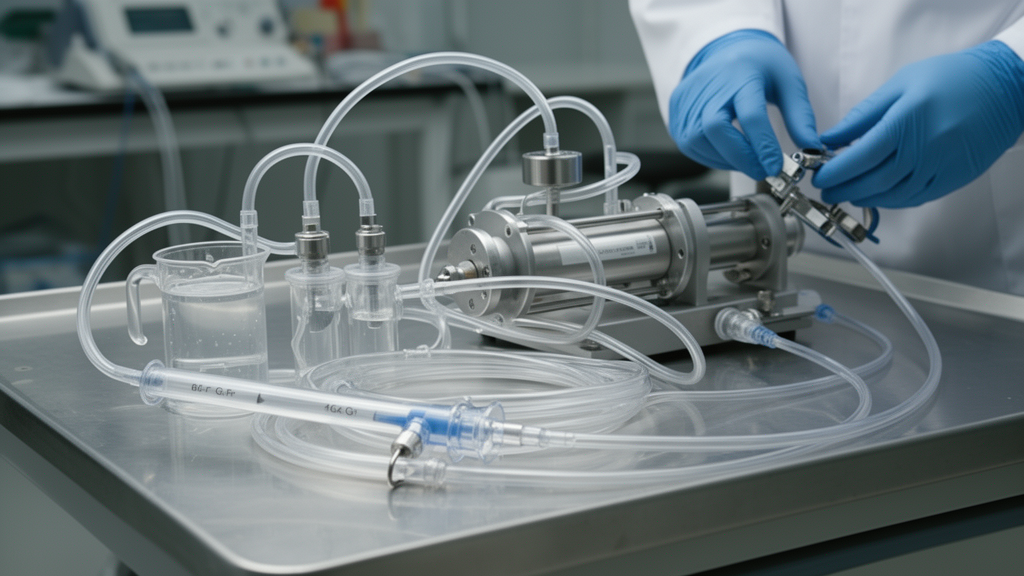
In an in vitro study, researchers compared the hydraulic performance of 14-gauge hemodialysis catheters against an 8-French pediatric arterial cannula in a closed-loop mock cardiopulmonary bypass circuit designed for a 3-kg small dog. Arterial cannulation in such small animals is difficult because vessel diameters may be too narrow for appropriately sized pediatric cannulas, and off-label use of hemodialysis catheters has been reported, but their pressure–flow characteristics under small-dog bypass conditions had remained unclear. The team tested one 8-French pediatric arterial cannula and six 14-gauge hemodialysis catheter specimens.
The catheters included separate side-hole and sealed designs at effective lengths of 25, 32, and 38 mm. A 34% glycerol–water solution by weight, with a viscosity of 2.8 cP at 28°C, served as an approximate Newtonian blood analogue flowing through the circuit. The Stockert S5 pump flow-rate setting was increased from 50 to 350 mL/min.
The researchers prespecified 50–300 mL/min as the primary analysis range, treating the 350 mL/min setting as exploratory. Outlet pressure was recorded 1,000 mm upstream of the test device, while inlet pressure was monitored 300 mm downstream and regulated to 60 mmHg. Six technical runs per condition were conducted using the same physical device and circuit setup.
Within the primary analysis range, outlet pressure reached approximately 136–137 mmHg at 300 mL/min. The mean differences between the 14-gauge specimens and the 8-French cannula ranged from +0.33 to +0.67 mmHg, with 95% confidence intervals spanning −1.33 to +2.15 mmHg. These narrow differences suggest that, at the circuit level, the tested dialysis catheters produced outlet pressures very close to those of the pediatric cannula across the prespecified flow range.
At the exploratory setting of 350 mL/min, outlet pressures were higher for all three side-hole 14-gauge specimens than for the 8-French cannula, indicating that performance differences between device types may emerge at flow rates above the primary analysis range. Catheter design also mattered. At 300 mL/min, outlet pressure was approximately 2–3 mmHg lower for the side-hole specimens than for the sealed specimens across all catheter lengths, a consistent pattern suggesting that side holes reduce resistance in this mock circuit.
The authors emphasized that these findings indicate only small observed circuit-level differences in outlet pressure among the tested devices within this standardized mock small-dog bypass circuit. The results do not establish formal equivalence, device-to-device interchangeability, or clinical validity. As a bench-top evaluation using a glycerol–water blood analogue rather than blood, and a single specimen of the cannula against six catheter specimens, the study's scope is limited to the hydraulic behavior of the devices in the mock circuit.
Clinical performance in living animals, including biocompatibility, insertion feasibility, and outcomes, was not assessed.
Subject of Research: Hydraulic performance of 14-G hemodialysis catheters versus an 8-Fr arterial cannula in a mock 3-kg small-dog cardiopulmonary bypass circuit
Article Title: Hydraulic performance of 14-G hemodialysis catheters versus an 8-Fr arterial cannula in a mock 3-kg small-dog cardiopulmonary bypass circuit
Article References: Wauchi, K., Ikubo, C., Imada, H., Miyata, M., & Tani, K. (2026). Hydraulic performance of 14-G hemodialysis catheters versus an 8-Fr arterial cannula in a mock 3-kg small-dog cardiopulmonary bypass circuit. PLOS One, 21(10), e0361473. https://doi.org/10.1371/journal.pone.0361473
Image Credits: AI Generated
DOI: 10.1371/journal.pone.0361473
Keywords: Hydraulic, performance, hemodialysis, catheters, versus, arterial, cannula, mock, small-dog, cardiopulmonary, bypass, circuit
Cite Scienmag News
William Thompson. (October 27, 2026). Research report: Hydraulic performance of 14-G hemodialysis catheters versus an 8-Fr arterial cannula in a mock 3-kg small-dog cardiopulmonary bypass circuit. Scienmag. https://scienmag.com/research-report-hydraulic-performance-of-14-g-hemodialysis-catheters-versus-an-8-fr-arterial-cannula-in-a-mock-3-kg-small-dog-cardiopulmonary-bypass-circuit/
William Thompson. "Research report: Hydraulic performance of 14-G hemodialysis catheters versus an 8-Fr arterial cannula in a mock 3-kg small-dog cardiopulmonary bypass circuit." Scienmag, 27 October 2026, https://scienmag.com/research-report-hydraulic-performance-of-14-g-hemodialysis-catheters-versus-an-8-fr-arterial-cannula-in-a-mock-3-kg-small-dog-cardiopulmonary-bypass-circuit/. Accessed 27 October 2026.
William Thompson. "Research report: Hydraulic performance of 14-G hemodialysis catheters versus an 8-Fr arterial cannula in a mock 3-kg small-dog cardiopulmonary bypass circuit." Scienmag. October 27, 2026. https://scienmag.com/research-report-hydraulic-performance-of-14-g-hemodialysis-catheters-versus-an-8-fr-arterial-cannula-in-a-mock-3-kg-small-dog-cardiopulmonary-bypass-circuit/


