


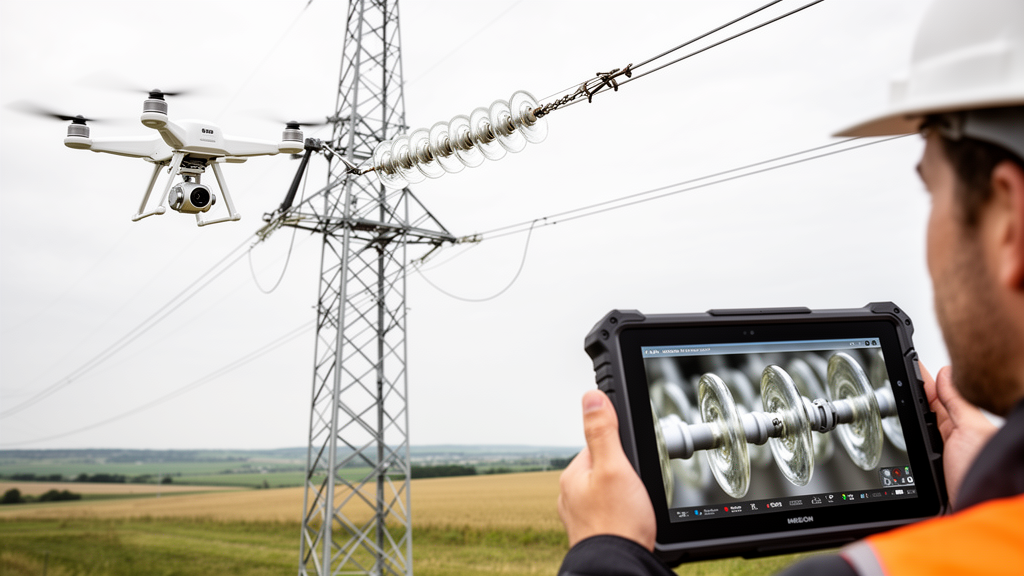
Engineers at the Energy Development Research Institute of China Southern Power Grid have built an artificial intelligence model that detects defective insulators on high-voltage transmission lines with an average precision of 99.2 percent, while remaining light enough to run directly on the limited computing hardware of an inspection drone. The model, described in a peer-reviewed research article published in PLOS ONE, combines a three-branch attention mechanism with an enhanced multi-scale feature fusion network built on the YOLOv8 object detection architecture. When benchmarked on an NVIDIA Jetson Xavier NX edge device using TensorRT FP16 semi-precision acceleration, it processed images at 46.9 frames per second with an inference delay of 21.3 milliseconds, meeting the real-time threshold of at least 30 frames per second that the authors identify for drone inspection. Insulators are the ceramic or glass components that keep current-carrying conductors electrically isolated from towers and the ground while also bearing the mechanical load of the line.
The stakes of this inspection task are considerable. The authors note that a large proportion of power grid safety incidents trace back to insulator faults, and because insulators spend their service life outdoors, they are degraded by extreme heat and cold, alternating humidity, wind-blown sand and air pollution, all of which erode the physical and electrical properties of the insulating material. Regular inspection is therefore a central task for grid operators, and drone-based imaging has increasingly made up for the deficiencies of traditional manual patrols in cost and efficiency. The central technical challenge the researchers set out to solve is a familiar tension in edge artificial intelligence: lightweight detection networks fit within the modest compute budget of a drone, but that compression tends to blunt accuracy, especially for small defect targets that occupy only a few pixels of an aerial photograph. The team’s answer operates on two fronts, one algorithmic and one architectural.
First, a Three-Branch Attention Mechanism, or TBAM, is embedded in both the backbone feature extraction network and the fusion network, teaching the model to suppress irrelevant background clutter and concentrate on defect surfaces. TBAM works by running three parallel branches over the input feature tensor. The first branch rotates the tensor along the height dimension and performs cross-channel information interaction; the second does the same along the width dimension; the third applies a Z-Pool operation, which concatenates average pooling and maximum pooling along the channel axis, reducing the channel dimension to two before learning spatial attention. The outputs of the three branches are then averaged together. According to the authors, this parallel design integrates channel and spatial attention at a small parameter cost, and unlike sequential modules such as CBAM, it avoids filtering out the weak feature responses of small defects in shallow network layers.
Second, an Enhanced Multi-Scale Feature Fusion Network, or EMSFFN, reworks the neck of YOLOv8 to preserve fine spatial detail that standard downsampling destroys. Because insulator defects photographed from a distance occupy a small portion of the overall image, the researchers added two shallow feature maps at 160 by 160 and 320 by 320 resolution into the feature pyramid structure. The 80 by 80 feature map is upsampled and concatenated with the 160 by 160 map, which is then upsampled again and merged with the 320 by 320 map. On the bottom-up path, a new 160 by 160 prediction head dedicated to small targets is appended, with a TBAM module placed just before it. In ablation tests, adding an additional 320 by 320 head roughly doubled the computational cost without improving accuracy, so the final model retains only the 160 by 160 head. The team also replaced the standard CIoU bounding-box regression loss with a new function called EDIoU, which introduces separate penalty terms for the top-left and bottom-right endpoints of the predicted box and simplifies the aspect-ratio penalty used in CIoU and EIoU.
Under identical training and test conditions, EDIoU raised average precision by 0.6 percentage points, reduced localization error by 0.7 pixels, and cut the number of training rounds needed for convergence from 180 to 160. The authors report that the improved loss is more sensitive to the positional detail of defect edges, which matters when defects are small or visually blurred. Training data came from drone-captured aerial images collected by China Southern Power Grid, with backgrounds spanning fields, mountains and forests, skies and buildings. The original set of 3,200 images was badly imbalanced, containing roughly 2,100 normal insulators but only about 400 self-explosion defects and 350 each of breakage and flashover defects. Geometric transformation, random rotation and noise augmentation were applied only to the training split, expanding the dataset to 6,400 images and lifting the minority defect classes to 1,400 or 1,500 samples each.
The evaluation protocol was designed to guard against inflated results. The original images were split 8:1:1 into training, validation and test sets, stratified by shooting time and transmission line, and enhanced images derived from the same original were always kept in the same subset to prevent data leakage. Five-fold cross-validation within the training set produced average precision values of 98.6, 98.8, 98.7, 98.5 and 98.9 percent across the folds, indicating stable performance under different data splits. A separate test on transmission lines never seen during training yielded an average precision of 98.5 percent, a mean average precision of 97.8 percent and a recall of 97.6 percent, and a cross-dataset test using an independent insulator image collection without any fine-tuning also held accuracy in a high range. Each experimental group was run five times, and paired t-tests comparing the benchmark and improved models returned a p-value below 0.01; the improved model’s mean average precision of 98.7 percent carried a standard deviation of 0.12 percent.
Against competing detectors trained on the same data, the combined model led on accuracy and efficiency alike. It outperformed YOLOv7, YOLOv8, YOLOv9, DETR and Faster R-CNN on average precision, mean average precision, parameter count and computational load, reaching 4.12 million parameters and 17.7 gigacalculations, figures the authors describe as the lowest among the compared models. Against newer lightweight architectures, it exceeded YOLOv10-N by about 1.5 percentage points and YOLOv11-N by about 1.2 points in mean average precision while keeping parameters and computation at the lowest level, and relative to RT-DETR-R18 it improved accuracy by roughly 1.9 points while cutting parameters by 33.7 percent and computation by 20.9 percent. On the Jetson Xavier NX, its delay was 1.6 milliseconds higher than YOLOv10-N and 1.3 milliseconds higher than YOLOv11-N, but with substantially better detection accuracy, and compared with RT-DETR-R18 it reduced inference delay by 46.48 percent and power consumption by 32.5 percent.
Performance varied sensibly across defect categories and target scales. Normal insulators were easiest to recognize, with 99.5 percent average precision and 99.3 percent recall, followed by self-explosion defects at 99.3 and 99.0 percent; damaged and flashover defects, which are smaller and more often obscured by complex surroundings, reached 98.9 and 98.8 percent average precision with recalls of 98.5 and 98.3 percent. On small targets specifically, the improvements proved decisive: the baseline model without the small-target prediction head scored 93.5 percent average precision and 92.8 percent recall on small objects, while the final model reached 98.4 and 98.0 percent. For medium targets the final model achieved 99.1 percent average precision and 98.8 percent recall, and for large targets 99.4 and 99.2 percent.
The attention mechanism comparisons also yielded instructive negative results. When SE and CBAM modules were integrated into the YOLOv8-EMSFFN network, detection performance declined rather than improved, with CBAM showing the greatest accuracy loss and the highest computational overhead. The authors attribute this to CBAM’s sequential design, in which the spatial attention branch can filter out small defect targets whose pixel share is very low in shallow feature layers, while SE models only channel dependencies and offers no spatial positioning. TBAM, by contrast, retains information in both channel and spatial dimensions through its parallel three-branch structure and Z-Pool operation, extracting features precisely in the areas where defects are located. In the fusion-position experiments, adding TBAM at both the backbone end and the fusion network produced the best result, with mean average precision rising from 94.6 percent without attention to 98.7 percent with both placements.
The authors state that future work will focus on introducing knowledge distillation technology to further reduce the computational and storage overhead of the model while maintaining performance. The dataset used in the study has been deposited in the public Zenodo repository with a permanent DOI, allowing readers to verify, reproduce and extend the results. For grid operators weighing the trade-offs of drone-based inspection, the study presents a measured case that a carefully restructured lightweight detector can approach the accuracy of far heavier models while fitting within the power, latency and memory constraints of an edge device carried aloft on an unmanned aerial vehicle.
Subject of Research: Lightweight deep learning detection of transmission line insulator defects on drone edge devices
Article Title: Multi-scale feature fusion network optimization and edge intelligent detection for transmission line insulator
Article References: Yang, C., & Ma, Y. (2026). Multi-scale feature fusion network optimization and edge intelligent detection for transmission line insulator. PLOS One, 21(10), e0361403. https://doi.org/10.1371/journal.pone.0361403
Image Credits: AI Generated
DOI: 10.1371/journal.pone.0361403
Keywords: insulator defect detection, transmission lines, YOLOv8, attention mechanism, multi-scale feature fusion, edge computing, unmanned aerial vehicles, power grid inspection, deep learning, object detection, TensorRT, Jetson Xavier NX
Cite Scienmag News
Marilyn Langley. (October 27, 2026). AI Model Spots Tiny Power Line Insulator Defects From Drone Cameras in Real Time. Scienmag. https://scienmag.com/ai-model-spots-tiny-power-line-insulator-defects-from-drone-cameras-in-real-time/
Marilyn Langley. "AI Model Spots Tiny Power Line Insulator Defects From Drone Cameras in Real Time." Scienmag, 27 October 2026, https://scienmag.com/ai-model-spots-tiny-power-line-insulator-defects-from-drone-cameras-in-real-time/. Accessed 27 October 2026.
Marilyn Langley. "AI Model Spots Tiny Power Line Insulator Defects From Drone Cameras in Real Time." Scienmag. October 27, 2026. https://scienmag.com/ai-model-spots-tiny-power-line-insulator-defects-from-drone-cameras-in-real-time/


