


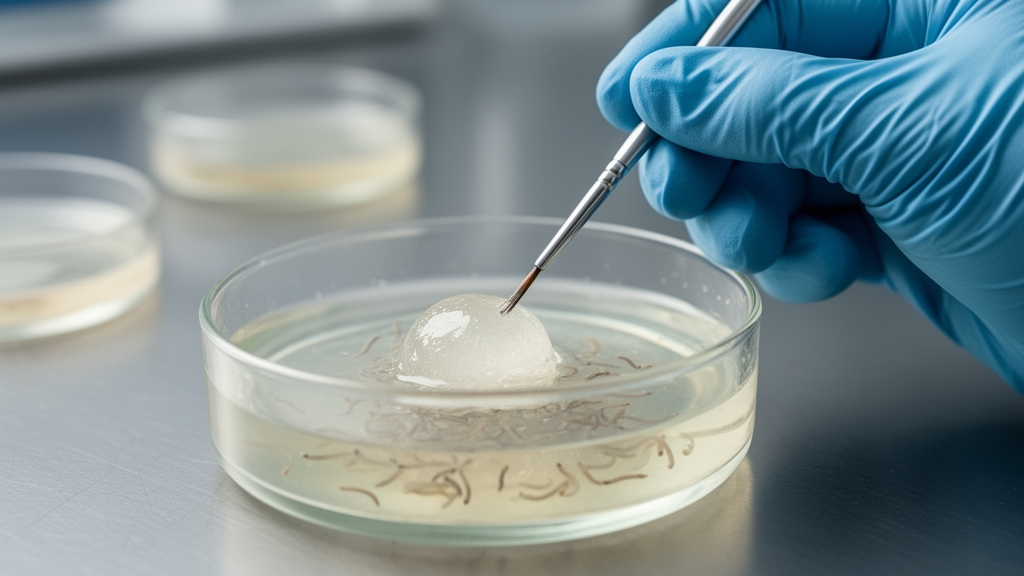
Maggot therapy uses necrophagous fly larvae to remove necrotic tissue from wounds, and it depends on strict aseptic protocols to ensure that larvae delivered to patients are free of microbial contamination. A crucial step in preparing therapeutic larvae is the dissociation of egg masses, because blowflies lay their eggs in tightly glued clusters that must be separated before disinfection can be uniform. Chemical agents used for this purpose, however, can cause sublethal effects.
A new laboratory study has examined how three disrupting compounds affect the post-embryonic development of two blowfly species, Chrysomya megacephala and Chrysomya putoria, and the results point to a clear winner: 0.5% papain. The research, conducted by Mariana dos Passos Nunes and colleagues, exposed egg masses of both species for ten minutes to one of three treatments: papain at 0.5%, sodium hydroxide at 1%, or potassium hydroxide at 2%, with distilled water as the control. After hatching, each replicate received 40 larvae, and the study monitored 640 larvae per species across the treatment groups.
The parameters tracked included viability, the duration of each developmental stage, the rate at which larvae ceased feeding, the weight of third-instar larvae, sex ratio, and the morphological normality of adults. Data normality was assessed with the Shapiro–Wilk test, comparisons between treatments relied on nonparametric Kruskal–Wallis tests followed by Dunn’s post hoc tests, and categorical variables were analyzed using chi-square tests and Fisher’s exact test, with significance set at p < 0.05.
The most striking feature of the results is that the two species responded differently to the same chemical stress. In Chrysomya megacephala, viability ranged from 57% to 70%, and no treatment significantly reduced viability or changed the pupation rate among the groups. Sodium hydroxide did leave a measurable mark on growth: larvae exposed to NaOH weighed significantly less as third instars, at 67.5 mg, compared with 69.9 mg in the control group.
Papain-treated larvae weighed 68.5 mg on average, a value that did not differ significantly from the control, indicating that the enzyme preserved growth essentially intact. Chrysomya putoria showed greater sensitivity to the alkaline compounds. Treatment with either sodium hydroxide or potassium hydroxide reduced total viability to 68%, a marked drop compared with the 88% to 91% observed in the control and papain groups.
The alkaline treatments also delayed the feeding cessation rate, meaning larvae took longer to stop feeding in preparation for pupation. In both species, papain preserved larval weight gain and maintained developmental stability. The total duration of the life cycle, which ranged from 10 to 11 days, and the morphological normality of the adults that emerged were not significantly affected by any treatment, meaning that even where viability was reduced, surviving larvae completed normal development.
Taken together, the findings identify Chrysomya megacephala as the more physiologically resilient of the two species when faced with chemical stress during early life stages, while Chrysomya putoria suffered a viability penalty of roughly 20 percentage points under the alkaline agents. Among the agents tested, 0.5% papain emerged as the most promising option for maggot therapy protocols, as it combines efficient dissociation of egg masses with the maintenance of larval biological quality, offering the best balance between the practical need to separate eggs for disinfection and the biological need to rear vigorous, developmentally normal larvae.
Because the work was carried out under controlled laboratory conditions with a defined set of agents and exposure times, the authors frame papain as the leading candidate among the compounds tested rather than a universally validated standard. Even so, the species-specific pattern they documented is a useful caution for laboratories rearing therapeutic larvae: the same dissolving agent can leave one blowfly species largely unscathed while measurably reducing viability in a close relative.
Subject of Research: Effects of chemical egg-mass dissolving agents on the development of blowfly larvae used in maggot therapy
Article Title: Effects of egg-mass-dissolving substances on the post-embryonic development of Chrysomya megacephala (Fabricius, 1794) and Chrysomya putoria (Wiedemann, 1830) (Diptera: Calliphoridae): Implications for maggot therapy
Article References: Nunes, M. D. P., Lima, J. P. D. O., Costa, J. D. S., Lessa, C. S. S., Filho, R. G. D. S., Alencar, J., & Aguiar, V. M. (2026). Effects of egg-mass-dissolving substances on the post-embryonic development of Chrysomya megacephala (Fabricius, 1794) and Chrysomya putoria (Wiedemann, 1830) (Diptera: Calliphoridae): Implications for maggot therapy. PLOS One, 21(10), e0361039. https://doi.org/10.1371/journal.pone.0361039
Image Credits: AI Generated
DOI: 10.1371/journal.pone.0361039
Keywords: maggot therapy, Chrysomya megacephala, Chrysomya putoria, papain, egg mass dissociation, larval development, Calliphoridae, viability, sodium hydroxide, potassium hydroxide, aseptic protocols, larval therapy
Cite Scienmag News
Morgan Morrow. (October 27, 2026). Papain Emerges as Gentlest Egg-Mass Dissolver for Maggot Therapy Larvae. Scienmag. https://scienmag.com/papain-emerges-as-gentlest-egg-mass-dissolver-for-maggot-therapy-larvae/
Morgan Morrow. "Papain Emerges as Gentlest Egg-Mass Dissolver for Maggot Therapy Larvae." Scienmag, 27 October 2026, https://scienmag.com/papain-emerges-as-gentlest-egg-mass-dissolver-for-maggot-therapy-larvae/. Accessed 27 October 2026.
Morgan Morrow. "Papain Emerges as Gentlest Egg-Mass Dissolver for Maggot Therapy Larvae." Scienmag. October 27, 2026. https://scienmag.com/papain-emerges-as-gentlest-egg-mass-dissolver-for-maggot-therapy-larvae/


