


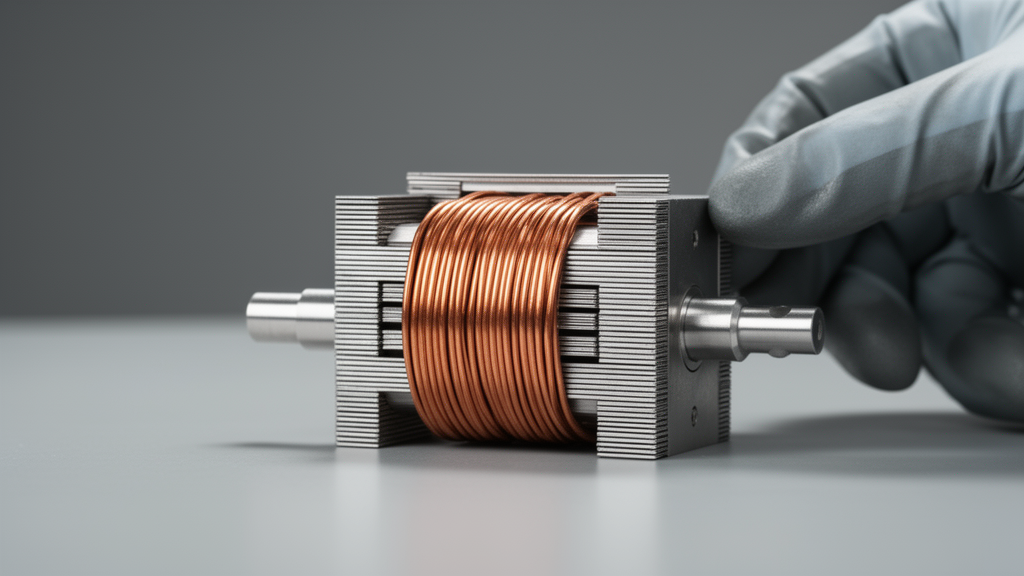
Linear oscillation actuators drive the compressors at the heart of modern refrigeration systems, and their performance depends heavily on how the stator core is built. A new study proposes a hybrid lamination strategy that embeds silicon steel into fan-shaped slots of soft magnetic composite (SMC) material, aiming to combine the high permeability of silicon steel with the structural flexibility of SMC.
Traditional tubular permanent magnet linear oscillation actuators (TPMLOAs) rely on radial lamination of silicon steel, an approach hampered by low stacking coefficients and difficult assembly. The hybrid design targets a stacking coefficient near unity, meaning the magnetic material fills the available space far more efficiently.
The researchers, Hongbin Zhang, Zhan Shen and Zhike Xu, established a geometric model to derive the material proportions, then used three-dimensional finite element analysis to examine how the quantity of silicon steel affects electromagnetic thrust, iron losses and efficiency.
The simulations showed that the hybrid lamination method effectively suppresses magnetic saturation during load operation. Magnetic saturation is most severe at the maximum mover displacement, precisely where compressors need the strongest force.
Compared with traditional radial lamination, the proposed design increased electromagnetic thrust by 26 percent at maximum mover displacement. At the negative mover position, thrust performance was comparable between the two designs.
That boost at maximum displacement is particularly valuable for compressor applications, where high thrust at the extremes of the stroke is critical to operation.
The approach is not without trade-offs. Including SMC increases eddy current losses at high frequencies, a cost the authors weigh against other benefits.
Those benefits are substantial in practice: the hybrid method significantly simplifies manufacturing and reduces assembly errors, addressing two of the main pain points of radial silicon steel lamination.
The team concludes that the hybrid lamination strategy offers a feasible, high-performance route to advanced linear oscillation actuators for compressor applications, though the findings rest on geometric modeling and finite element simulation rather than hardware testing.
Subject of Research: Hybrid lamination of silicon steel and soft magnetic composite in tubular permanent magnet linear oscillation actuators
Article Title: A hybrid lamination strategy for enhanced performance in linear oscillation actuators
Article References: Zhang, H., Shen, Z., & Xu, Z. (2026). A hybrid lamination strategy for enhanced performance in linear oscillation actuators. PLOS One, 21(10), e0360739. https://doi.org/10.1371/journal.pone.0360739
Image Credits: AI Generated
DOI: 10.1371/journal.pone.0360739
Keywords: linear oscillation actuator, soft magnetic composite, silicon steel, electromagnetic thrust, magnetic saturation, finite element analysis, compressor, refrigeration, stator core, iron losses, hybrid, lamination
Cite Scienmag News
Janet Harlan. (October 27, 2026). Hybrid lamination boosts thrust in linear oscillation actuators. Scienmag. https://scienmag.com/hybrid-lamination-boosts-thrust-in-linear-oscillation-actuators/
Janet Harlan. "Hybrid lamination boosts thrust in linear oscillation actuators." Scienmag, 27 October 2026, https://scienmag.com/hybrid-lamination-boosts-thrust-in-linear-oscillation-actuators/. Accessed 27 October 2026.
Janet Harlan. "Hybrid lamination boosts thrust in linear oscillation actuators." Scienmag. October 27, 2026. https://scienmag.com/hybrid-lamination-boosts-thrust-in-linear-oscillation-actuators/


