

Tuesday, October 27, 2026
Science
No Result
View All Result
  • Login
  • HOME
  • SCIENCE NEWS
  • CONTACT US
  • HOME
  • SCIENCE NEWS
  • CONTACT US
No Result
View All Result
Scienmag
No Result
View All Result
Home Science News

Resilience Links Performance Anxiety to Lower Well-Being in Music Students

October 27, 2026
in Science News
Glenn Wilkins
By Glenn Wilkins Scienmag Editorial Profile - Clinical Psychology
Reading Time: 3 mins read
0
Resilience Links Performance Anxiety to Lower Well-Being in Music Students

Resilience Links Performance Anxiety to Lower Well-Being in Music Students

65
SHARES
587
VIEWS
Share on FacebookShare on Twitter
ADVERTISEMENT

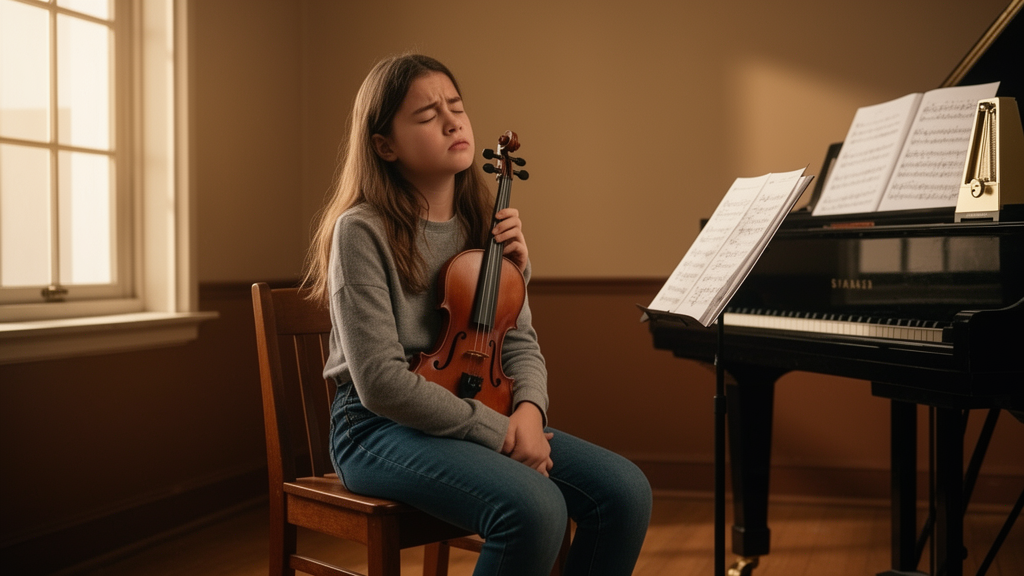
Music performance students spend years training under intense evaluation, playing and singing for juries, teachers, and audiences whose judgments can shape their careers. A new cross-sectional study from China examines how that pressure relates to how these students feel about their lives, and it finds that performance anxiety is negatively associated with subjective well-being. The research, conducted by Xiong Gao and Pingting Li of Zhangjiajie College and published in the journal Frontiers in Psychology, also identifies psychological resilience as a statistical pathway that accounts for part of that association.

The survey included 946 university music performance students. Because the design was cross-sectional, capturing a single moment in time, the results describe associations rather than proven causal effects. The researchers used two statistical modeling approaches from the PROCESS toolkit: Model 4, which tested whether resilience indirectly linked anxiety and well-being, and Model 72, which tested how two forms of perfectionism moderated the relationships among the three variables.

The core finding was straightforward. Students who reported higher performance anxiety reported lower subjective well-being. When resilience was added to the model, a significant indirect association emerged: performance anxiety was linked to lower resilience, which in turn was linked to lower well-being.

In other words, resilience statistically accounted for part of the connection between stage fright and life satisfaction, though the study cannot establish that anxiety actually erodes resilience over time. The perfectionism analysis added a layer of nuance. In this study, each dimension separately moderated the association between performance anxiety and resilience, meaning the strength of that link depended on a student's perfectionism profile.

What the two dimensions did not do, at least for that first link, was interact. The three-way interaction among performance anxiety, adaptive perfectionism, and maladaptive perfectionism on the anxiety-resilience association was not significant. Whatever joint patterns the two perfectionism dimensions produce, they did not show up in how anxiety related to resilience in this sample.

The picture changed for the second focal association. Both perfectionism dimensions also moderated the positive association between resilience and subjective well-being, and here the three-way interaction was significant and negative. That means the combined levels of adaptive and maladaptive perfectionism jointly shaped how strongly resilience translated into well-being, a conditional pattern that did not appear anywhere else in the models.

Importantly, the researchers report that the resilience-well-being association remained positive across all examined combinations of perfectionism. Higher resilience went with higher well-being regardless of where a student fell on the perfectionism dimensions; perfectionism changed the strength of that association, not its direction. The authors conclude that adaptive and maladaptive perfectionism show distinct separate and joint conditional patterns across the two focal associations examined in the study.

The findings arrive with clear limitations. The sample consisted of music performance students in China, and the data were self-reported at one point in time, so the results may not generalize to other populations, cultures, or conservatory systems, and no causal claims can be drawn. The article's final formatted version was still forthcoming at the time of the abstract's release, with the study received in August 2026 and accepted in October 2026.

Even so, the work offers a measured contribution to positive psychology: it maps how anxiety, resilience, and two faces of perfectionism are wired together in a high-stakes training environment, suggesting that resilience may be a meaningful statistical link between the pressure of performance and how students experience their lives.

Subject of Research: Associations among performance anxiety, psychological resilience, perfectionism, and subjective well-being in university music performance students

Article Title: Exploring the relationship between performance anxiety and subjective well-being in music performance students: the role of psychological resilience and perfectionism

Article References: Gao, X., & Li, P. (2026). Exploring the relationship between performance anxiety and subjective well-being in music performance students: the role of psychological resilience and perfectionism. Frontiers in Psychology, 17, Article 1967733. https://doi.org/10.3389/fpsyg.2026.1967733

Image Credits: AI Generated

DOI: 10.3389/fpsyg.2026.1967733

Keywords: performance anxiety, subjective well-being, psychological resilience, adaptive perfectionism, maladaptive perfectionism, music students, cross-sectional study, moderation analysis, positive psychology, China, Exploring, relationship

Cite Scienmag News

Glenn Wilkins. (October 27, 2026). Resilience Links Performance Anxiety to Lower Well-Being in Music Students. Scienmag. https://scienmag.com/resilience-links-performance-anxiety-to-lower-well-being-in-music-students/

Glenn Wilkins. "Resilience Links Performance Anxiety to Lower Well-Being in Music Students." Scienmag, 27 October 2026, https://scienmag.com/resilience-links-performance-anxiety-to-lower-well-being-in-music-students/. Accessed 27 October 2026.

Glenn Wilkins. "Resilience Links Performance Anxiety to Lower Well-Being in Music Students." Scienmag. October 27, 2026. https://scienmag.com/resilience-links-performance-anxiety-to-lower-well-being-in-music-students/


Tags: adaptive perfectionismChinacross-sectional studycross-sectional study on music studentsExploringimpact of evaluation pressure on studentsmaladaptive perfectionismmental health interventions for performance studentsmoderation analysismoderation effects of perfectionismmusic performance student well-beingmusic studentsperfectionism and mental health in musiciansperformance anxietyperformance anxiety in musiciansperformance pressure and student mental healthpositive psychologypsychological factors affecting music educationpsychological resiliencepsychological resilience in studentsRelationshipresilience as a buffer for anxietysubjective well-beingsubjective well-being and performance anxiety
Share26Tweet16
Previous Post

Two Insect-Killing Fungi Recorded in Switzerland for the First Time

Next Post

Research report: The helochelydrid turtle Helochelydra nopcsai from the Early Cretaceous (late Barremian – early Aptian) fissure fills of Balve, North Rhine-Westphalia, Germany, including a large sample of granicones

Related Posts

Claudin-18 Protein Linked to Poorer Survival in Colorectal Cancer
Science News

Claudin-18 Protein Linked to Poorer Survival in Colorectal Cancer

October 27, 2026
Repetitive DNA Expansion Disrupts Gene Density Uniformity Across Vertebrate Chromosomes
Science News

Repetitive DNA Expansion Disrupts Gene Density Uniformity Across Vertebrate Chromosomes

October 27, 2026
Hybrid lamination boosts thrust in linear oscillation actuators
Science News

Hybrid lamination boosts thrust in linear oscillation actuators

October 27, 2026
FloBuzz Delivers Automated Electric Shocks to Free-Flying Bees
Science News

FloBuzz Delivers Automated Electric Shocks to Free-Flying Bees

October 27, 2026
Research report: The helochelydrid turtle Helochelydra nopcsai from the Early Cretaceous (late Barremian – early Aptian) fissure fills of Balve, North Rhine-Westphalia, Germany, including a large sample of granicones
Science News

Research report: The helochelydrid turtle Helochelydra nopcsai from the Early Cretaceous (late Barremian – early Aptian) fissure fills of Balve, North Rhine-Westphalia, Germany, including a large sample of granicones

October 27, 2026
Two Insect-Killing Fungi Recorded in Switzerland for the First Time
Biology

Two Insect-Killing Fungi Recorded in Switzerland for the First Time

October 27, 2026
Next Post
Research report: The helochelydrid turtle Helochelydra nopcsai from the Early Cretaceous (late Barremian – early Aptian) fissure fills of Balve, North Rhine-Westphalia, Germany, including a large sample of granicones

Research report: The helochelydrid turtle Helochelydra nopcsai from the Early Cretaceous (late Barremian – early Aptian) fissure fills of Balve, North Rhine-Westphalia, Germany, including a large sample of granicones

  • Mothers who receive childcare support from maternal grandparents show more optimized

    Mothers who receive childcare support from maternal grandparents show more parental warmth, finds NTU Singapore study

    27656 shares
    Share 11059 Tweet 6912
  • University of Seville Breaks 120-Year-Old Mystery, Revises a Key Einstein Concept

    1061 shares
    Share 424 Tweet 265
  • Bee body mass, pathogens and local climate influence heat tolerance

    682 shares
    Share 273 Tweet 171
  • Researchers record first-ever images and data of a shark experiencing a boat strike

    546 shares
    Share 218 Tweet 137
  • Groundbreaking Clinical Trial Reveals Lubiprostone Enhances Kidney Function

    531 shares
    Share 212 Tweet 133
Science

Embark on a thrilling journey of discovery with Scienmag.com—your ultimate source for cutting-edge breakthroughs. Immerse yourself in a world where curiosity knows no limits and tomorrow’s possibilities become today’s reality!

RECENT NEWS

  • Repetitive DNA Expansion Disrupts Gene Density Uniformity Across Vertebrate Chromosomes
  • Claudin-18 Protein Linked to Poorer Survival in Colorectal Cancer
  • FloBuzz Delivers Automated Electric Shocks to Free-Flying Bees
  • Hybrid lamination boosts thrust in linear oscillation actuators

Categories

  • Agriculture
  • Anthropology
  • Archaeology
  • Athmospheric
  • Biology
  • Biotechnology
  • Blog
  • Bussines
  • Cancer
  • Chemistry
  • Climate
  • Earth Science
  • Editorial Policy
  • Marine
  • Mathematics
  • Medicine
  • Pediatry
  • Policy
  • Psychology & Psychiatry
  • Science Education
  • Science News
  • Social Science
  • Space
  • Technology and Engineering

Subscribe to Blog via Email

Enter your email address to subscribe to this blog and receive notifications of new posts by email.

Join 5,151 other subscribers

© 2025 Scienmag - Science Magazine

Welcome Back!

Login to your account below

Forgotten Password?

Retrieve your password

Please enter your username or email address to reset your password.

Log In
No Result
View All Result
  • HOME
  • SCIENCE NEWS
  • CONTACT US

© 2025 Scienmag - Science Magazine

Discover more from Science

Subscribe now to keep reading and get access to the full archive.

Continue reading