


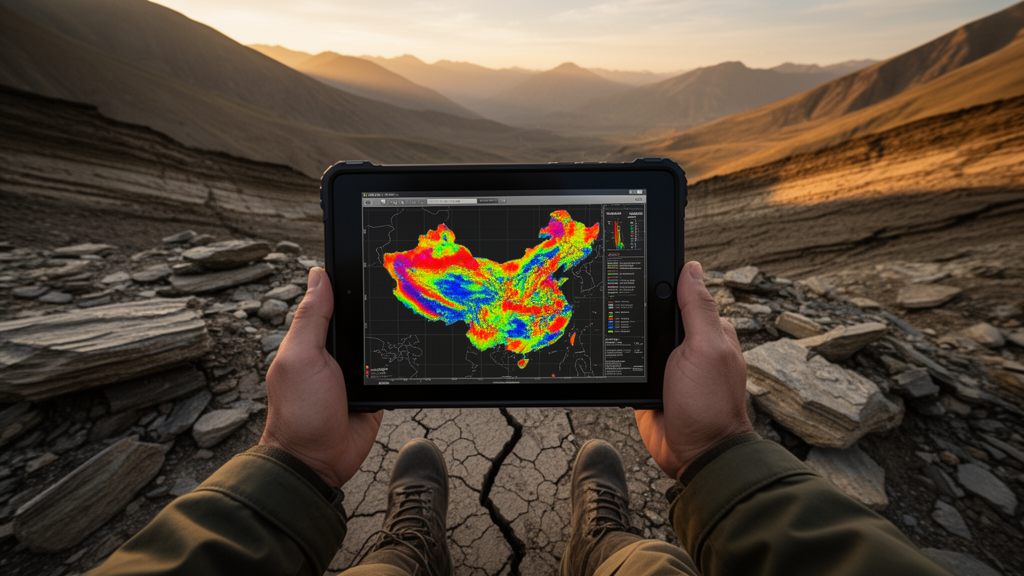
A new analysis of more than five decades of seismic records now shows that two key statistical measures of earthquake behavior vary systematically across the country's tectonic regions, and that underground heat appears to shape them in measurable ways. The study, published in Scientific Reports, draws on the Chinese mainland earthquake catalog spanning 1970 to 2025. The researchers divided the catalog into 20 seismic belts and, for each one, estimated the completeness magnitude, the threshold below which the record of small earthquakes is too sparse to be trustworthy.
Only events above that threshold entered the analysis. Two quantities took center stage. The first is the b-value, which describes the relative abundance of small versus large earthquakes in a region.
The second is the spatial fractal dimension, Dc, which captures how earthquake locations cluster in space. The team calculated both before and after applying nearest-neighbor distance declustering, a technique that removes aftershocks from the catalog so that the underlying background seismicity can be examined on its own. Declustering left a clear statistical signature.
Removing aftershocks raised the average fractal dimension from 1.30 to 1.65, while lowering both the a-value, a measure of overall seismic productivity, and the b-value. In physical terms, aftershocks fill in the gaps around mainshocks, making earthquake locations look more tightly clustered; once they are stripped away, the remaining events spread more diffusely, and the proportion of small events drops. The most striking finding is that the relationship between the b-value and the fractal dimension is not universal but regional.
In the Tibetan seismic region the two measures are negatively correlated, meaning areas with more small earthquakes relative to large ones tend to have more clustered seismicity. In the South China and Xinjiang seismic regions the correlation flips to positive, while in North China it is weakly negative. Any hazard model that assumes a single global relationship between these parameters, the results imply, would misrepresent at least some parts of the mainland.
Heat flow emerged as a consistent physical control on the b-value. Whether before or after declustering, regions with higher heat flow showed higher b-values. The authors interpret this through thermal weakening: hotter crust promotes microcracking, which favors a larger proportion of small events and thus raises the b-value.
The same heat also appears to facilitate strain localization along major faults, concentrating deformation into narrower zones, which lowers the fractal dimension. Consistent with this interpretation, the Dc-value was negatively correlated with heat flow before declustering, though that correlation disappeared once aftershocks were removed. The relationship between fractal dimension and the maximum shear strain rate told a different story depending on tectonic regime.
In the eastern, extensional regions of the mainland, the correlation was positive; in the western, compressional regions it was negative. The researchers attribute this contrast to differing mechanisms of strain energy partitioning, with extensional and compressional settings distributing accumulated tectonic energy in distinct ways. By quantifying how thermal state, strain rate, and tectonic province jointly govern the complexity of seismicity, the study offers new criteria for seismic hazard assessment.
Still, the message is clear: the statistical texture of earthquake occurrence in the Chinese mainland is not one pattern but many, each imprinted by the deep geophysical conditions of its tectonic home.
Subject of Research: Fractal dimension and b-value of seismicity across 20 seismic belts in the Chinese mainland
Article Title: Tectonic regionality and geophysical controls of the fractal dimension and b-value of seismicity in the Chinese mainland
Article References: Bi, J., Li, Y., & Pan, Y. (2026). Tectonic regionality and geophysical controls of the fractal dimension and b-value of seismicity in the Chinese mainland. Scientific Reports. https://doi.org/10.1038/s41598-026-77154-9
Image Credits: AI Generated
DOI: 10.1038/s41598-026-77154-9
Keywords: seismicity, b-value, fractal dimension, declustering, heat flow, shear strain rate, Chinese mainland, tectonic regions, aftershocks, seismic hazard assessment, Tectonic, regionality
Cite Scienmag News
Denise Maddox. (October 27, 2026). Fractal Fingerprints of Chinese Mainland Seismicity Reveal Deep Tectonic Controls. Scienmag. https://scienmag.com/fractal-fingerprints-of-chinese-mainland-seismicity-reveal-deep-tectonic-controls/
Denise Maddox. "Fractal Fingerprints of Chinese Mainland Seismicity Reveal Deep Tectonic Controls." Scienmag, 27 October 2026, https://scienmag.com/fractal-fingerprints-of-chinese-mainland-seismicity-reveal-deep-tectonic-controls/. Accessed 27 October 2026.
Denise Maddox. "Fractal Fingerprints of Chinese Mainland Seismicity Reveal Deep Tectonic Controls." Scienmag. October 27, 2026. https://scienmag.com/fractal-fingerprints-of-chinese-mainland-seismicity-reveal-deep-tectonic-controls/


