


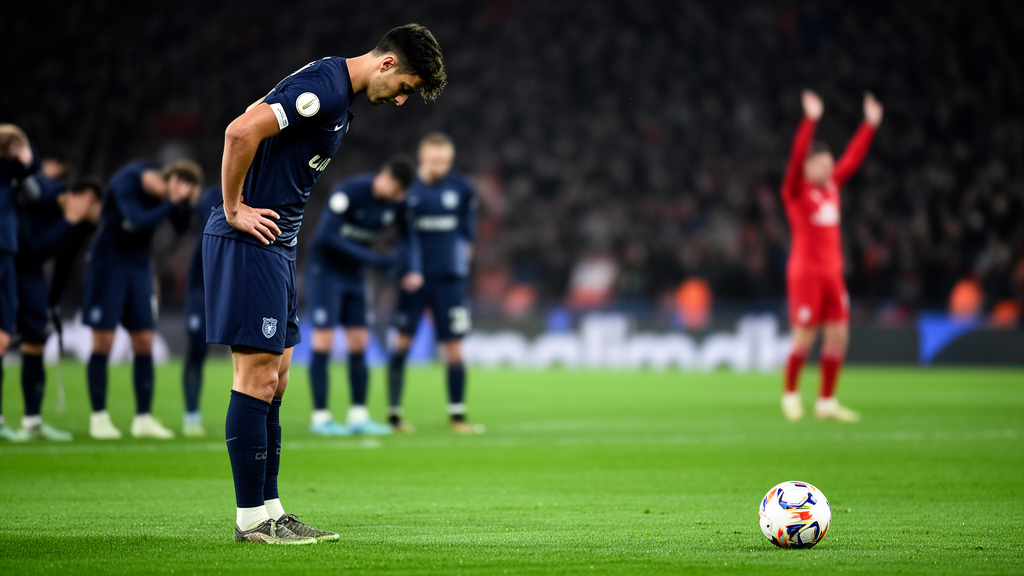
A single unforced passing error in professional football is far more than a momentary lapse. According to a large-scale analysis of more than 1.19 million event records from 330 professional matches, published in Frontiers in Psychology, the odds of a player committing another unforced passing error were approximately 57 percent higher immediately after an error than after a successful pass. Situational pressure independently raised error odds by roughly 21 percent per additional pressure component. But the study’s most striking findings concern what happens when errors accumulate: error probability climbed monotonically from 17.7 percent following a success to 51.6 percent after six consecutive errors, and the players least prone to mistakes were paradoxically the ones whose performance deteriorated most steeply once a chain of errors began.
The research, conducted by Mark R. Wilson and So Hyun Park of the University of Exeter Medical School, represents the first large-scale test of Attentional Control Theory: Sport (ACTS) in association football. ACTS proposes that competitive anxiety arises not from situational pressure alone but from a performer’s appraisal of two interacting factors: the cost of failure, meaning what is at stake, and the probability of failure, meaning how the performer believes they are doing. These appraisals update dynamically during performance, so an error should raise the perceived probability of future failure, and when that occurs in a high-stakes context the psychological disruption should be greatest. Previous archival studies in American football and tennis had supported this multiplicative prediction, with the probability of an unforced error in tennis doubling when players had erred on their previous shot during a high-pressure point.
To test these predictions in football, the researchers drew on StatsBomb’s open event data, covering ten competitions including four seasons of La Liga, the 2003/04 Premier League, two seasons of the UEFA Champions League, the 2018 FIFA World Cup, the 2019 FIFA Women’s World Cup, and the 2018 National Women’s Soccer League. The dataset contained 1,190,821 individual events from 330 matches, 113 unique teams and 2,252 unique players. Because football’s continuous, interdependent gameplay lacks the discrete boundaries of tennis points or NFL plays, the team focused on passing, the most frequent and distributed offensive action, with roughly 1,000 incidents per match. Unforced passes, those made without immediate physical pressure from an opponent, served as the football equivalent of the unforced errors studied in tennis. Approximately 15.7 percent of classifiable passes were excluded as forced, leaving 281,560 unforced pass actions for the primary analyses.
Situational pressure was operationalised through a four-component additive index capturing distinct cost-of-failure contexts: trailing on the scoreboard, which applied to 25.7 percent of actions; closing-in-balance, defined as at least 75 minutes elapsed with a goal difference of one or less, present in 11.6 percent of actions; knockout match status, present in 9.9 percent; and numerical disadvantage following a red card, present in 1.18 percent of actions and concentrated in 38 of the 330 matches. Running scores were reconstructed from exact goal timestamps, and standard errors were clustered simultaneously on player and match to account for the nesting of events within both. The overall error rate in the primary dataset of 272,381 passes was 19.4 percent, and marginal error rates rose steadily with the pressure index, from 17.8 percent with no pressure markers active to 24.2 percent at three markers.
Both main effects replicated as ACTS predicts, but the crucial interaction did not. Rather than widening the post-error gap, pressure narrowed it: each additional pressure component reduced the multiplicative prior-error effect by approximately 9 percent, an odds ratio of 0.91. This runs opposite to the pattern documented in American football and tennis, and the authors treat the magnitude cautiously. Sensitivity analyses showed that separating the trailing component from the composite index reduced the interaction to non-significance, indicating that trailing drives most of the narrowing rather than the pressure index uniformly. The authors suggest that the four-component index may be an inadequate proxy for the moment-to-moment psychological pressure that ACTS theorises, since football’s stakes fluctuate rapidly within passages of play in ways that discrete components cannot capture. Over 90 percent of passes in the data occurred at pressure levels zero or one, a skew that may explain why football pressure research has traditionally concentrated on discrete, highly leveraged events such as penalty shootouts.
A key methodological innovation was separating what a player attempted from how well they executed it. The researchers extracted three pass-difficulty covariates: pass length, a forward-pass indicator, and pass height. These covariates exerted enormous effects on error probability. High passes carried roughly 15 times the odds of failing compared with ground passes, low passes about 4 times the odds, and forward passes 3.4 times the odds of non-forward passes. Using the Karlson-Holm-Breen decomposition, which corrects for the rescaling artefact that affects naive coefficient comparisons across nested logistic models, the team found that pass difficulty mediated 59.0 percent of the pressure main effect and 58.8 percent of the prior-error main effect. In other words, players under pressure or immediately after an error were attempting harder passes than usual, and this shift in pass selection accounted for about 60 percent of both effects. The authors note this pattern is consistent either with impaired decision quality or with a deliberate shift in risk preference, echoing the break-even effect from behavioural economics in which people who have recently experienced a loss become more willing to accept high-risk gambles offering a path to erase the deficit.
The second study moved from the individual to the team, asking whether errors are contagious. For each of 54,409 unforced pass errors, the researchers identified the next unforced pass by any player on the same team. In 86.9 percent of cases a teammate took that follow-up pass, and in 13.1 percent the source player took it themselves. The error rate when the source player took the follow-up was 28.7 percent, an elevation of 9.3 percentage points above the unconditional baseline, while the rate when a teammate took it was 27.2 percent, an elevation of 7.8 percentage points. A residual contagion test, which compared each teammate’s observed error rate against their own personal baseline across the full dataset, confirmed that teammates erred 3.9 percentage points above their own norm, a result that cannot be explained by higher-error-rate players systematically receiving the ball after errors. This interpersonal effect was roughly half the magnitude of the within-player effect, consistent with the theoretical expectation that direct performance accomplishments influence confidence more strongly than vicarious experience.
Notably, when pass-difficulty covariates were added to the contagion models, the adjusted same-player coefficient fell to statistical non-significance, suggesting that much of the same-player-specific elevation may operate through what was attempted on the next pass. The component-level analysis showed that late-game balance and knockout status reliably raised follow-up error probability, while trailing and numerical disadvantage did not. The findings align with qualitative research on collective team collapses, in which elite athletes described how individual mistakes created insecurity across the whole team and caused errors to multiply. Related archival work on penalty shootouts suggests that an opponent’s success may be an even more powerful driver of failure expectations than a teammate’s performance, raising questions the present data cannot resolve.
The third study followed chains rather than pairs of consecutive errors, using binomial generalised linear mixed models with random intercepts for players and matches and a per-player random slope for chain depth. Error probability escalated monotonically with each additional consecutive prior error, from 17.7 percent at depth zero to 51.6 percent at depth six, with no plateau across the observable range. The population-average chain effect was an odds ratio of 1.066 per consecutive prior error, and mediation analysis indicated that 91.7 percent of this escalation operated through riskier pass selection rather than degraded execution of comparable passes. As chains deepened, players across the board shifted toward longer, more forward and more aerial passes. The asymmetry between errors and successes was stark: between-player variation in chain susceptibility was roughly twice as large on the error side as on the success side, and a sensitivity analysis matching the truncation severity of the two estimates suggested the true asymmetry is closer to eight-fold.
The individual-differences findings carry the study’s most provocative implication. Within every one of the seven playing positions, the players with the lowest baseline error rates showed the steepest error-chain escalation, with the association holding from strikers to centre-backs and surviving sensitivity checks against shrinkage artefacts. The authors interpret this through schema incongruence: because errors are rarer for elite performers, each mistake represents a more profound violation of expectations and a more painful gap between actual performance and internalised self-guides of being flawless and reliable. As chains lengthen, attributions may shift from unstable and external toward stable and internal, compounding the disruption. The least error-prone players shifted furthest toward difficult passes as chains deepened, with their aerial-pass rate rising roughly double that of the most error-prone tertile, a pattern the authors describe as redemptive action, an attempt to restore a threatened sense of competence through high-value plays. The authors caution that observational data cannot measure players’ internal appraisals, so tactical explanations such as opponents pressing reliable passers harder after a visible error cannot be excluded. Still, the practical message is clear: the cost of an error lies less in the error itself than in what it becomes if allowed to compound, and a low error rate is no guarantee of resilience to a chain of errors.
Subject of Research: Error compounding, contagion, and individual vulnerability in professional football passing
Article Title: When, where, and for whom do errors compound? Error sequences, contagion, and individual vulnerability in professional football
Article References: Wilson, M. R., & Park, S. H. (2026). When, where, and for whom do errors compound? Error sequences, contagion, and individual vulnerability in professional football. Frontiers in Psychology, 17, Article 1945783. https://doi.org/10.3389/fpsyg.2026.1945783
Image Credits: AI Generated
DOI: 10.3389/fpsyg.2026.1945783
Keywords: error compounding, professional football, Attentional Control Theory, choking under pressure, error contagion, pass selection, sport psychology, StatsBomb event data, sequential dependence, anxiety, team collapses, individual differences
Cite Scienmag News
Glenn Wilkins. (October 27, 2026). Errors Beget Errors in Elite Football, and the Best Players Are Most Vulnerable. Scienmag. https://scienmag.com/errors-beget-errors-in-elite-football-and-the-best-players-are-most-vulnerable/
Glenn Wilkins. "Errors Beget Errors in Elite Football, and the Best Players Are Most Vulnerable." Scienmag, 27 October 2026, https://scienmag.com/errors-beget-errors-in-elite-football-and-the-best-players-are-most-vulnerable/. Accessed 27 October 2026.
Glenn Wilkins. "Errors Beget Errors in Elite Football, and the Best Players Are Most Vulnerable." Scienmag. October 27, 2026. https://scienmag.com/errors-beget-errors-in-elite-football-and-the-best-players-are-most-vulnerable/


