


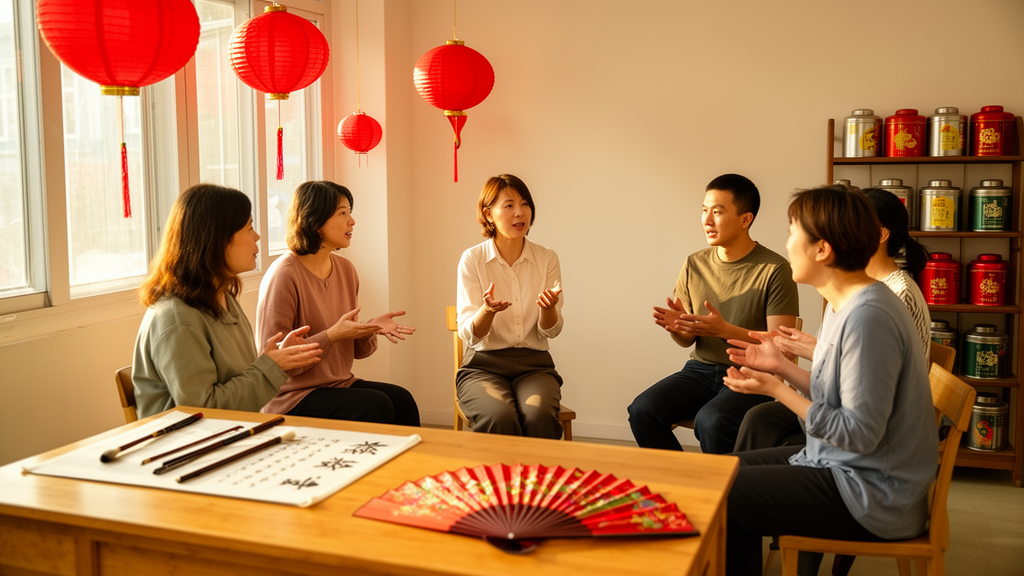
Learning Mandarin may do more for students when culture is woven directly into the language work rather than taught as a separate lecture. A quasi-experimental study of Mandarin-as-a-second-language learners found that an eight-week culturally integrated program improved both intercultural communicative competence and learners’ willingness to communicate across cultures, with the latter appearing to carry much of the effect.
The program embedded cultural comparison, small-group discussion, role-play, misunderstanding-repair tasks, and short written reflections into communicative classroom tasks. In this design, culture served as the material of language practice itself, not a supplementary topic delivered alongside grammar and vocabulary drills.
Researchers used a pre-test/post-test control-group design. The analysis retained 62 learners who completed both testing points and attended at least 75 percent of sessions, with 31 participants in the experimental group and 31 in the control group, which received regular Mandarin instruction.
Intercultural communicative competence and intercultural willingness to communicate were measured with self-report scales scored on total-scale values. In the experimental group, competence scores rose from 2.958 before the program to 3.650 afterward, while willingness-to-communicate scores rose from 2.859 to 3.519. The control group remained essentially unchanged on both measures.
After adjusting for baseline scores, assignment to the culturally integrated program was statistically associated with higher post-test competence (p = 0.005) and higher post-test willingness to communicate (p < 0.001), suggesting the gains were unlikely to reflect chance alone.
The study’s central question was psychological: does such instruction build competence directly, or does it work by first making students more ready to engage in intercultural interaction? A bootstrap mediation model addressed this by testing whether willingness to communicate accounted for the link between instruction and competence.
The mediation analysis yielded a significant indirect effect of 0.520, with a 95 percent confidence interval of 0.256 to 0.823, while the direct effect of instruction on competence was not statistically significant. In other words, willingness to communicate largely accounted for the association between the culturally integrated program and competence gains.
The authors caution that the mediator and outcome were measured concurrently, so the findings are consistent with, rather than demonstrate, the proposed pathway: that culturally integrated Mandarin instruction supports competence by increasing learners’ readiness to engage in intercultural communication. Because the design was quasi-experimental and relied on self-report scales, the results describe associations within this sample rather than proven causal mechanisms.
Subject of Research: Effects of culturally integrated Mandarin instruction on intercultural communicative competence and willingness to communicate
Article Title: Culturally integrated Mandarin instruction and intercultural communicative competence: the mediating role of intercultural willingness to communicate
Article References: Ding, C. (2026). Culturally integrated Mandarin instruction and intercultural communicative competence: the mediating role of intercultural willingness to communicate. Frontiers in Psychology, 17, Article 1929538. https://doi.org/10.3389/fpsyg.2026.1929538
Image Credits: AI Generated
DOI: 10.3389/fpsyg.2026.1929538
Keywords: Mandarin instruction, intercultural communicative competence, willingness to communicate, second language education, quasi-experimental study, mediation analysis, culture in language teaching, self-report scales, Culturally, integrated, Mandarin, instruction
Cite Scienmag News
Philip Murphy. (October 27, 2026). Culturally Integrated Mandarin Lessons Boost Intercultural Communication Readiness. Scienmag. https://scienmag.com/culturally-integrated-mandarin-lessons-boost-intercultural-communication-readiness/
Philip Murphy. "Culturally Integrated Mandarin Lessons Boost Intercultural Communication Readiness." Scienmag, 27 October 2026, https://scienmag.com/culturally-integrated-mandarin-lessons-boost-intercultural-communication-readiness/. Accessed 27 October 2026.
Philip Murphy. "Culturally Integrated Mandarin Lessons Boost Intercultural Communication Readiness." Scienmag. October 27, 2026. https://scienmag.com/culturally-integrated-mandarin-lessons-boost-intercultural-communication-readiness/


