

Monday, October 26, 2026
Science
No Result
View All Result
  • Login
  • HOME
  • SCIENCE NEWS
  • CONTACT US
  • HOME
  • SCIENCE NEWS
  • CONTACT US
No Result
View All Result
Scienmag
No Result
View All Result
Home Science News

New Kinetic Model Predicts Natural Gas Hydrate Growth Using Chemical Potential

October 26, 2026
in Science News, Technology and Engineering
Denise Maddox
By Denise Maddox Scienmag Editorial Profile - Mechanical Engineering
Reading Time: 3 mins read
0
New Kinetic Model Predicts Natural Gas Hydrate Growth Using Chemical Potential

New Kinetic Model Predicts Natural Gas Hydrate Growth Using Chemical Potential

65
SHARES
587
VIEWS
Share on FacebookShare on Twitter
ADVERTISEMENT

Researchers have proposed a kinetic model for natural gas hydrate growth that is driven by the chemical potential difference between phases, and verified it against published experimental data with deviations as low as about 2.35 percent. The study, authored by Hao Liang of CNOOC (China) Co., Ltd. Hainan Branch, Jianbing Jiang of Lanzhou City University, and Juan He of Chengdu University of Technology, appears in Frontiers in Chemical Engineering in the chemical reaction engineering section.

Natural gas hydrate has emerged in recent decades as a promising alternative energy resource, attracting worldwide attention in the petroleum and natural gas industry. Hydrate-based technologies have demonstrated considerable potential in engineering applications including natural gas exploitation, transportation, gas sequestration, and seawater desalination. However, the industrial application of these technologies is severely constrained by an insufficient understanding of hydrate formation kinetics, especially in complex multiphase systems where gas, liquid, and solid phases coexist.

The new work is built upon published experimental data and aims to characterize the driving force for hydrate growth by accounting for temperature and pressure. On this basis, the authors propose a kinetic model for hydrate growth driven by chemical potential. The model also incorporates the factors that govern how quickly material reaches a growing crystal: diffusion, temperature, and the hydrate surface area available for growth.

To verify the formulation, the team compared the model's calculated growth rates against experimental data reported for hydrate growth in both oil–water suspensions and gas–water systems. The results indicate that the model can effectively predict hydrate growth rates in both settings with high reliability, according to the authors. The verification numbers are specific.

For hydrate growth in oil–water dispersed emulsion systems, the deviation between the model's calculations and the experimental data ranges from 2.7 percent to 7.6 percent. For gas–water systems, the calculated deviation is 2.35 percent to 2.89 percent. These deviations are reported by the authors as evidence of the model's accuracy across the two distinct multiphase environments.

The authors position the work as both an interpretive and an engineering contribution. On the interpretive side, expressing growth in terms of the chemical potential driving force provides a reference for interpreting hydrate growth mechanisms. On the engineering side, the model is intended to offer technical support for the optimization of hydrate-based engineering applications in the petroleum and natural gas industry, where formation kinetics have been a limiting uncertainty.

The scope of the study is defined by the data it draws on. Because the model is built and verified against published experimental measurements rather than new laboratory tests, its reliability reflects the quality and range of the underlying data, and the reported deviations apply to the oil–water emulsion and gas–water conditions for which verification was performed. The authors do not report validation beyond these system types in the present work.

Within that scope, the reported accuracy in two physically distinct systems—oil–water dispersed emulsions and gas–water contacts—suggests that the chemical-potential framework captures the relevant growth physics across both settings. For a field in which hydrate formation kinetics has been identified as insufficiently understood, a model that predicts growth rates to within a few percent in both environments offers a step toward more dependable hydrate-based engineering practice, from exploitation and transportation to sequestration and desalination applications.

Subject of Research: A chemical-potential-based kinetic model for natural gas hydrate growth kinetics

Article Title: A kinetic model for the growth of natural gas hydrates based on chemical potential driving force

Article References: Liang, H., Jiang, J., & He, J. (2026). A kinetic model for the growth of natural gas hydrates based on chemical potential driving force. Frontiers in Chemical Engineering, 8, Article 1934897. https://doi.org/10.3389/fceng.2026.1934897

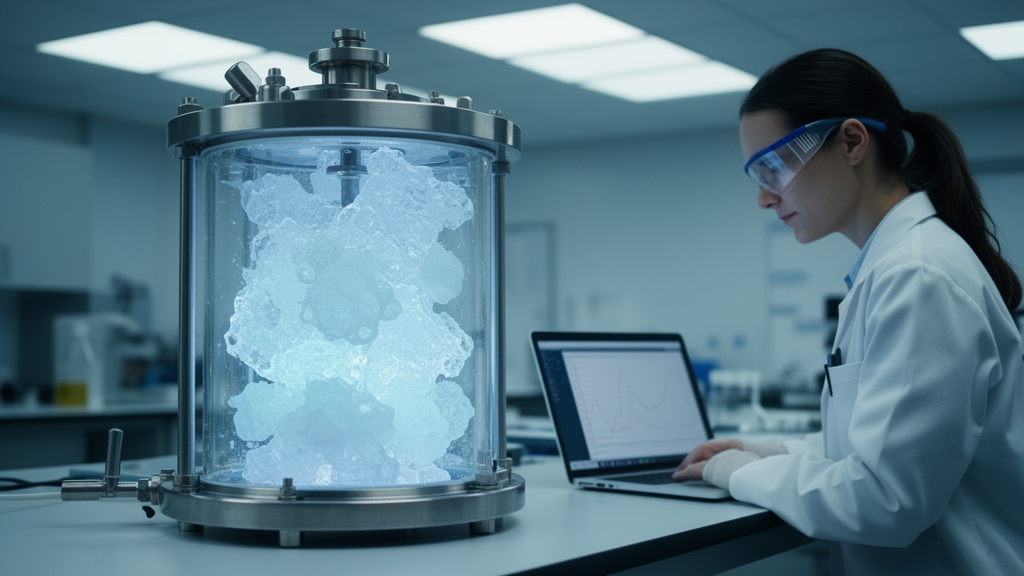
Image Credits: AI Generated

DOI: 10.3389/fceng.2026.1934897

Keywords: natural gas hydrates, chemical potential, kinetic model, hydrate growth rate, gas–water systems, oil–water emulsions, multiphase systems, petroleum industry, gas sequestration, seawater desalination, thermodynamics, Frontiers in Chemical Engineering

Cite Scienmag News

Denise Maddox. (October 26, 2026). New Kinetic Model Predicts Natural Gas Hydrate Growth Using Chemical Potential. Scienmag. https://scienmag.com/new-kinetic-model-predicts-natural-gas-hydrate-growth-using-chemical-potential/


Denise Maddox. "New Kinetic Model Predicts Natural Gas Hydrate Growth Using Chemical Potential." Scienmag, 26 October 2026, https://scienmag.com/new-kinetic-model-predicts-natural-gas-hydrate-growth-using-chemical-potential/. Accessed 26 October 2026.

Denise Maddox. "New Kinetic Model Predicts Natural Gas Hydrate Growth Using Chemical Potential." Scienmag. October 26, 2026. https://scienmag.com/new-kinetic-model-predicts-natural-gas-hydrate-growth-using-chemical-potential/

Tags: applications of gas hydrates in petroleum industrychemical potentialchemical potential difference in hydrate formationchemical potential-driven hydrate formationexperimental validation of hydrate growth modelsFrontiers in Chemical Engineeringgas sequestrationgas sequestration in hydrate formgas–water systemshydrate formation kinetics in multiphase systemshydrate growth ratehydrate-based gas transportationinfluence of temperature and pressure on hydrate growthkinetic modelkinetic modeling of hydrate formationmultiphase systemsnatural gas hydrate as an energy resourceNatural gas hydrate growthnatural gas hydratesoil–water emulsionspetroleum industryseawater desalinationseawater desalination using gas hydratesthermodynamics
Share26Tweet16
Previous Post

Research report: Liraglutide regulate osteogenesis-resorption via macrophage under compressive stress

Next Post

Ancient catfish lineage from Southeast Asian peat swamps revealed as earliest branch of its family

Related Posts

Multispectral drone survey maps mangrove biomass in northern Vietnam with high accuracy
Science News

Multispectral drone survey maps mangrove biomass in northern Vietnam with high accuracy

October 26, 2026
High Altitude Reshapes Diabetes Drug Dapagliflozin in Rats, With Effects Fading Over Time
Medicine

High Altitude Reshapes Diabetes Drug Dapagliflozin in Rats, With Effects Fading Over Time

October 26, 2026
Rare Malignant Tumor Found Growing in the Greater Omentum in 37-Year-Old Man
Medicine

Rare Malignant Tumor Found Growing in the Greater Omentum in 37-Year-Old Man

October 26, 2026
Tidal Breathing Test Flags Airflow Differences in Wheezing Infants
Medicine

Tidal Breathing Test Flags Airflow Differences in Wheezing Infants

October 26, 2026
Why repurposed drugs failed against COVID-19: evidence, policy and the Bulgarian case
Medicine

Why repurposed drugs failed against COVID-19: evidence, policy and the Bulgarian case

October 26, 2026
Internalized Weight Bias Links Gestational Attitudes to Exercise Avoidance
Medicine

Internalized Weight Bias Links Gestational Attitudes to Exercise Avoidance

October 26, 2026
Next Post
Ancient catfish lineage from Southeast Asian peat swamps revealed as earliest branch of its family

Ancient catfish lineage from Southeast Asian peat swamps revealed as earliest branch of its family

  • Mothers who receive childcare support from maternal grandparents show more optimized

    Mothers who receive childcare support from maternal grandparents show more parental warmth, finds NTU Singapore study

    27656 shares
    Share 11059 Tweet 6912
  • University of Seville Breaks 120-Year-Old Mystery, Revises a Key Einstein Concept

    1061 shares
    Share 424 Tweet 265
  • Bee body mass, pathogens and local climate influence heat tolerance

    682 shares
    Share 273 Tweet 171
  • Researchers record first-ever images and data of a shark experiencing a boat strike

    546 shares
    Share 218 Tweet 137
  • Groundbreaking Clinical Trial Reveals Lubiprostone Enhances Kidney Function

    531 shares
    Share 212 Tweet 133
Science

Embark on a thrilling journey of discovery with Scienmag.com—your ultimate source for cutting-edge breakthroughs. Immerse yourself in a world where curiosity knows no limits and tomorrow’s possibilities become today’s reality!

RECENT NEWS

  • Multispectral drone survey maps mangrove biomass in northern Vietnam with high accuracy
  • High Altitude Reshapes Diabetes Drug Dapagliflozin in Rats, With Effects Fading Over Time
  • Rare Malignant Tumor Found Growing in the Greater Omentum in 37-Year-Old Man
  • Tidal Breathing Test Flags Airflow Differences in Wheezing Infants

Categories

  • Agriculture
  • Anthropology
  • Archaeology
  • Athmospheric
  • Biology
  • Biotechnology
  • Blog
  • Bussines
  • Cancer
  • Chemistry
  • Climate
  • Earth Science
  • Editorial Policy
  • Marine
  • Mathematics
  • Medicine
  • Pediatry
  • Policy
  • Psychology & Psychiatry
  • Science Education
  • Science News
  • Social Science
  • Space
  • Technology and Engineering

Subscribe to Blog via Email

Enter your email address to subscribe to this blog and receive notifications of new posts by email.

Join 5,151 other subscribers

© 2025 Scienmag - Science Magazine

Welcome Back!

Login to your account below

Forgotten Password?

Retrieve your password

Please enter your username or email address to reset your password.

Log In
No Result
View All Result
  • HOME
  • SCIENCE NEWS
  • CONTACT US

© 2025 Scienmag - Science Magazine

Discover more from Science

Subscribe now to keep reading and get access to the full archive.

Continue reading