


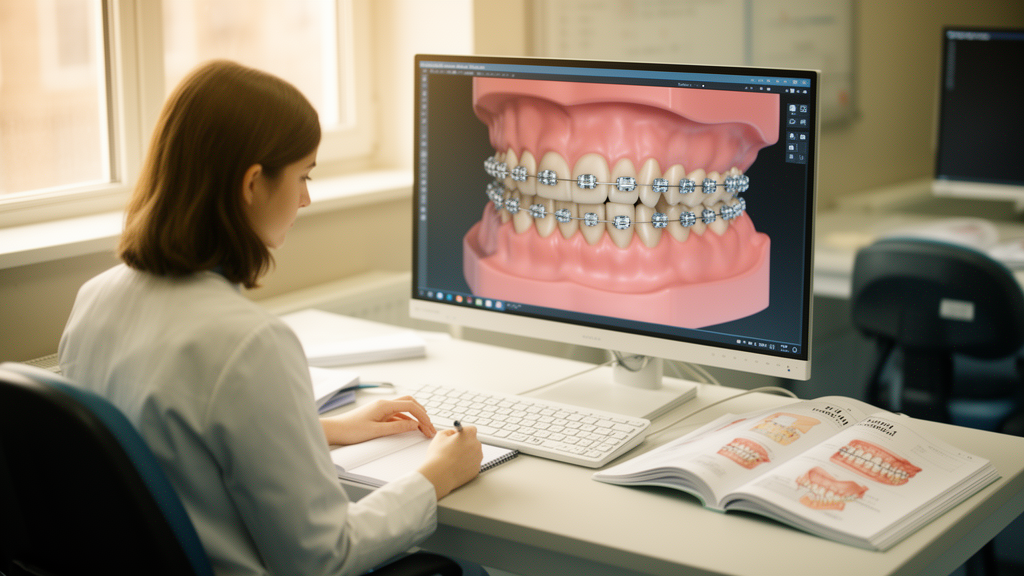
Generative adversarial networks, the artificial intelligence architectures that learn to fabricate convincing images from real data, are being explored as a way around one of orthodontic education’s most stubborn constraints: the patient-consent and privacy rules that make it difficult to build large libraries of real patient photographs and scans for case-based teaching. A new scoping review published in BMC Medical Education maps what the research literature has so far achieved in this niche, and the picture that emerges is one of genuine promise shadowed by thin, early-stage evidence. The review, which searched PubMed, Scopus, ERIC and IEEE Xplore from 2014, the year GANs were first described, through 28 June 2026, identified 79 articles for full-text assessment.
Only seven met the inclusion criteria: studies that primarily used or demonstrated the potential of GANs to generate orthodontic-relevant images. Those seven studies were trained on datasets ranging from just 302 to 50,000 images, a spread that itself illustrates how inconsistent the field remains. Once grouped by image type, the included studies fell into five categories.
Two addressed facial de-identification of frontal or profile photographs, two synthesized panoramic radiographs, and one each covered lateral cephalogram synthesis, cone-beam computed tomography synthesis, and intraoral photograph synthesis. The review combined search terms for orthodontics or craniofacial conditions with the main GAN architectures, including vanilla, conditional, deep convolutional, style-based and cycle-consistent models, supplemented by manual reference-list screening of relevant reviews. Records were de-duplicated and screened by title and abstract before full-text review.
Across all five groups, the review reports that GAN-generated images were frequently indistinguishable from real images even to trained clinicians, particularly at moderate resolutions. The included studies spanned the synthesis of facial photographs, panoramic radiographs, lateral cephalograms, cone-beam computed tomography volumes and intraoral photographs, the full imaging spectrum used in orthodontic assessment.
At very high resolutions, however, the balance shifts. The review reports that fine anatomical detail, including individual tooth morphology, cortical bone texture and soft tissue, remained the most reliable cues for expert detection of synthetic images. Coarse appearances may pass clinical inspection, but scrutiny of fine anatomical structure can still reveal the fabrication.
Beyond teaching materials, the review highlights a second application: augmenting datasets for diagnostic artificial intelligence. Synthetic images improved the accuracy of downstream diagnostic AI models when used to balance imbalanced training datasets. The review also notes that AI-enhanced low-dose CBCT preserved clinical decision-making while reducing radiation exposure, suggesting GAN-derived techniques may contribute to dose reduction as well as data expansion.
For educators, the underlying motivation is straightforward. Case- and scenario-based teaching is a cornerstone of postgraduate orthodontic training, but assembling authentic case libraries is limited by patient-consent and privacy constraints. GANs can produce high-fidelity synthetic images without exposing real patient data, offering a potential solution to these constraints.
The review’s conclusions, however, are deliberately cautious. The author reports that the lack of standardization across GAN studies remains an issue, and that the limited evidence suggesting GAN-generated dental and facial images are sufficiently realistic derives from single-centre, single-population pilot studies with limited external validation. With only seven included studies, none of the findings can yet be generalized across populations, imaging systems or educational settings.
The path forward identified in the review involves larger, more diverse multi-centre datasets and conditional models tailored to specific malocclusion types or facial forms. The review also observes that GAN-generated images contain clinically relevant information that can be used to expand existing datasets and train deep-learning models, positioning synthesis as both an educational tool and an AI development resource. For now, the review establishes a baseline rather than a verdict.
GANs hold promise for advancing orthodontic education, but the evidence base consists of a handful of pilot studies, and questions of image fidelity at fine anatomical scales, standardization of methods and external validation remain open.
Subject of Research: The generative adversarial networks (GANs) for case- or scenario-based teaching in orthodontic education, a scoping review
Article Title: The generative adversarial networks (GANs) for case- or scenario-based teaching in orthodontic education, a scoping review
Article References: Borzabadi-Farahani, A. (2026). The generative adversarial networks (GANs) for case- or scenario-based teaching in orthodontic education, a scoping review. BMC Medical Education. https://doi.org/10.1186/s12909-026-10241-7
Image Credits: AI Generated
DOI: 10.1186/s12909-026-10241-7
Keywords: generative, adversarial, networks, GANs, case-, scenario-based, teaching, orthodontic, education, scoping, review, scientific research
Cite Scienmag News
Courtney Benton. (October 26, 2026). AI Image Generators Show Early Promise for Orthodontic Teaching Without Patient Photos. Scienmag. https://scienmag.com/ai-image-generators-show-early-promise-for-orthodontic-teaching-without-patient-photos/
Courtney Benton. "AI Image Generators Show Early Promise for Orthodontic Teaching Without Patient Photos." Scienmag, 26 October 2026, https://scienmag.com/ai-image-generators-show-early-promise-for-orthodontic-teaching-without-patient-photos/. Accessed 26 October 2026.
Courtney Benton. "AI Image Generators Show Early Promise for Orthodontic Teaching Without Patient Photos." Scienmag. October 26, 2026. https://scienmag.com/ai-image-generators-show-early-promise-for-orthodontic-teaching-without-patient-photos/


