


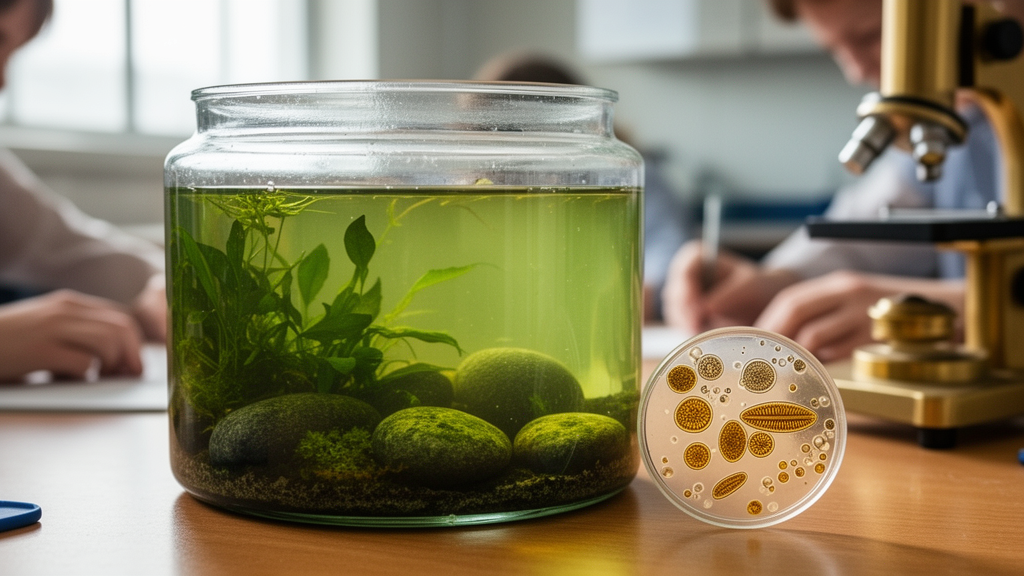
High school students in León, Spain, have ended up with a rare claim to scientific fame: an experiment they ran in their classroom aquarium has produced a brand-new species of diatom. The find came out of the CiDIA-micro project, part of the 2024 Microprojects of the European University Alliance EURECA-PRO at the University of León. The project assesses the aquatic environmental impact of biodegradable and compostable packaging materials certified under the UNE-EN 13432:2001 standard and the TÜV Austria OK compost HOME scheme.
Rather than relying on professional researchers alone, the initiative enlisted 111 students and seven teachers from six high schools, who collected and analysed water samples to monitor changes in diatom communities. The experiment involved culturing benthic algae in 18-litre tanks for twenty weeks to test how different bioplastics affected the growth of periphytic diatoms, measuring abundance, diversity and the occurrence of teratological, or malformed, forms. The material that yielded the new species came from one experimental unit at the León secondary school.
The tank had been inoculated with epiphytic algal communities collected from Sentiz Lake in Valdepolo, obtained by scraping roots of the aquatic plant Myriophyllum alterniflorum. Water parameters, including pH and concentrations of ammonium, nitrites, nitrates, carbonate hardness and phosphates, were determined on site with a colourimetric reagent kit. Algae growing on artificial substrata were sampled with a toothbrush and preserved in formaldehyde before laboratory analysis.
Preparing diatoms for study is a chemically demanding business. In the laboratory, the organic content of the sample was oxidised with 30 percent hydrogen peroxide, heated to 70–90 degrees Celsius to speed the reaction, and treated with hydrochloric acid to remove calcium carbonate residues. Cleaned frustules were mounted on slides in Naphrax, a synthetic resin with a high refractive index, and examined at 1000-times magnification with a differential interference contrast light microscope.
Under the light microscope, the new diatom shows valves that are linear-lanceolate with concave-contracted margins at the mid-valve and protracted, rostrate ends. The valves measure 32.0 to 35.7 micrometres long and 3.9 to 6.3 micrometres wide, with 18 to 19 striae in 10 micrometres that are weakly radiate. Scanning electron microscopy revealed a narrow, linear axial area, a circular central area and a straight, filiform raphe.
Externally, the proximal raphe endings expand into central pores and are slightly deflected to the same side of the valve, while the distal endings are hooked and reach the valve mantle at the apex. Internally, the species possesses well-developed helictoglossae, and the areolae are circular at the valve centre, numbering 37 to 46 in 10 micrometres, becoming elongated and elliptical toward the ends. Assigning the species to the genus Craticula rested on a set of distinctive features: a shallow mantle, apically elongated external areola foramina that become roundish at the valve centre together with elliptical internal areolae, and external central raphe endings turned slightly toward the primary side of the valve.
Notably, C. scientiacivica lacks longitudinal ribs and a thick raphe-sternum, but the authors point out that these traits are also absent in many other Craticula taxa, so their absence does not rule out membership. The heavily silicified 'craticular' or 'heribaudii' resting stages that some species form under stress were not detected in the material. The combination of valve shape and measurements appears to be unique within the genus.
According to the authors, this is the only known Craticula species with a consistent panduriform outline in frustule shape. The morphologically similar Navicula akebergii carries a distinctive stigma in the central area that excludes it from Craticula, while Navicula adamsii from Lake Tanganyika has a slightly constricted mid-valve but far less protracted apices. Other Craticula species were judged barely comparable on the basis of valve dimensions or shape.
One striking feature of the type population is its tendency to produce teratological forms, which accounted for 26 percent of the individuals observed, 96 valves out of the total counted. These malformed specimens showed abnormal outlines with deflected ends, absence of the typical median constriction on one side, deformed copulae and raphe misalignment. Several diatom genera, including Amphora, Encyonema and Pseudo-nitzschia, are known for producing aberrant valves, especially in polluted environments or laboratory cultures.
The twenty-week duration of the study may have played a role, since prolonged cultivation time has been linked to increased teratological forms. Importantly, deformed cells dominated in the control treatments, which rules out leaching of chemicals from the bioplastics as the cause, although unfavourable culture or nutritional conditions have previously been reported to induce such deformities in Navicula species in ageing laboratory cultures. Ecologically, the species was recorded under controlled experimental conditions across different microcosms, appearing in nine of the seventeen, but it reached its highest abundance in a single control tank, where the 96 individuals were observed.
The water in that environment had a pH of 9, a hardness of 1.3 degrees dH, ammonium at 0.1 milligrams per litre and phosphate at 3 milligrams per litre, with nitrite and nitrate below the detection limit. The species was found alongside a familiar cast of freshwater diatoms, including Achnanthidium minutissimum, Craticula buderi, Encyonopsis microcephala, Navicula radiosa, several Nitzschia and Gomphonema species, and Ulnaria ulna. Because all treatments and replicates were inoculated with the same natural aliquot, the authors hypothesise that the species may have arrived as aerial propagules and grown accidentally in one of the aquaria curated by the students.
The discovery fits into a surprising tradition. Nupela exotica was described from a tropical freshwater aquarium near Orléans, France, in 2003, and Eunotia pottieziana was found living in a tropical aquarium in an author's home. What makes this find notable is its school setting.
School-based citizen science projects routinely involve students in ecological data collection but rarely report direct new species discoveries, largely because such programmes lack expert taxonomists and the infrastructure for validation. Comparable initiatives, such as a school trap programme that generated first barcode records for hundreds of species and a bacteria project in which school classes helped describe new genera and species in peer-reviewed articles, show the potential of such collaborations. With C. scientiacivica, named explicitly for the citizen science project that revealed it, that potential has now extended to diatom taxonomy itself, demonstrating how classroom experiments integrated with professional taxonomic work can uncover species new to science.
Subject of Research: Description of a new diatom species, Craticula scientiacivica, discovered during a school-based citizen science experiment in León, Spain
Article Title: Craticula scientiacivica ( Stauroneidaceae ), sp. nov., a new diatom species found during a citizen science project
Article References: Moyón, J., Borrego-Ramos, M., Taboada, Á., Olenici, A., & Blanco, S. (2026). Craticula scientiacivica (Stauroneidaceae), sp. nov., a new diatom species found during a citizen science project. PhytoKeys, 275, 141-149. https://doi.org/10.3897/phytokeys.275.192720
Image Credits: AI Generated
DOI: 10.3897/phytokeys.275.192720
Keywords: diatoms, Craticula scientiacivica, new species, citizen science, taxonomy, Stauroneidaceae, aquarium, bioplastics, teratology, phytoplankton, Spain, microscopy
Cite Scienmag News
Morgan Morrow. (October 26, 2026). New diatom species discovered by high school students in classroom aquarium experiment. Scienmag. https://scienmag.com/new-diatom-species-discovered-by-high-school-students-in-classroom-aquarium-experiment/
Morgan Morrow. "New diatom species discovered by high school students in classroom aquarium experiment." Scienmag, 26 October 2026, https://scienmag.com/new-diatom-species-discovered-by-high-school-students-in-classroom-aquarium-experiment/. Accessed 26 October 2026.
Morgan Morrow. "New diatom species discovered by high school students in classroom aquarium experiment." Scienmag. October 26, 2026. https://scienmag.com/new-diatom-species-discovered-by-high-school-students-in-classroom-aquarium-experiment/


