


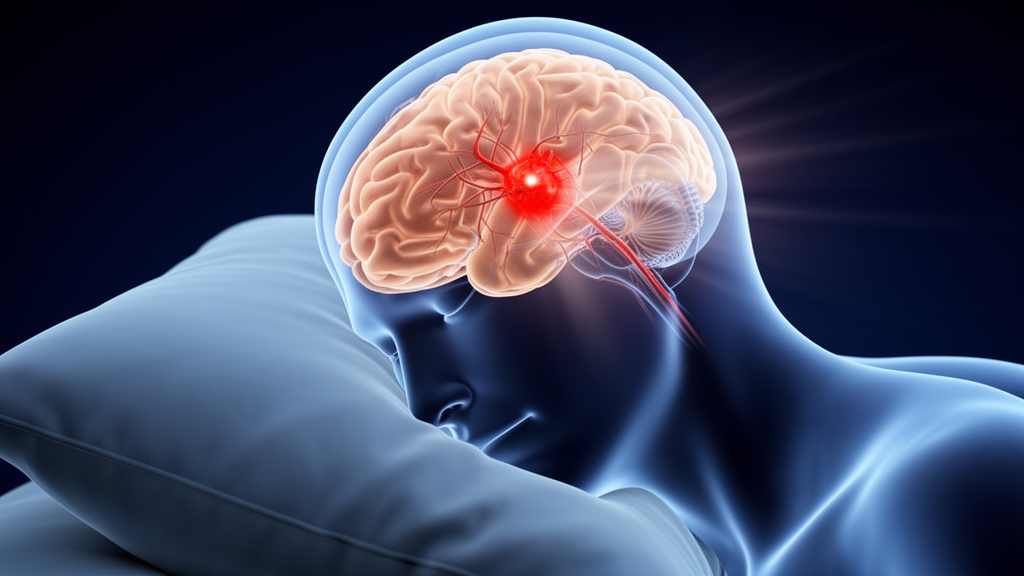
People who habitually sleep fewer than seven hours or more than nine hours a night appear to face a higher risk of spontaneous intracerebral hemorrhage, a devastating form of stroke caused by a ruptured blood vessel inside the brain, according to a new observational study drawing on more than 314,000 participants from the UK Biobank. The research, conducted by a team from Jinjiang Municipal Hospital and collaborating Chinese institutions and published in Frontiers in Neurology, also found supporting evidence in a separate hospital-based dataset, with the association for long sleep emerging as the stronger and more consistent of the two. Abnormal sleep duration has previously been linked to stroke in general, but evidence specific to bleeding strokes has remained limited.
The new study set out to address that gap using a two-part design: a large prospective cohort analysis and a cross-sectional hospital comparison. In the UK Biobank portion, the researchers followed 314,236 participants who were free of sICH at baseline. Over the follow-up period, 1,387 of them developed incident spontaneous intracerebral hemorrhage.
The team used Cox proportional hazards models to estimate hazard ratios, the standard statistical tool for prospective cohort data, and complemented them with restricted cubic splines to examine the shape of the dose-response relationship across the full range of sleep durations. The results showed a U-shaped pattern. Compared with normal sleepers, short sleepers had a modestly elevated risk of incident sICH, with an adjusted hazard ratio of 1.14 and a 95 percent confidence interval of 1.03 to 1.26.
Long sleepers showed a substantially higher risk, with an adjusted hazard ratio of 1.55 and a confidence interval of 1.15 to 2.09. The splines placed the lowest estimated hazard at approximately seven to eight hours of sleep per day, in both datasets. Notably, the authors themselves flagged that the short-sleep association was modest and less robust in sensitivity analyses, while the long-sleep signal held up more consistently.
The hospital-based component provided a complementary perspective. It included 312 patients with imaging-confirmed spontaneous intracerebral hemorrhage and 515 neurosurgical controls without intracerebral hemorrhage, all drawn from Jinjiang Municipal Hospital. Using logistic regression, the researchers calculated odds ratios: 1.49 for short sleep, with a confidence interval of 1.04 to 2.13, and 2.05 for long sleep, with a confidence interval of 1.17 to 3.59.
Although this cross-sectional design cannot establish temporal sequence the way a prospective cohort can, the convergence of the two datasets on the same U-shaped pattern strengthens the overall picture. The team took several steps to probe whether the findings could be artifacts of confounding or missing data. Additional statistical adjustment for medications, blood pressure, and indicators of prevalent ill health left the estimates broadly intact, yielding hazard ratios of 1.10 for short sleep and 1.43 for long sleep.
Multiple imputation of missing data, a technique that fills in gaps under explicit statistical assumptions, produced similarly stable estimates of 1.13 and 1.50. These sensitivity analyses suggest the associations are not easily explained away by the most obvious alternative explanations. The researchers also examined a systemic inflammatory marker score as a secondary, exploratory analysis, testing whether inflammation might lie on the pathway between sleep duration and hemorrhagic stroke.
The answer, on this evidence, was no. Adjustment for the marker score changed the estimates only modestly, and no interaction, including interaction with inflammatory marker burden, remained statistically significant after false-discovery-rate correction, a method that guards against spurious findings when many tests are run simultaneously. Inflammation, at least as captured by this score, neither explained nor reliably modified the sleep-hemorrhage associations. The authors urge caution on one point in particular: long sleep may partly reflect prevalent ill health rather than causing harm itself.
Although the additional adjustments for indicators of ill health did not eliminate the long-sleep association, the possibility that residual confounding contributes cannot be excluded in an observational study of this kind. The long-sleep finding therefore warrants cautious interpretation, as the study's conclusion explicitly states. Several limitations frame the findings.
The hospital dataset is cross-sectional and cannot establish that sleep patterns preceded the hemorrhage. And as with any observational cohort, unmeasured confounders could contribute to the observed associations. The hazard ratios and odds ratios describe associations, not proven causal effects, and the confidence intervals for some estimates, particularly for long sleep, are wide enough to leave meaningful uncertainty about the exact magnitude of risk.
Even with those caveats, the study adds a specific and previously scarce data point to the sleep-stroke literature: habitual sleep duration may serve as a useful marker of susceptibility to spontaneous intracerebral hemorrhage. For now, the message from the data is measured rather than alarmist: both ends of the sleep-duration spectrum were associated with higher risk, the association for long sleep was stronger and more consistent, and roughly seven to eight hours per day marked the lowest estimated hazard in both datasets examined.
Subject of Research: Association between habitual sleep duration and spontaneous intracerebral hemorrhage risk in a prospective UK Biobank cohort with supporting hospital-based data
Article Title: Habitual sleep duration and spontaneous intracerebral hemorrhage: a prospective UK Biobank cohort study with supporting hospital-based neurosurgical data
Article References: Dai, W., Zhu, Y., Yang, L., Zhang, M., Chen, Y., Fang, Z., Qi, Z., Hou, P., & Guo, X. (2026). Habitual sleep duration and spontaneous intracerebral hemorrhage: a prospective UK Biobank cohort study with supporting hospital-based neurosurgical data. Frontiers in Neurology, 17, Article 1960098. https://doi.org/10.3389/fneur.2026.1960098
Image Credits: AI Generated
DOI: 10.3389/fneur.2026.1960098
Keywords: sleep duration, intracerebral hemorrhage, stroke, UK Biobank, prospective cohort study, short sleep, long sleep, hazard ratio, inflammatory markers, neuroepidemiology, observational study, Habitual
Cite Scienmag News
Cassandra Pierce. (October 26, 2026). Sleeping Too Little or Too Long Linked to Higher Brain Bleed Risk in Large UK Cohort. Scienmag. https://scienmag.com/sleeping-too-little-or-too-long-linked-to-higher-brain-bleed-risk-in-large-uk-cohort/
Cassandra Pierce. "Sleeping Too Little or Too Long Linked to Higher Brain Bleed Risk in Large UK Cohort." Scienmag, 26 October 2026, https://scienmag.com/sleeping-too-little-or-too-long-linked-to-higher-brain-bleed-risk-in-large-uk-cohort/. Accessed 26 October 2026.
Cassandra Pierce. "Sleeping Too Little or Too Long Linked to Higher Brain Bleed Risk in Large UK Cohort." Scienmag. October 26, 2026. https://scienmag.com/sleeping-too-little-or-too-long-linked-to-higher-brain-bleed-risk-in-large-uk-cohort/


