

Monday, October 26, 2026
Science
No Result
View All Result
  • Login
  • HOME
  • SCIENCE NEWS
  • CONTACT US
  • HOME
  • SCIENCE NEWS
  • CONTACT US
No Result
View All Result
Scienmag
No Result
View All Result
Home Science News Biology

Host repair protein TDP2 cleaves VirD2 from Agrobacterium T-DNA complexes

October 26, 2026
in Biology, Medicine
Juliet Wilcox
By Juliet Wilcox Scienmag Editorial Profile - Human Genetics
Reading Time: 2 mins read
0
Host repair protein TDP2 cleaves VirD2 from Agrobacterium T-DNA complexes

Host repair protein TDP2 cleaves VirD2 from Agrobacterium T-DNA complexes

65
SHARES
587
VIEWS
Share on FacebookShare on Twitter
ADVERTISEMENT

When Agrobacterium tumefaciens genetically transforms a plant cell, it delivers a single-stranded DNA segment, the T-DNA, as a covalent complex with the virulence protein VirD2. This complex must ultimately be integrated into the plant genome, but the protein attached to the DNA 5′ end blocks the ligation step, so VirD2 has to be removed before integration can be completed.

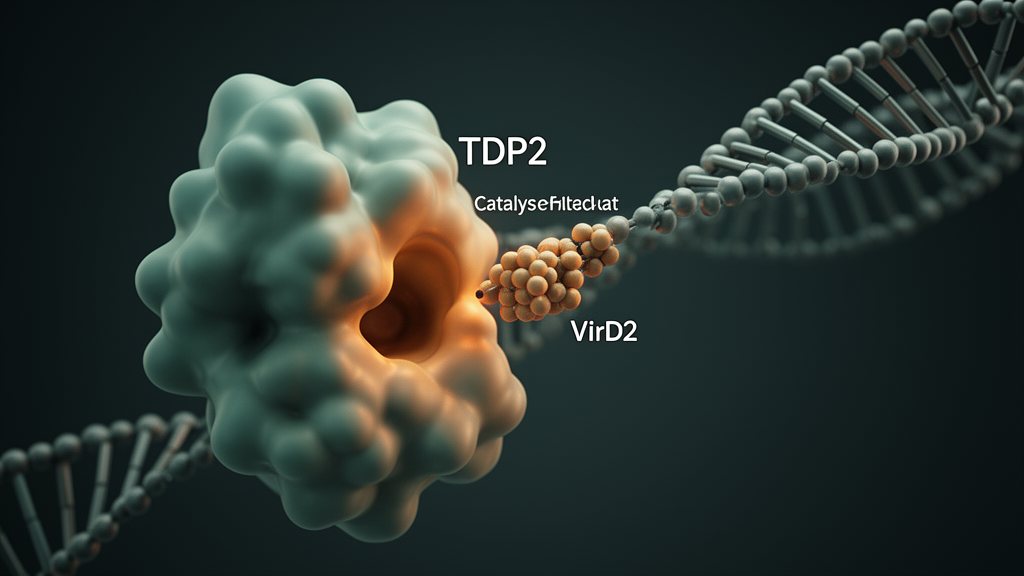
Researchers had proposed that TDP2, tyrosine phosphodiesterase 2, a protein known to resolve protein-DNA adducts, might provide the pathway for cleaving VirD2 from the T-complex, but this function had never been proven directly. To test it, the team developed a simple technique to generate fluorescently labeled VirD2-ssDNA complexes in vitro, establishing a tractable experimental system for studying VirD2 removal from synthetic T-complexes.

Using this system, the researchers mapped the DNA substrate requirements for VirD2-mediated formation of these complexes and then asked whether TDP2 could act on them. They found that TDP2 from both mammalian and plant sources specifically cleaved VirD2 from the synthetic T-complexes.

The activity was dependent on magnesium ions and required a conserved histidine residue in the C-terminal region of TDP2, indicating that the reaction follows the catalytic mechanism expected for this repair enzyme.

The authors note that these results strongly support the hypothesis that plant TDP2 can remove VirD2 from the T-DNA before its integration into the plant genome. Because the work was performed with synthetic complexes in vitro, it demonstrates biochemical capability rather than direct observation of the process inside plant cells, but it provides the first direct evidence that TDP2 can perform this cleavage on VirD2-T-DNA complexes.

Subject of Research: Removal of the Agrobacterium VirD2 protein from T-DNA complexes by the DNA repair protein TDP2

Article Title: Removal of VirD2 from a synthetic T-DNA complex of Agrobacterium by the host DNA repair protein TDP2

Article References: Lacroix, B., & Citovsky, V. (2026). Removal of VirD2 from a synthetic T-DNA complex of Agrobacterium by the host DNA repair protein TDP2. PLOS Pathogens, 22(10), e1014750. https://doi.org/10.1371/journal.ppat.1014750

Image Credits: AI Generated

DOI: 10.1371/journal.ppat.1014750

Keywords: Agrobacterium, T-DNA, VirD2, TDP2, DNA repair, protein-DNA adducts, genetic transformation, plant genome integration, tyrosine phosphodiesterase 2, in vitro biochemistry, Removal, synthetic

Cite Scienmag News

Juliet Wilcox. (October 26, 2026). Host repair protein TDP2 cleaves VirD2 from Agrobacterium T-DNA complexes. Scienmag. https://scienmag.com/host-repair-protein-tdp2-cleaves-vird2-from-agrobacterium-t-dna-complexes/

Juliet Wilcox. "Host repair protein TDP2 cleaves VirD2 from Agrobacterium T-DNA complexes." Scienmag, 26 October 2026, https://scienmag.com/host-repair-protein-tdp2-cleaves-vird2-from-agrobacterium-t-dna-complexes/. Accessed 26 October 2026.

Juliet Wilcox. "Host repair protein TDP2 cleaves VirD2 from Agrobacterium T-DNA complexes." Scienmag. October 26, 2026. https://scienmag.com/host-repair-protein-tdp2-cleaves-vird2-from-agrobacterium-t-dna-complexes/


Tags: AgrobacteriumAgrobacterium tumefaciensconserved histidine residueDNA repairDNA repair enzymesgenetic transformationhost repair proteins in gene transferin vitro biochemistrymagnesium-dependent enzymatic activityplant genetic transformationplant genome integrationprotein-DNA adduct resolutionprotein-DNA adductsremovalsyntheticT-DNAT-DNA integrationT-DNA transfer mechanismTDP2TDP2 enzyme functiontyrosine phosphodiesterase 2VirD2VirD2 cleavage assayVirD2 protein removalVirD2-ssDNA complex
Share26Tweet16
Previous Post

Blood Thinner Showdown: Enoxaparin Matches Heparin on Sepsis Survival

Next Post

Sleeping Too Little or Too Long Linked to Higher Brain Bleed Risk in Large UK Cohort

Related Posts

Sleeping Too Little or Too Long Linked to Higher Brain Bleed Risk in Large UK Cohort
Medicine

Sleeping Too Little or Too Long Linked to Higher Brain Bleed Risk in Large UK Cohort

October 26, 2026
Blood Thinner Showdown: Enoxaparin Matches Heparin on Sepsis Survival
Medicine

Blood Thinner Showdown: Enoxaparin Matches Heparin on Sepsis Survival

October 26, 2026
Fear, Denial and Appointment Delays Pushed Turkish Women to Late-Stage Breast Cancer
Medicine

Fear, Denial and Appointment Delays Pushed Turkish Women to Late-Stage Breast Cancer

October 26, 2026
SARS-CoV-2 antibodies found in up to 76 percent of people across three West African countries
Medicine

SARS-CoV-2 antibodies found in up to 76 percent of people across three West African countries

October 26, 2026
Thirteen practical tips to improve bacteriophage genome annotation
Biology

Thirteen practical tips to improve bacteriophage genome annotation

October 26, 2026
First Placebo-Controlled Trial Will Test Prednisone for Drug-Induced Liver Injury
Medicine

First Placebo-Controlled Trial Will Test Prednisone for Drug-Induced Liver Injury

October 26, 2026
Next Post
Sleeping Too Little or Too Long Linked to Higher Brain Bleed Risk in Large UK Cohort

Sleeping Too Little or Too Long Linked to Higher Brain Bleed Risk in Large UK Cohort

  • Mothers who receive childcare support from maternal grandparents show more optimized

    Mothers who receive childcare support from maternal grandparents show more parental warmth, finds NTU Singapore study

    27656 shares
    Share 11059 Tweet 6912
  • University of Seville Breaks 120-Year-Old Mystery, Revises a Key Einstein Concept

    1061 shares
    Share 424 Tweet 265
  • Bee body mass, pathogens and local climate influence heat tolerance

    682 shares
    Share 273 Tweet 171
  • Researchers record first-ever images and data of a shark experiencing a boat strike

    546 shares
    Share 218 Tweet 137
  • Groundbreaking Clinical Trial Reveals Lubiprostone Enhances Kidney Function

    531 shares
    Share 212 Tweet 133
Science

Embark on a thrilling journey of discovery with Scienmag.com—your ultimate source for cutting-edge breakthroughs. Immerse yourself in a world where curiosity knows no limits and tomorrow’s possibilities become today’s reality!

RECENT NEWS

  • Foxtail Millet Genotypes Show Stable High Yields Across Six Indian Environments
  • Sleeping Too Little or Too Long Linked to Higher Brain Bleed Risk in Large UK Cohort
  • Host repair protein TDP2 cleaves VirD2 from Agrobacterium T-DNA complexes
  • Blood Thinner Showdown: Enoxaparin Matches Heparin on Sepsis Survival

Categories

  • Agriculture
  • Anthropology
  • Archaeology
  • Athmospheric
  • Biology
  • Biotechnology
  • Blog
  • Bussines
  • Cancer
  • Chemistry
  • Climate
  • Earth Science
  • Editorial Policy
  • Marine
  • Mathematics
  • Medicine
  • Pediatry
  • Policy
  • Psychology & Psychiatry
  • Science Education
  • Science News
  • Social Science
  • Space
  • Technology and Engineering

Subscribe to Blog via Email

Enter your email address to subscribe to this blog and receive notifications of new posts by email.

Join 5,151 other subscribers

© 2025 Scienmag - Science Magazine

Welcome Back!

Login to your account below

Forgotten Password?

Retrieve your password

Please enter your username or email address to reset your password.

Log In
No Result
View All Result
  • HOME
  • SCIENCE NEWS
  • CONTACT US

© 2025 Scienmag - Science Magazine

Discover more from Science

Subscribe now to keep reading and get access to the full archive.

Continue reading