


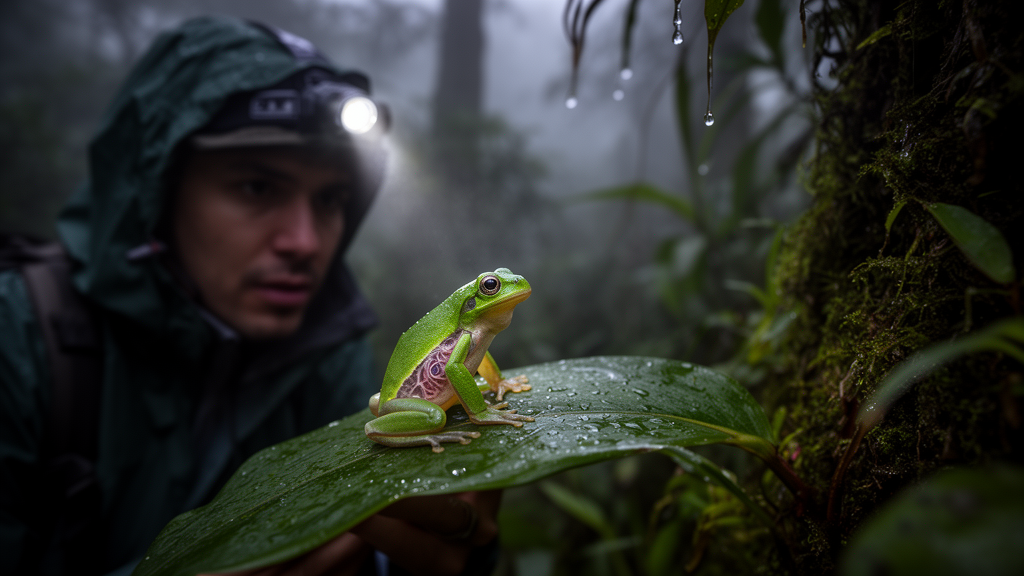
A glassfrog collected in central Peru and initially mistaken for a known species has turned out to be something entirely new. Researchers working near the town of Tingo Maria in the Departamento Huánuco have described Chimerella mira, the third recognized species in a little-known genus of transparent-bellied frogs, after molecular, morphological and bioacoustic analyses revealed that the specimens were far more divergent than their appearance suggested. The name mira, Latin for ‘surprising’, reflects the fact that the frogs looked, at first glance, like Chimerella corleone, a species described from north-eastern Peru.
The discovery began during fieldwork in November 2019, when the team collected two adult male glassfrogs on the bank of the Río Patay Rondos, roughly 16 kilometres west of Tingo Maria at 798 metres above sea level. Based on overall similarity and the fact that the site lies within the Huallaga river system, which also contains the type locality of C. corleone in the Cainarachi valley, the researchers tentatively identified the animals as that species. Only later, when they examined the preserved specimens in detail, sequenced molecular markers and analysed call recordings, did substantial differences emerge, pointing to an undescribed evolutionary lineage.
Glassfrogs of the family Centrolenidae are among the most distinctive frogs of the Neotropics, distributed from Mexico to Argentina and southeastern Brazil and famous for the partly transparent skin on their undersides. Currently 163 centrolenid species are recognized in twelve genera. The genus Chimerella was erected in 2009 for Chimerella mariaelenae from Ecuador, and a second species, C. corleone, was added in 2014 from the Cainarachi valley near Tarapoto in Departamento San Martín. Knowledge of both species remains sparse, making the confirmation of a third member of the genus particularly significant.
To resolve the relationships of the puzzling frogs, the team combined sequences of three mitochondrial genes, fragments of 12S and 16S rRNA and cytochrome b, totalling 2326 nucleotides, together with a 1021-nucleotide fragment of the single-copy nuclear gene Rag-1. The maximum likelihood analysis recovered three distinct and highly supported clades within Chimerella: one corresponding to C. corleone, one to C. mariaelenae, and a third containing the new central Peruvian samples, which emerged as sister to the C. corleone clade. Uncorrected p-distances in a 523-nucleotide fragment of the 16S gene ranged from 3.6 to 4.0 percent between the new species and C. corleone, and from 3.5 to 3.8 percent between the new species and C. mariaelenae, values similar to or higher than those recorded between other congeneric species pairs of centrolenids.
The nuclear data added an independent line of evidence. Among the limited Chimerella samples available, no haplotype sharing was detected in the Rag-1 gene, meaning that each of the three mitochondrial clades also carried its own distinct set of nuclear alleles. A formal species delimitation analysis using ASAP on a trimmed 475-base-pair alignment of the 16S fragment likewise supported three subsets, separating the central Peruvian frogs from both C. corleone and C. mariaelenae. One complication remains: three samples from higher elevations in the Departamentos Amazonas and San Martín, tentatively referred to as Chimerella sp., clustered with C. corleone in the mitochondrial tree with p-distances of only 0.2 to 0.6 percent, yet showed no Rag-1 haplotype sharing with it and differ markedly in morphology, a puzzle the authors defer to future research.
Morphology corroborated the genetic picture. The new frogs share the defining traits of Chimerella, including a humeral spine in males, a transparent ventral parietal peritoneum, and white pericardial, hepatic and visceral peritonea. But constant qualitative differences separate them from their relatives. In life, C. mira has a yellow-green dorsum dotted with small round pale-yellowish flecks, a silvery white iris with fine black spotting and a dark brown median streak, and a truncate snout in lateral profile. C. corleone, by contrast, shows a dark green dorsum, a silvery grey iris with dark reticulation and a slightly rounded snout, while C. mariaelenae has a green dorsum with black flecks and an orange to reddish iris. Iris colouration, though seemingly subtle, has proven a reliable diagnostic character in many frog groups, including centrolenids.
The most striking divergence came from sound. The advertisement calls of C. mira consist of two to three high-pitched pulsed notes of the ‘Trii’ type, with note durations of 42 to 85 milliseconds and a dominant frequency of 5543 to 6135 hertz. Calls of C. corleone and C. mariaelenae instead contain simple single-pulse ‘Tic’ notes, with note durations of only 10 to 15 and 4 to 7 milliseconds respectively. According to the authors, these differences far exceed what is normally seen as intraspecific call variation, which is particularly telling in centrolenids, a family in which different species often sound remarkably alike. The calls were recorded at approximately 25 degrees Celsius from males sitting on the upper surfaces of leaves 0.5 to 2.5 metres above the ground, calling in near-synchronous waves during light rainfall.
The formal description rests on two adult males deposited in Peruvian collections in Lima. The holotype, an adult male with a snout-vent length of 19.6 millimetres, was collected on 6 November 2019, and the paratype, measuring 18.1 millimetres, one day earlier. Both were found in a swampy area apparently temporarily flooded by the river, with small lentic waterbodies, emerging shrub vegetation and younger trees. Other anurans recorded in sympatry included Boana lanciformis, Leptodactylus griseigularis and an undetermined Adenomera, while the glassfrog Hyalinobatrachium carlesvilai occurred within a few hundred metres. Egg clutches and tadpoles of the new species remain unknown, and fine transverse scratches on the paratype’s anterior dorsum suggest that male-male fighting behaviour, common in some glassfrogs, may occur.
The habitat itself adds an ecological twist. C. corleone is known exclusively from vegetation on vertical rock walls within the spray zone at the edge of waterfalls, whereas C. mira was found at the exposed edge of a comparatively large river, without rock walls or spray. The authors note that this agrees with earlier observations that congeneric centrolenids can use different habitat types, and that some glassfrog species appear more flexible in habitat choice than others. How C. mira larvae survive in a river prone to high water and strong current during the rainy season remains an open question; the frogs were found at the beginning of the rains, and the authors hypothesize that reproduction may occur outside that season or that slow-running conditions among the small trees may allow larval development.
So far, C. mira is known only from its type locality, though it may be more widespread in the Huallaga River basin at similar elevations. Because population size and actual range are unknown, the authors propose the IUCN Red List category ‘Data Deficient’. Beyond the new species itself, the study highlights how much remains hidden among Neotropical glassfrogs, particularly in Peru, where the authors describe the group as markedly understudied. The unresolved status of the high-elevation Chimerella populations in Amazonas and San Martín, morphologically distinct yet genetically close to C. corleone in mitochondrial markers, underscores that point and is the subject of a planned future contribution.
Subject of Research: Description of a new glassfrog species, Chimerella mira, from central Peru using genetic, morphological and bioacoustic evidence
Article Title: A third species of glassfrog in the genus Chimerella ( Anura , Centrolenidae ) from central Peru, discovered by an integrative taxonomic approach
Article References: Köhler, J., Venegas, P. J., Castillo-Urbina, E., Glaw, F., Aguilar-Puntriano, C., & Vences, M. (2023). A third species of glassfrog in the genus Chimerella (Anura, Centrolenidae) from central Peru, discovered by an integrative taxonomic approach. Evolutionary Systematics, 7(2), 195-209. https://doi.org/10.3897/evolsyst.7.102950
Image Credits: AI Generated
DOI: 10.3897/evolsyst.7.102950
Keywords: glassfrog, Chimerella mira, Peru, new species, taxonomy, Centrolenidae, bioacoustics, phylogenetics, amphibians, Huallaga basin, species delimitation, herpetology
Cite Scienmag News
Drew Townsend. (October 26, 2026). New glassfrog species surprises scientists in central Peru after field mix-up. Scienmag. https://scienmag.com/new-glassfrog-species-surprises-scientists-in-central-peru-after-field-mix-up/
Drew Townsend. "New glassfrog species surprises scientists in central Peru after field mix-up." Scienmag, 26 October 2026, https://scienmag.com/new-glassfrog-species-surprises-scientists-in-central-peru-after-field-mix-up/. Accessed 26 October 2026.
Drew Townsend. "New glassfrog species surprises scientists in central Peru after field mix-up." Scienmag. October 26, 2026. https://scienmag.com/new-glassfrog-species-surprises-scientists-in-central-peru-after-field-mix-up/


