


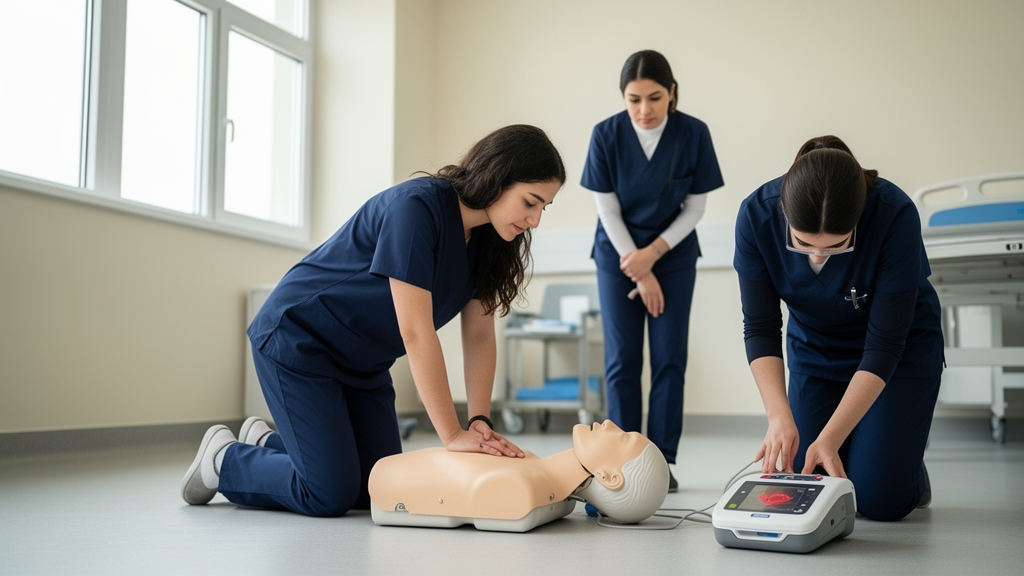
Undergraduate nursing students in Palestine scored, on average, just above sixty percent on a test of Basic Life Support knowledge and reported only low-to-moderate confidence in their abilities related to Advanced Cardiovascular Life Support, according to a cross-sectional study published in BMC Medical Education. The survey of 428 nursing students at two Palestinian universities also found that students who knew more about BLS tended to feel more confident about ACLS, a link the authors describe as educationally relevant but not proof that one causes the other.
The research team, led by Eba’a Dasan Barghouthi and colleagues, used a self-reported questionnaire covering demographics, academic details, seventeen multiple-choice questions on BLS knowledge, and sixteen five-point Likert-scale items measuring self-confidence in ACLS. On the knowledge test, students achieved a mean score of 10.38 out of 17, equivalent to 61.06 percent with a standard deviation of 18.03. On the confidence scale, the mean total was 37.36 out of 80, with a mean item score of 2.33 out of 5. The researchers report that the knowledge test showed modest internal consistency, with a KR-20 coefficient of .605, while the confidence scale showed excellent reliability, with Cronbach’s alpha of .918.
Statistical analysis revealed a positive correlation between BLS knowledge and ACLS self-confidence, with a Pearson coefficient of r = .413 (p < .001). Both knowledge and confidence were higher among students who had previously attended BLS or CPR classes, who had real experience performing resuscitation, and who had reached a more advanced academic year, with all of these differences statistically significant at p < .001. In a multiple linear regression model, four factors were independently associated with ACLS self-confidence: academic year (β = .329, p < .001), previous attendance at BLS/CPR classes (β = .222, p < .001), BLS knowledge (β = .179, p < .001), and actual resuscitation experience (β = .119, p = .003). Together, these variables accounted for 37.1 percent of the variability in self-confidence scores, with an adjusted R² of .362.
The authors interpret these findings as pointing to the combined importance of formal training, hands-on experience, and academic progression in shaping how prepared nursing students feel for advanced resuscitation scenarios. Because the study was cross-sectional, it captures a single point in time and can identify associations but cannot establish causal effects of training, experience, or academic advancement on confidence. The modest reliability of the BLS knowledge test also means the knowledge measure itself carries some measurement imprecision, a limitation the researchers acknowledge in reporting their psychometric results.
Within the scope of the study population, the picture that emerges is one of moderate factual knowledge about basic resuscitation paired with self-assessed confidence in advanced cardiovascular care that averages below the midpoint of the five-point scale. Students further along in their programs, those with additional BLS or CPR coursework, and those who had actually performed resuscitation reported consistently higher confidence, and greater BLS knowledge tracked with greater confidence even after accounting for the other factors in the regression model. The authors suggest that understanding the relationship between objective BLS knowledge and perceived ACLS confidence could inform how resuscitation training is structured in nursing education, while framing their conclusions carefully as identifying educationally relevant associations rather than demonstrating that any particular intervention would raise knowledge or confidence.
Subject of Research: Basic Life Support knowledge and Advanced Cardiovascular Life Support self-confidence among undergraduate nursing students in Palestine
Article Title: Nursing students’ knowledge of Basic Life Support (BLS) and self-confidence in Advanced Cardiovascular Life Support (ACLS) in Palestine
Article References: Barghouthi, E. D., Marawaa, A., Khalid, H., & Abbad, Y. (2026). Nursing students’ knowledge of Basic Life Support (BLS) and self-confidence in Advanced Cardiovascular Life Support (ACLS) in Palestine. BMC Medical Education. https://doi.org/10.1186/s12909-026-10675-z
Image Credits: AI Generated
DOI: 10.1186/s12909-026-10675-z
Keywords: Basic Life Support, Advanced Cardiovascular Life Support, nursing students, Palestine, cross-sectional study, resuscitation training, self-confidence, CPR education, BMC Medical Education, nursing education, Nursing, students
Cite Scienmag News
Courtney Benton. (October 26, 2026). Nursing Students in Palestine Show Moderate BLS Knowledge and Modest ACLS Confidence. Scienmag. https://scienmag.com/nursing-students-in-palestine-show-moderate-bls-knowledge-and-modest-acls-confidence/
Courtney Benton. "Nursing Students in Palestine Show Moderate BLS Knowledge and Modest ACLS Confidence." Scienmag, 26 October 2026, https://scienmag.com/nursing-students-in-palestine-show-moderate-bls-knowledge-and-modest-acls-confidence/. Accessed 26 October 2026.
Courtney Benton. "Nursing Students in Palestine Show Moderate BLS Knowledge and Modest ACLS Confidence." Scienmag. October 26, 2026. https://scienmag.com/nursing-students-in-palestine-show-moderate-bls-knowledge-and-modest-acls-confidence/


