


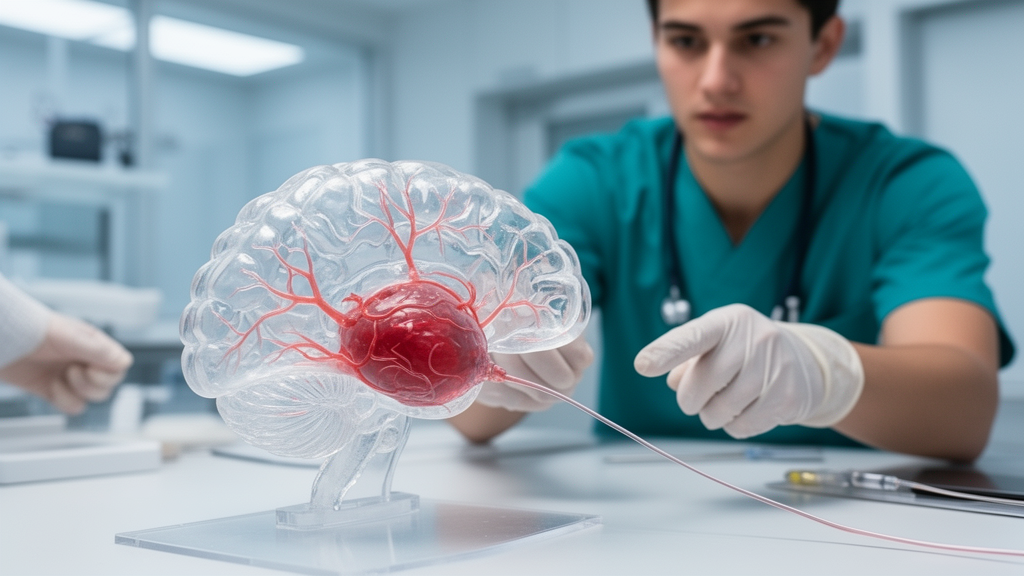
Medical students who trained on a low-cost, 3D-printed model of a cerebral aneurysm gained slightly more knowledge than classmates who received lectures alone, but the hands-on sessions did not measurably improve their practical skills, motivation, or interest in interventional radiology. That is the central finding of a prospective, nonrandomized study published in BMC Medical Education, in which 45 medical students were assigned by their pre-existing clerkship groups to lecture-only, lecture-first, or simulation-first training, with 39 students completing the full protocol and entering the final analysis. The simulation used a 3D-printed replica of a cerebral aneurysm.
Students in the simulation groups handled actual endovascular devices, practicing microcatheter navigation through the printed anatomy. The study team tracked how long participants needed to complete microcatheter tracking as an objective skill measure, alongside examiner-rated skill assessments, written knowledge tests, and self-reported questionnaires covering motivation to learn and interest in interventional radiology. Longitudinal outcomes were analyzed using mixed-design analyses of variance.
Knowledge scores rose over the course of the training in all groups, and students who received any simulation component scored higher overall than the lecture-only group, a between-group difference that reached statistical significance at p = 0.047. Yet the pattern reversed for motivation: the lecture-only group reported higher motivation scores overall, with a main effect of group at p = 0.015. No significant group effects emerged for interest in interventional radiology (p = 0.775), skill assessment scores (p = 0.432), or microcatheter tracking time (p = 0.185), and no significant group-by-time interactions appeared for any of these outcomes—meaning the trajectories of change over time were statistically indistinguishable across the training formats.
The instructional sequence question produced an equally sobering result. Whether students attended the lecture before the simulation or the simulation before the lecture made no detectable difference to knowledge: the comparison between the lecture-first and simulation-first groups showed no overall group effect (p = 0.374) and no significant group-by-time interaction. Both simulation groups nonetheless rated their experience enthusiastically, with a median satisfaction score of 10 out of 10, suggesting that the hands-on format itself resonated with learners even where measurable educational gains did not diverge from conventional teaching.
The authors describe the 3D-printed aneurysm model as low-cost, and it gave medical students direct contact with real endovascular devices—experience that lecture-based teaching alone cannot provide. The near-perfect satisfaction ratings indicate the model succeeded on that experiential level, and the authors suggest it may offer an accessible option for neurointerventional education. The study's conclusions, however, are appropriately restrained.
The authors state plainly that greater improvements in knowledge, skills, motivation, or interest with simulation-inclusive education were not demonstrated, nor was the superiority of either instructional sequence established. Because allocation followed pre-existing clerkship groups rather than randomization, the three cohorts could have differed in ways that influenced the results, and the modest sample of 39 analyzed students limits statistical power to detect small effects. The knowledge advantage for simulation-inclusive training, while statistically significant, should be read as an association observed in a small nonrandomized comparison rather than proof of a causal benefit.
What the study does establish is feasibility and acceptability. A 3D-printed cerebral aneurysm model allowed medical students to practice endovascular maneuvers with actual devices, and they valued the experience highly.
Subject of Research: Simulation-based neurointerventional education using a 3D-printed cerebral aneurysm model among medical students
Article Title: Effects of neurointerventional simulation training and instructional sequence using a 3D-printed cerebral aneurysm model: a prospective nonrandomized study among medical students
Article References: Ebisudani, Y., Haruma, J., Miyoshi, T., Sugiu, K., Hiramatsu, M., Murai, S., Kimura, R., Edaki, H., Kawakami, M., Sotome, Y., Date, I., & Tanaka, S. (2026). Effects of neurointerventional simulation training and instructional sequence using a 3D-printed cerebral aneurysm model: a prospective nonrandomized study among medical students. BMC Medical Education. https://doi.org/10.1186/s12909-026-10691-z
Image Credits: AI Generated
DOI: 10.1186/s12909-026-10691-z
Keywords: medical education, simulation training, 3D printing, cerebral aneurysm, neurointervention, interventional radiology, medical students, microcatheter, nonrandomized study, endovascular devices, Effects, neurointerventional
Cite Scienmag News
Courtney Benton. (October 26, 2026). 3D-Printed Aneurysm Model Lets Medical Students Try Neurointervention Hands-On. Scienmag. https://scienmag.com/3d-printed-aneurysm-model-lets-medical-students-try-neurointervention-hands-on/
Courtney Benton. "3D-Printed Aneurysm Model Lets Medical Students Try Neurointervention Hands-On." Scienmag, 26 October 2026, https://scienmag.com/3d-printed-aneurysm-model-lets-medical-students-try-neurointervention-hands-on/. Accessed 26 October 2026.
Courtney Benton. "3D-Printed Aneurysm Model Lets Medical Students Try Neurointervention Hands-On." Scienmag. October 26, 2026. https://scienmag.com/3d-printed-aneurysm-model-lets-medical-students-try-neurointervention-hands-on/


