

Monday, October 26, 2026
Science
No Result
View All Result
  • Login
  • HOME
  • SCIENCE NEWS
  • CONTACT US
  • HOME
  • SCIENCE NEWS
  • CONTACT US
No Result
View All Result
Scienmag
No Result
View All Result
Home Science News Technology and Engineering

Porous adhesive layer roughly doubles bonding strength between dissimilar materials

October 26, 2026
in Technology and Engineering
Denise Maddox
By Denise Maddox Scienmag Editorial Profile - Mechanical Engineering
Reading Time: 3 mins read
0
Porous adhesive layer roughly doubles bonding strength between dissimilar materials

Porous adhesive layer roughly doubles bonding strength between dissimilar materials

65
SHARES
587
VIEWS
Share on FacebookShare on Twitter
ADVERTISEMENT

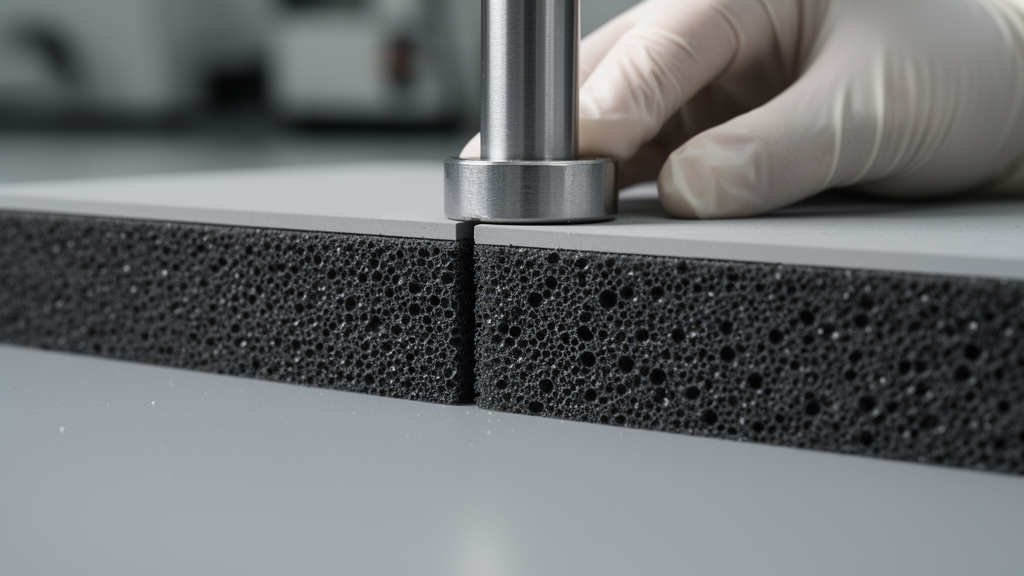
Researchers at the National Institute for Materials Science (NIMS) in Japan have developed a simple coating-and-drying process that creates a porous “anchor” layer capable of strongly bonding materials that normally refuse to stick together. The team, led by Shunto Arai of the Research Center for Macromolecules and Biomaterials, showed that a mesh-like film with nanometer- to micrometer-sized pores can join a flexible polymer to glass with a strength exceeding 7 megapascals, approximately double the vertical tensile strength achieved without the structured layer. The work was published in the journal Small on September 10, 2026.

The method exploits a physical phenomenon called viscoelastic phase separation. When a carefully formulated solution is coated onto a surface and dried, the components separate as the solvent evaporates, spontaneously organizing into a mesh-like porous structure that the researchers call a printable porous anchor (PPA). No scratching, etching, or other surface treatment of the substrates is required. The resulting layer works through a hybrid mechanism: on one side it adheres to a substrate such as glass through chemical affinity, while on the other side its tiny pores allow a soft polymer to become incorporated into the structure, creating a mechanical anchor effect through physical interlocking.

This dual mechanism addresses a long-standing limitation in multi-material manufacturing. Combining hard materials such as metals, glass, and ceramics with soft polymers like rubber and plastics is increasingly important for lightweight vehicles, flexible electronics, and soft robots, yet dissimilar materials are notoriously difficult to bond. Conventionally, engineers have had to design and develop a bespoke adhesive for each material pairing, a case-by-case approach that adds cost and complexity. An alternative of roughening substrate surfaces through mechanical scratching or chemical etching can improve adhesion, but it increases energy consumption, complicates the manufacturing process, and generates processing residues that raise environmental concerns.

In their experiments, the team applied the PPA between glass and a flexible polymer that has low intrinsic adhesion to glass. The structured layer approximately doubled the vertical tensile strength compared with conventional bonding, with the joint exceeding 7 MPa. The researchers attribute this resistance to interfacial fracture to the topology of the adhesive layer itself: rather than relying solely on chemical compatibility between the adhesive and both substrates, the porous structure converts part of the load into mechanical interlocking, so the joint no longer depends entirely on finding a chemistry that works for both sides of the interface.

The NIMS team positions the PPA as a potential platform technology rather than a single-purpose adhesive. Because the porous layer is printable and can be formed by simple solution coating and drying, the same structural principle could in principle accommodate a wide variety of material combinations without redesigning the adhesive for each one. The researchers are currently pursuing two extensions: imparting conductivity to the anchor layer so that bonded interfaces can also dissipate heat and maintain electrical connectivity, and formulating the layer from highly heat-resistant materials capable of withstanding harsh environments.

If those development efforts succeed, the technology could expand design flexibility in fields where multi-material structures are expected to become essential, including next-generation mobility, wearable devices, and soft robotics. For now, the reported results establish that structuring the adhesive layer itself, rather than the substrate surfaces, offers a route to strong joints between incompatible materials, achieved with nothing more elaborate than coating a solution and letting it dry.

Subject of Research: A porous adhesive layer formed by solution coating and drying that bonds dissimilar materials through combined chemical affinity and mechanical interlocking

Article Title: “Porous anchor” that strongly bonds dissimilar materials formed simply by coating and drying

Article References: “Porous anchor” that strongly bonds dissimilar materials formed simply by coating and drying. Original publication (Bibliographic details unavailable.)

Image Credits: AI Generated

DOI: Not provided

Keywords: adhesives, dissimilar materials, porous anchor, viscoelastic phase separation, multi-material structures, bonding strength, NIMS, polymers, glass, materials science, soft robotics, manufacturing

Cite Scienmag News

Denise Maddox. (October 26, 2026). Porous adhesive layer roughly doubles bonding strength between dissimilar materials. Scienmag. https://scienmag.com/porous-adhesive-layer-roughly-doubles-bonding-strength-between-dissimilar-materials/


Denise Maddox. "Porous adhesive layer roughly doubles bonding strength between dissimilar materials." Scienmag, 26 October 2026, https://scienmag.com/porous-adhesive-layer-roughly-doubles-bonding-strength-between-dissimilar-materials/. Accessed 26 October 2026.

Denise Maddox. "Porous adhesive layer roughly doubles bonding strength between dissimilar materials." Scienmag. October 26, 2026. https://scienmag.com/porous-adhesive-layer-roughly-doubles-bonding-strength-between-dissimilar-materials/

Tags: adhesivesadvanced materials sciencebonding dissimilar materials without surface treatmentbonding strengthdissimilar materialsglassimproving interface strength between dissimilar substratesinnovative coating-and-drying method for material bondingmanufacturingmaterials sciencemechanically interlocking porous films for strong adhesionmulti-material structuresnanometer- to micrometer-sized pore structures in adhesivesnanostructured adhesive layers for flexible polymers and glassNIMSphysical and chemical adhesion mechanisms in porous coatingspolymersPorous adhesive layer for enhanced bonding strengthporous anchorprintable porous anchor (PPA) for material adhesionsoft roboticsviscoelastic phase separationviscoelastic phase separation in coating processes
Share26Tweet16
Previous Post

Parasite Defies Textbook Genetics With Hundreds of Centromeres Scattered Across Its Chromosomes

Next Post

New Creatine Derivatives Show Memory and Motor Gains in Mice, but Antidepressant Effects Remain Elusive

Related Posts

Why Gamified Fitness Apps in Dutch Municipalities Rarely Move Beyond the Pilot Stage
Medicine

Why Gamified Fitness Apps in Dutch Municipalities Rarely Move Beyond the Pilot Stage

October 26, 2026
Al2O3 Buffer Layer Separates Strain from Interface Effects in Crystallized Ge Films
Technology and Engineering

Al2O3 Buffer Layer Separates Strain from Interface Effects in Crystallized Ge Films

October 26, 2026
Simple Muscle Signal Pipeline Drives Robotic Arm, But Speed Remains a Hurdle
Science News

Simple Muscle Signal Pipeline Drives Robotic Arm, But Speed Remains a Hurdle

October 26, 2026
Roads on the Brink: Mapping Compound Earthquake and Landslide Vulnerability in Ethiopia’s Rift
Technology and Engineering

Roads on the Brink: Mapping Compound Earthquake and Landslide Vulnerability in Ethiopia’s Rift

October 26, 2026
Hydrogen combustion retrofitted into an existing aircraft APU: thermodynamic feasibility
Science News

Hydrogen combustion retrofitted into an existing aircraft APU: thermodynamic feasibility

October 26, 2026
Platelet-Rich Plasma in Collagen Tubes Restores Nerve Function in Difficult Cases
Science News

Platelet-Rich Plasma in Collagen Tubes Restores Nerve Function in Difficult Cases

October 26, 2026
Next Post
New Creatine Derivatives Show Memory and Motor Gains in Mice, but Antidepressant Effects Remain Elusive

New Creatine Derivatives Show Memory and Motor Gains in Mice, but Antidepressant Effects Remain Elusive

  • Mothers who receive childcare support from maternal grandparents show more optimized

    Mothers who receive childcare support from maternal grandparents show more parental warmth, finds NTU Singapore study

    27656 shares
    Share 11059 Tweet 6912
  • University of Seville Breaks 120-Year-Old Mystery, Revises a Key Einstein Concept

    1061 shares
    Share 424 Tweet 265
  • Bee body mass, pathogens and local climate influence heat tolerance

    682 shares
    Share 273 Tweet 171
  • Researchers record first-ever images and data of a shark experiencing a boat strike

    546 shares
    Share 218 Tweet 137
  • Groundbreaking Clinical Trial Reveals Lubiprostone Enhances Kidney Function

    531 shares
    Share 212 Tweet 133
Science

Embark on a thrilling journey of discovery with Scienmag.com—your ultimate source for cutting-edge breakthroughs. Immerse yourself in a world where curiosity knows no limits and tomorrow’s possibilities become today’s reality!

RECENT NEWS

  • New Creatine Derivatives Show Memory and Motor Gains in Mice, but Antidepressant Effects Remain Elusive
  • Porous adhesive layer roughly doubles bonding strength between dissimilar materials
  • Parasite Defies Textbook Genetics With Hundreds of Centromeres Scattered Across Its Chromosomes
  • Genetic influence on behaviour and disease measured in 500,000 sibling pairs

Categories

  • Agriculture
  • Anthropology
  • Archaeology
  • Athmospheric
  • Biology
  • Biotechnology
  • Blog
  • Bussines
  • Cancer
  • Chemistry
  • Climate
  • Earth Science
  • Editorial Policy
  • Marine
  • Mathematics
  • Medicine
  • Pediatry
  • Policy
  • Psychology & Psychiatry
  • Science Education
  • Science News
  • Social Science
  • Space
  • Technology and Engineering

Subscribe to Blog via Email

Enter your email address to subscribe to this blog and receive notifications of new posts by email.

Join 5,151 other subscribers

© 2025 Scienmag - Science Magazine

Welcome Back!

Login to your account below

Forgotten Password?

Retrieve your password

Please enter your username or email address to reset your password.

Log In
No Result
View All Result
  • HOME
  • SCIENCE NEWS
  • CONTACT US

© 2025 Scienmag - Science Magazine

Discover more from Science

Subscribe now to keep reading and get access to the full archive.

Continue reading