


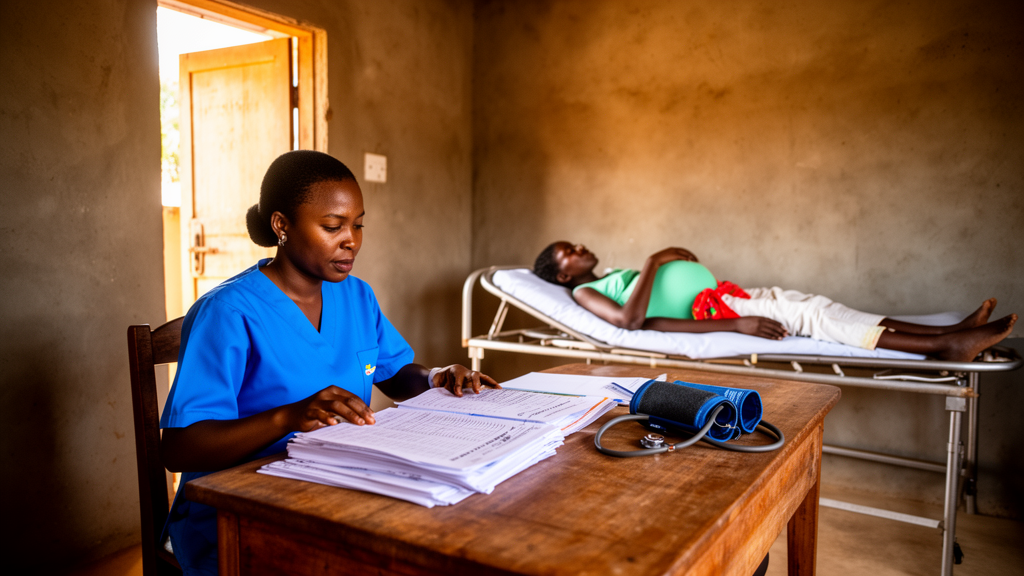
In the maternity wards of rural Malawi, there is no national protocol for obstetric triage. No color-coded acuity scale, no formal five-level classification system, no laminated algorithm taped to the admissions desk. And yet, when a woman in labor arrives at the hospital gate, decisions about who gets seen first, who gets a bed, and who gets sent to wait in a courtyard are made within minutes. A new qualitative study published in PLOS Global Public Health reveals how this invisible system actually works: not through formal triage tools, but through standardized admission forms, a shared vocabulary of danger signs, and a four-centimeter cervical dilation threshold that quietly divides the urgent from the not-yet-urgent.
The research, led by Emily Bundy of Karolinska Institutet together with colleagues at Kamuzu University of Health Sciences in Blantyre, examined how hospital-based admission procedures for childbirth are experienced by the people who live them: maternity care providers, laboring women, and their companions. The team collected data at two rural hospitals in Malawi’s central region, one a public district hospital providing free maternity care and the other a faith-based facility operating on a fee-for-service model. Both were chosen because they handled at least 2,500 births per year and offered cesarean sections and blood transfusions, making them representative of the higher-tier rural facilities where complicated deliveries end up. The public hospital ran with roughly eight midwives per shift managing around 30 births a day; the faith-based hospital fielded about four midwives per shift for an average of 15 daily deliveries.
The stakes of these admission decisions are considerable. Sub-Saharan Africa carries an estimated maternal mortality burden of 545 deaths per 100,000 live births and neonatal mortality of 28 deaths per 1,000 live births, and delays in receiving appropriate emergency care within health facilities are a leading contributor to perinatal death in Malawi. Inadequate triage, shortages of equipment and drugs, poor blood supply, and overburdened staff all compound these delays. Yet while standardized obstetric triage systems have been shown to reduce waiting times and improve diagnostic accuracy in both high- and low-resource settings, Malawi has no national guidelines for obstetric triage, leaving admission decisions entirely in the hands of labor ward staff.
What Bundy’s team found is that in the absence of formal triage instruments, the humble obstetric admission form has become the de facto organizing framework. The forms used at both hospitals, despite slight variations, all included explicit screening for danger signs such as bleeding, fluid loss, severe pain, headache, and fever, along with obstetric history, physical examination, and a care plan. Although the forms were never designed as triage tools, providers used them to determine patient acuity, direct clinical decisions, and manage the flow of women through the maternity unit. The form’s stepwise design also served a pedagogical function: during crowded periods, junior providers and students could sit at the admissions table completing initial assessments while a senior midwife reviewed the information and made the final call on disposition.
One of the study’s most striking findings concerns the liminal space between arrival and admission. Women in latent labor, those whose cervix had not yet reached the four-centimeter threshold marking active labor, occupied an ambiguous clinical status. At the public hospital, they were directed to a tin-roofed cement structure in the hospital courtyard, physically on hospital grounds but separate from the labor ward, where they waited with intermittent observation, storing belongings and preparing food. Providers framed this as a proactive mortality-reducing measure: keeping high-risk mothers close to medical care rather than sending them home, where distance and transportation barriers could prove fatal if labor progressed quickly. But women and companions often read the delay differently. “If they go to a latent room, if she feels pain say it is not yet time so they are suffering instead of helping us,” one companion at the public hospital told the researchers.
Danger signs emerged as the true currency of the admission process. Severe bleeding, a fast heartbeat, headache, and vomiting were recognized not only by providers but by women and their companions, creating what the authors describe as a shared marker of obstetric risk. When a woman arrived with no danger signs, she moved through the routine admissions pathway. When a danger sign appeared, the standardized sequence was immediately interrupted and she was repositioned into an emergency category. “When a person comes like in a labour room she reaches on the station and we greet her and ask for danger signs. Danger signs are signs that the person is showing, e.g., losing blood and having a fast heartbeat,” a provider at the faith-based hospital explained. During high patient volumes, particularly at the frequently overcrowded public hospital, this danger-sign-based prioritization functioned as triage in all but name. “When the patients are many we do try to use triage because we only have few rooms and we may not take them all in,” one provider there said.
The system was also deliberately flexible at the top. With high-acuity mothers, providers abandoned the written form altogether and switched to rapid verbal questioning, sometimes beginning medical intervention before the history was complete. “Taking the history of the patient is a long process so to avoid losing the life of a patient we start intervening before a completion of history taking,” a public hospital provider reported. Documentation was completed retroactively once the patient was stabilized. The public hospital went further, assigning specific rooms to particular danger signs, with dedicated spaces for pre-eclampsia, eclampsia, and hemorrhage cases. Providers also directed extra attention and emotional care toward mothers with a history of poor outcomes, such as a woman in her sixth pregnancy with no living child.
But the same standardization that created clinical order also created social boundaries. The study, which drew on the anthropologist Mary Douglas’s concepts of purity, danger, and risk to interpret its findings, found that communication during admissions was selectively restricted. Providers rarely introduced themselves, making it difficult for mothers to identify their caregivers or lodge complaints. Consent for physical examination was inconsistent, requested by some providers and skipped by others. After an initial greeting, the admissions process became largely interrogative, with the patient unable to ask her own questions. Observers noted that “patients had little to say. Most of the time it was the nurse giving instructions or asking questions. The patient was mostly at the receiving end.” Companions, meanwhile, were expected to attend to women’s physical needs but excluded from clinical discussions, their involvement legitimized only when formal consent for cesarean delivery was required. “They don’t consider guardians as important, they only value us when we come with the patient and when they want our consent but to be walking side by side in the whole process, no,” one companion said.
The COVID-19 pandemic sharpened these exclusions. At the faith-based facility, only one companion was allowed at a time, and companions were sometimes sent out at night, told they might infect the babies, or relegated to sleeping in an outside kitchen. Masking requirements and a ticket system for entering the unit further restricted access. The authors caution that it is difficult to disentangle the effects of established ward practices from pandemic-era infection control measures within their data, a limitation they acknowledge alongside incomplete demographic information for some participants and the absence of public involvement in shaping the research questions or interpretation.
The study’s conclusions point toward what the authors call individualized standardization: preserving the risk classification and clinical efficiency that standardized admission procedures demonstrably provide, while building in person-centered communication and defined points for companion engagement. Suggested approaches include modifying admission forms to capture patient preferences alongside danger signs, establishing explicit moments when companions are included in discussions, and in-service training emphasizing respectful communication and shared decision-making. In settings where a handful of midwives face dozens of deliveries a day with basic equipment, the danger-sign framework remains a cost-sensitive, potentially life-saving measure. The challenge, the researchers argue, is not the absence of standardization but the fact that existing classifications prioritize physiological risk while leaving little room for the emotional and relational dimensions of childbirth, dimensions that, when ignored, can leave women feeling abandoned in the very institutions meant to protect them.
Subject of Research: Obstetric admission and triage practices in rural Malawian hospitals
Article Title: Creating order in the uncertainty of childbirth: A qualitative study of obstetric admission and triage practices in rural Malawi
Article References: Bundy, E., Kandeya, B., Chimwaza, W., Hanson, C., Chipeta, E., & Alvesson, H. M. (2026). Creating order in the uncertainty of childbirth: A qualitative study of obstetric admission and triage practices in rural Malawi. PLOS Global Public Health, 6(10), e0006312. https://doi.org/10.1371/journal.pgph.0006312
Image Credits: AI Generated
DOI: 10.1371/journal.pgph.0006312
Keywords: obstetric triage, Malawi, maternal health, qualitative research, danger signs, labor ward, person-centered care, perinatal mortality, standardization, companions, midwives, low-resource settings
Cite Scienmag News
Harold Sullivan. (October 26, 2026). In rural Malawi, childbirth triage runs on danger signs and paper forms, not formal protocols. Scienmag. https://scienmag.com/in-rural-malawi-childbirth-triage-runs-on-danger-signs-and-paper-forms-not-formal-protocols/
Harold Sullivan. "In rural Malawi, childbirth triage runs on danger signs and paper forms, not formal protocols." Scienmag, 26 October 2026, https://scienmag.com/in-rural-malawi-childbirth-triage-runs-on-danger-signs-and-paper-forms-not-formal-protocols/. Accessed 26 October 2026.
Harold Sullivan. "In rural Malawi, childbirth triage runs on danger signs and paper forms, not formal protocols." Scienmag. October 26, 2026. https://scienmag.com/in-rural-malawi-childbirth-triage-runs-on-danger-signs-and-paper-forms-not-formal-protocols/


