


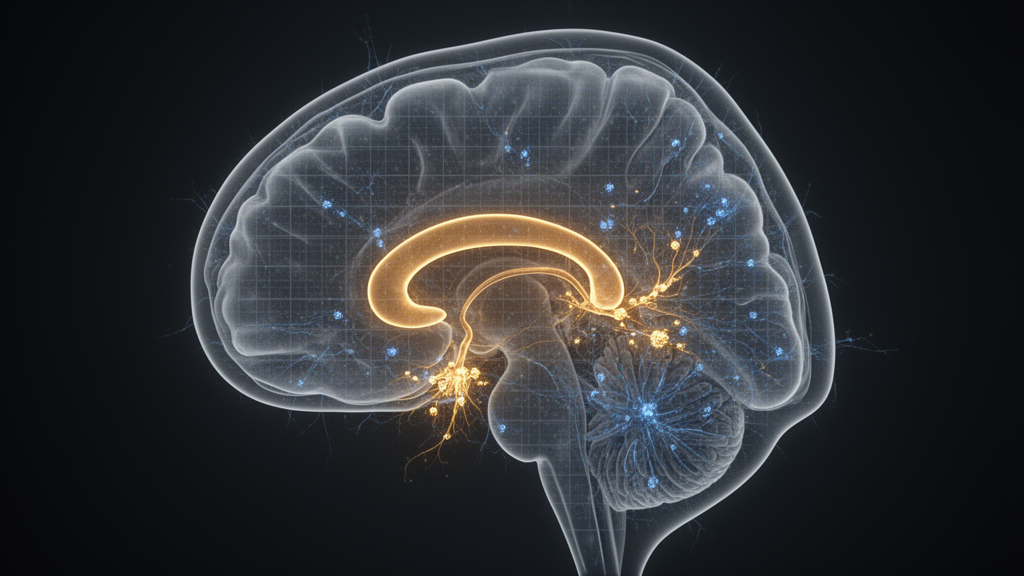
Some of the most consequential lessons of a social life are never experienced firsthand. A child watches a parent flinch at a particular situation and adjusts future behavior accordingly. A pedestrian sees someone slip and fall on an icy street corner and quietly files that location away as dangerous. This capacity to convert the witnessed experiences of others into one’s own memories is a defining feature of social species, yet the neural machinery behind it has remained largely opaque. New research from the Social Brain Lab at the Netherlands Institute for Neuroscience, led by Frédéric Michon Linde in the groups of Valeria Gazzola and Christian Keysers, now offers a single-neuron-level view of how the rat brain performs this transformation, and the results suggest that the hippocampus serves as the meeting point between another individual’s experience and one’s own map of space.
The study, published in Nature Communications, rests on a simple but powerful premise. As Linde puts it, a great deal of what social animals learn does not come from direct experience but from observing what happens to others. That is an extraordinarily efficient strategy: an animal can learn to avoid danger without ever having to suffer it. Learning from others is not a uniquely human talent. Rodents also learn from each other, which makes the rat a suitable model for asking what individual neurons do when an animal witnesses a salient event befall somebody else. In humans, the researchers explain, we already knew that seeing someone else in pain triggers a feeling of pain in the observer, but what remained unclear was which brain process turned this empathic sharing into a spatial map carrying a label of danger for a particular location. Answering that question requires access to single neurons, and therefore animal studies.
To obtain that access, the team recorded the activity of individual neurons in the hippocampus, a brain region with a central role in spatial memory. Within this structure, neuroscientists have long identified place cells, neurons that respond preferentially when an animal occupies a specific location in an environment. These cells collectively provide something like an internal map of space. The new finding concerns what happens to these neurons when the animal is not merely moving through space but watching another individual undergo a salient emotional experience. The researchers found that the very same place cells also responded to seeing another animal go through such an experience, but only when the observer happened to be in the specific location that the neuron encodes.
This spatial selectivity is what gives the result its force. As Keysers describes it, the researchers could see a map of space in the hippocampus, and how the experiences of others become anchored in that map. In other words, the brain appeared to link a particular place with what happened to someone else there, so that the witnessed event was not stored as a free-floating impression but as an entry in the observer’s own spatial ledger. For Linde, this is among the most important findings of the study. In a brain structure that is central to space and memory, the team found neurons that combine where the observer is with what the observer perceives happening to another individual. The hippocampus, in this view, does not reserve its spatial coding for firsthand navigation; it also provides the coordinates onto which vicarious experience is written.
But anchoring an experience to a place is only part of the story. Memories are not like photographs, fixed at the moment of capture. The brain must process newly acquired information again for the memory to last over time. The researchers therefore examined what happened in the hippocampus during the rest period that followed the observation. They found that the same patterns of brain activity associated with the earlier observation were preferentially reactivated during this rest. This phenomenon, in which recently formed activity patterns replay while the animal is quiet, is known to contribute to the consolidation of memory. The reactivation observed here suggests that the socially witnessed event, once anchored to a location, was being rehearsed by the brain in the observer’s absence, a process that could help stabilize the new association so that it survives beyond the immediate moment of witnessing.
The final piece of evidence came when the animals were later placed back in the same environment. The rats were more wary, confirming that they had genuinely learned from the observation rather than from any firsthand experience of danger. Crucially, the researchers also observed a change in the brain: the animals displayed more stable neuronal representations of the space after learning. Together, these observations connect three stages of a single process. A witnessed experience is anchored to a place by hippocampal neurons, rehearsed through preferential reactivation during rest, and eventually expressed both behaviorally, as wariness in the relevant environment, and neurally, as a more stable spatial representation. The findings thus point to possible neural mechanisms through which experiences we observe in others can become part of our own memory and shape our future behavior.
The adaptive value of such a system is easy to appreciate. Learning from others allows an animal to avoid breaking a leg on a slippery corner without ever having to fall there. In more extreme situations, the same principle could matter even more. A soldier who sees a fellow soldier seriously injured by an explosion on a particular road may later become highly alert when returning to that location, or to places that resemble it. Normally, this is adaptive: the brain has learned that a particular environment may be dangerous without the observer having to experience the injury firsthand. The mechanism identified in the rats provides a candidate biological substrate for this everyday form of vicarious caution, in which another person’s distress is written into the observer’s own map of space.
Yet a system that links another individual’s distress to one’s own spatial map could also become a liability. The association could become too strong, persist after the danger has passed, or generalize to many environments that were never actually dangerous. This is one reason Linde sees post-traumatic stress disorder as an interesting direction for future research. In the experiment, the animals learned where danger looms from seeing what happens to others, and the researchers could see how that information became linked to spatial representations in the hippocampus. An important question, which the study did not test, is whether related mechanisms might become exaggerated in conditions such as PTSD, for example if a memory of danger becomes too persistent or spreads to places that are actually safe, resulting in persistent anxiety. The current work did not investigate PTSD. Rather, it identifies a basic mechanism that could help researchers ask, in future studies, how socially witnessed danger becomes anchored to places, and how such memories remain specific or become overgeneralized in the disorder.
The researchers are careful to frame the work as fundamental rather than as a direct step towards treatment. The study was conducted in rats, and its contribution is to reveal a basic mechanism at the level of single neurons, not to establish clinical benefits. What the findings do provide is a concrete biological hypothesis about how the experiences of others enter one’s own memory: hippocampal place cells that respond to both the observer’s location and a witnessed salient event, reactivation of those patterns during rest, and stabilization of the spatial representation after learning. This framework gives future researchers specific neural targets for asking how socially acquired information is processed, and how the anchoring of witnessed danger to place might go awry when memories become too persistent or too broadly applied.
A next question for the Social Brain Lab is how information about others reaches the hippocampus in the first place. The witnessed event must travel from sensory processing of another individual’s experience to the spatial coding system of the observer’s own brain, and the route by which this happens remains to be mapped. Understanding this could reveal more about how other people’s experiences become part of our own memories and guide our behavior. For a social species, the implications reach far beyond the laboratory. Much of what any individual knows about the world arrives secondhand, through the eyes of others, and the new findings suggest that the brain treats this borrowed experience as material for its own spatial memory, anchoring what happened to somebody else in the very map it uses to navigate safely through the world.
Subject of Research: How hippocampal place cells in rats anchor socially witnessed experiences to spatial memories
Article Title: Watching others shapes what we learn
Article References: Watching others shapes what we learn. Original publication (Bibliographic details unavailable.)
Image Credits: AI Generated
DOI: Not provided
Keywords: Watching, others, shapes, learn, scientific research, peer-reviewed research
Cite Scienmag News
Cassandra Pierce. (October 26, 2026). Rat hippocampus study reveals how witnessed danger becomes anchored to place in memory. Scienmag. https://scienmag.com/rat-hippocampus-study-reveals-how-witnessed-danger-becomes-anchored-to-place-in-memory/
Cassandra Pierce. "Rat hippocampus study reveals how witnessed danger becomes anchored to place in memory." Scienmag, 26 October 2026, https://scienmag.com/rat-hippocampus-study-reveals-how-witnessed-danger-becomes-anchored-to-place-in-memory/. Accessed 26 October 2026.
Cassandra Pierce. "Rat hippocampus study reveals how witnessed danger becomes anchored to place in memory." Scienmag. October 26, 2026. https://scienmag.com/rat-hippocampus-study-reveals-how-witnessed-danger-becomes-anchored-to-place-in-memory/


