


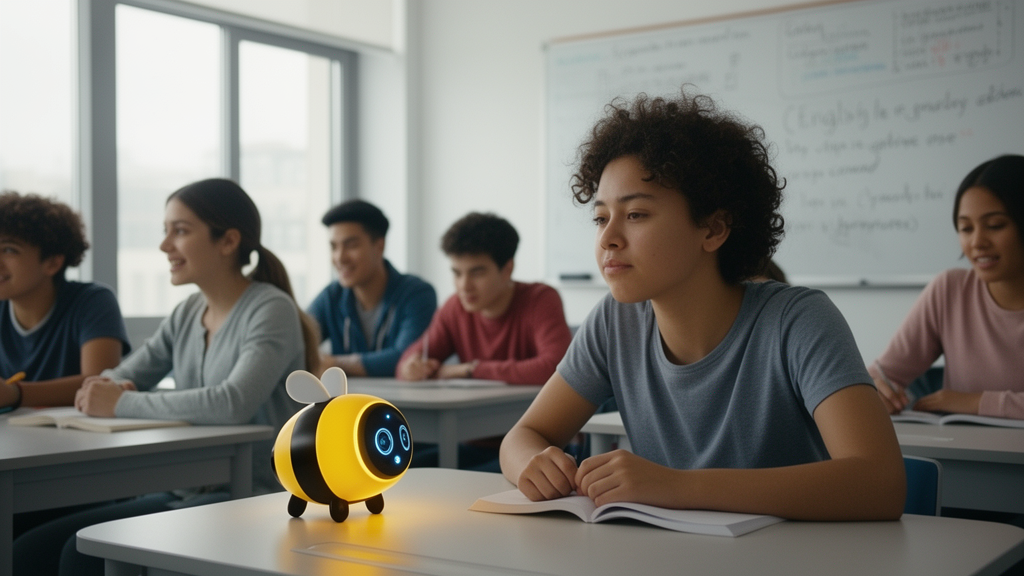
Researchers have built an emotion recognition system that reads students’ facial expressions and classifies them into seven emotional states with a reported test accuracy of 98.25 percent, with the aim of supporting emotionally responsive English language learning. The framework, described in a study published in Discover Artificial Intelligence, combines a convolutional neural network (CNN) with a nature-inspired tuning method called Bumble Bee Mating Optimization (BBMO), which automatically searches for the network’s best settings. The study reports precision of 98.09 percent, recall of 98.15 percent and an F1-score of 98.19 percent on a dataset of 1,962 labelled facial images, and the authors frame the result as a step toward classrooms where software can flag anxiety, disengagement or confidence in real time.
The motivation comes from a long-standing idea in language pedagogy. The study grounds its approach in the Affective Filter Hypothesis, which holds that emotional states such as anxiety, motivation and confidence can either facilitate or obstruct language acquisition by changing how learners process new material. Positive emotional conditions are thought to lower this affective filter, aiding comprehension and retention, while stress and fear can impede learning. In conventional classrooms, teachers must rely on their own eyes, ears and intuition to gauge how students feel, an approach the paper describes as subjective and prone to missing rapid emotional shifts. The authors argue that automated recognition offers a more structured and consistent way to detect emotional cues, allowing instructors to adapt lessons and create a more supportive environment.
The researchers identify a specific gap in the existing literature. Most emotion recognition systems, they write, are general-purpose tools that were not designed for language classrooms, and they do not target learning-related emotions such as motivation, anxiety and confidence. Many deep learning models also lack systematic optimization strategies, which limits their adaptability in dynamic educational settings. The study addresses this by tailoring its framework to seven emotional categories relevant to student behaviour: anger, contempt, disgust, fear, happiness, sadness and surprise. The system is designed to deliver real-time emotional feedback and support adaptive learning pathways, although the authors are careful to note that the direct impact on educational outcomes has not yet been experimentally validated in real classrooms.
The technical pipeline begins with image preprocessing. Facial expression images are passed through a median filter, a non-linear technique that replaces each pixel with the statistical median of its neighbours within a local window. This suppresses noise such as salt-and-pepper artefacts while preserving the high-frequency details of facial features, and the images are then normalized so pixel values fall between 0 and 1. Feature extraction follows using Local Binary Patterns (LBP), a texture descriptor that compares each pixel’s grayscale intensity with those of its neighbours, encoding the result as a binary pattern. Because LBP captures fine-grained texture information, it is well suited to distinguishing subtle differences between facial expressions, particularly under varying illumination. An ablation analysis in the study found that the LBP-based CNN outperformed a raw-image CNN, which the authors attribute to the discriminative local texture information captured before deep feature extraction.
The classification stage uses a CNN with three convolutional layers, each followed by ReLU activation and max-pooling, and two fully connected layers for classification. Convolutional layers slide learnable filters across the input image to produce feature maps that encode where and how strongly particular patterns appear, while pooling layers downsample these maps to reduce computational load and highlight the most significant features. The output layer applies a SoftMax function to convert the network’s scores into a probability distribution across the seven emotional classes. Images were resized to 48 by 48 pixels, and the model was trained with the Adam optimizer at an initial learning rate of 0.001, a batch size of 32 and 50 epochs, with results averaged over multiple independent runs.
The distinctive element is the BBMO optimization layer, which tunes the CNN’s hyperparameters, including the learning rate, the number of convolutional filters, kernel size, batch size and the number of fully connected neurons. The algorithm borrows its structure from bumblebee colonies, in which queens, workers and drones play distinct roles. In the algorithm’s analogy, candidate solutions act like worker bees exploring the search space, while the best-performing solutions serve as queens that guide the search. Mating behaviour, modelled probabilistically, balances exploration of new regions of the parameter space against exploitation of promising ones. The authors argue that this adaptive balance reduces the risk of premature convergence, a known weakness of methods such as Particle Swarm Optimization, and helps avoid the slow convergence and high computational cost associated with Genetic Algorithms in high-dimensional, non-convex search spaces.
Performance comparisons support the claimed advantage of the optimization strategy. Against ResNet-50, which achieved 76.72 percent accuracy and a 75.09 percent F1-score, and Inception, which reached 78.987 percent accuracy and a 78.81 percent F1-score, the BBMO-CNN performed markedly better. The authors attribute the weaker results of the deeper architectures to the limited dataset size and the overfitting risk that large networks face when trained on small data. A K-Nearest Neighbours classifier reached 97 percent across all metrics, which the authors ascribe to the controlled nature of the dataset and the discriminative LBP features, though they caution that KNN may not generalize well to noisier, real-world data. BBMO-CNN also outperformed versions of the model tuned with PSO, Genetic Algorithms, random search and grid search in the study’s comparison of optimization methods.
Detailed diagnostics reveal both strengths and weaknesses. The confusion matrix showed strong performance for emotions such as happiness and surprise, with correct prediction rates exceeding 95 percent, but misclassification occurred between related states, notably fear and disgust, and between sadness and neutral expressions, whose facial features are similar. Receiver Operating Characteristic analysis produced Area Under the Curve values between 0.92 and 0.98, with surprise the most accurately recognized emotion at 0.98. Training loss decreased consistently, but validation loss began rising after roughly epoch 30, signalling overfitting; the team responded with dropout layers at a rate of 0.5, L2 regularization and early stopping. On hardware constraints, the system achieved an average inference latency of 99.69 milliseconds per image, with a standard deviation of plus or minus 7.78 milliseconds, on a CPU-only Intel Core i5-3320M with 8 GB of RAM, corresponding to roughly 10 frames per second. The authors describe this as near real-time capability suitable for interactive educational monitoring, while noting it does not meet ultra-low-latency streaming requirements.
Ethical and privacy considerations receive substantial attention in the paper. Because facial expression data constitutes sensitive personal information, the authors specify that images are processed solely for emotion recognition and never stored or used for identity recognition. All data is anonymized, no personal identifiers are retained, and facial landmarks and extracted features are processed locally on the device, with only anonymized emotion outputs feeding the adaptive learning layer. The paper calls for informed consent, voluntary participation with the right to withdraw, secure data storage and compliance with applicable data protection regulations. The authors also stress the need for culturally and contextually appropriate algorithms and enhanced teacher training before such systems enter classrooms.
The study’s limitations are acknowledged candidly. The dataset of 1,962 images is relatively small for deep learning, and detailed demographic attributes such as age, gender and ethnicity are not provided, which limits diversity analysis and may affect generalizability to real classrooms with varied lighting, backgrounds and populations. The model was evaluated on a single dataset, which the authors warn may produce optimistic performance estimates, and they report additional testing on benchmark datasets including CK+, JAFFE and FER-2013 to probe consistency. Crucially, the paper states that the direct impact of the high-accuracy classifier on student performance, engagement and learning improvement has not been experimentally validated; the current work focuses on model development rather than classroom deployment, and claims about adaptive learning enhancement and emotional support should be treated as potential applications. Future work, the authors write, will integrate the system into real educational settings to empirically assess whether reading students’ emotions actually improves how they learn English.
Subject of Research: Optimized facial emotion recognition for supporting English language learning environments
Article Title: Emotion recognition-based framework for supporting English learning environments using BBMO-CNN
Article References: Si, B. (2026). Emotion recognition-based framework for supporting English learning environments using BBMO-CNN. Discover Artificial Intelligence, 6(1), Article 1571. https://doi.org/10.1007/s44163-026-02260-6
Image Credits: AI Generated
DOI: 10.1007/s44163-026-02260-6
Keywords: emotion recognition, convolutional neural network, Bumble Bee Mating Optimization, English language learning, facial expression analysis, Local Binary Patterns, affective computing, hyperparameter optimization, adaptive learning, educational technology, data privacy, deep learning
Cite Scienmag News
Blake Davidson. (October 26, 2026). Bumble Bee-Inspired AI Reads Students’ Facial Emotions to Support English Learning. Scienmag. https://scienmag.com/bumble-bee-inspired-ai-reads-students-facial-emotions-to-support-english-learning/
Blake Davidson. "Bumble Bee-Inspired AI Reads Students’ Facial Emotions to Support English Learning." Scienmag, 26 October 2026, https://scienmag.com/bumble-bee-inspired-ai-reads-students-facial-emotions-to-support-english-learning/. Accessed 26 October 2026.
Blake Davidson. "Bumble Bee-Inspired AI Reads Students’ Facial Emotions to Support English Learning." Scienmag. October 26, 2026. https://scienmag.com/bumble-bee-inspired-ai-reads-students-facial-emotions-to-support-english-learning/


