


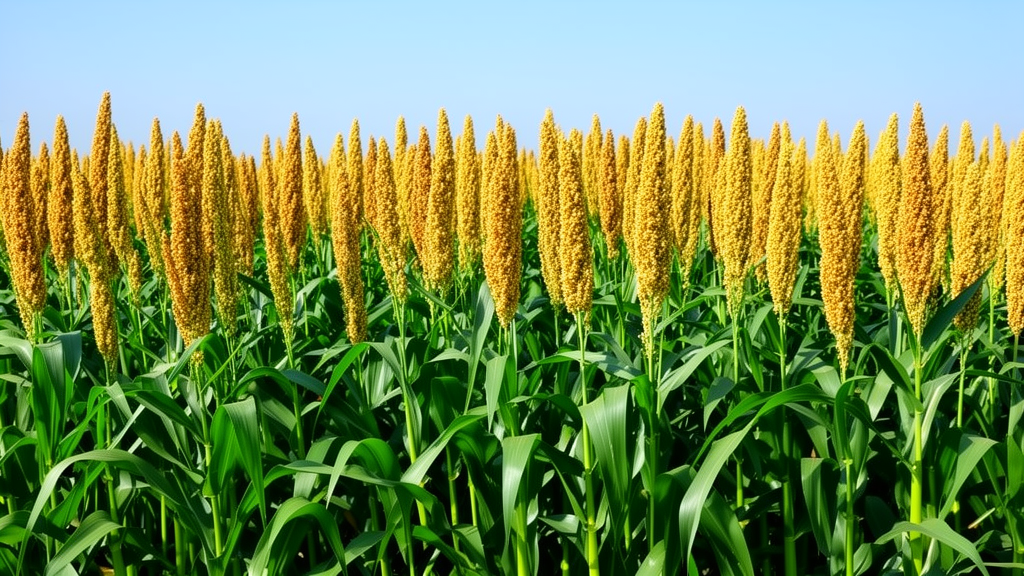
A study published in Scientific Reports evaluated four multi-trait selection indices—SHI, FAI-BLUP, MTSI, and MGIDI—on a diverse panel of 218 pearl millet genotypes grown across four contrasting environments representing the A, A₁, and B pearl millet-growing zones of India. The goal was to identify genotypes combining improved nutritional composition, reduced anti-nutritional factors, and desirable yield-related performance, traits that are difficult to improve together because of complex interactions among them. The research team measured a broad set of characteristics in each genotype: concentrations of iron, zinc, manganese, and phosphorus; total tannin content and phytic acid content as anti-nutritional factors; and a suite of yield-related traits including grain filling duration, tiller productivity, spike size, sink capacity, thousand-seed weight, and seed yield per plant.
Combined analysis of variance revealed highly significant effects of genotype, environment, and genotype × environment interaction for every trait evaluated. This indicates substantial genetic variability within the panel as well as differential responses of genotypes to environmental conditions—precisely the kind of complexity that makes simultaneous selection for nutrition and yield stability challenging. The authors note that addressing micronutrient malnutrition through pearl millet biofortification remains challenging because of complex trait interactions, anti-nutritional factors, and genotype × environment interactions that cause a genotype's performance to shift from one location to another.
The study's comparative framework directly tackles these obstacles by testing whether different statistical selection approaches agree on which genotypes deserve advancement. Correlation analysis added an important layer of understanding. Nutritional traits and yield-related traits showed positive associations with one another, suggesting that breeders need not sacrifice one to gain the other.
Anti-nutritional traits, by contrast, displayed antagonistic relationships with the desirable characteristics, confirming the tension breeders face when trying to raise mineral density while lowering anti-nutritional compounds. When the four indices were applied at a 15% selection intensity, they produced distinct but overlapping patterns of expected selection gains. MGIDI delivered expected gains of 8.78% for iron, 3.85% for zinc, and 3.01% for manganese, while simultaneously reducing phytic acid content by 6.31% and total tannin content by 10.70%.
MTSI produced the greatest expected gains for several yield-related traits, including tiller productivity at 21.55%, seed yield per plant at 14.63%, spike size at 11.98%, and sink capacity at 16.51%. These percentages represent expected changes in the selected group relative to the full panel, not guarantees of field performance. SHI achieved the largest reductions in anti-nutritional factors, cutting phytic acid content by 17.90% and total tannin content by 13.40%.
FAI-BLUP showed substantial expected gains for several yield traits but, notably, increased phytic acid content by 8.96% and total tannin content by 13.40%. This divergence illustrates a central finding of the work: the choice of selection index materially changes which trade-offs a breeding program accepts, and indices optimized primarily for yield can inadvertently work against nutritional quality goals. Despite these differences, strong concordance emerged among the approaches.
Four genotypes—IP 15,872, IP 19,584, IP 3757, and IP 6310—were consistently selected by all four indices. The authors report that these consensus genotypes represent promising genetic resources for developing pearl millet with improved nutritional quality, reduced anti-nutritional factors, and desirable yield-related attributes. Agreement across four different selection frameworks strengthens confidence that these lines carry genuinely favorable trait combinations rather than artifacts of any single method.
The findings come from a 218-genotype PMiGAP panel evaluated across four environments in India, and the reported gains are expected selection responses calculated at a fixed selection intensity rather than observed outcomes of a finished variety. The authors also emphasize that trait interactions, anti-nutritional factors, and genotype × environment interactions remain obstacles that the consensus genotypes help mitigate but do not eliminate.
Subject of Research: Multi-trait stability indices for selecting nutrient-dense and yield-stable pearl millet genotypes
Article Title: Integration of multi-trait stability indices for selection of nutrient-dense and yield-stable pearl millet genotypes across environments
Article References: Hemanth, S., Singh, S. P., Singhal, T., Naveen, A., Yadav, S., Kapoor, C., Sharma, S., Bhargavi, H. A., Jangala, D. J., Singh, N., & Satyavathi, C. T. (2026). Integration of multi-trait stability indices for selection of nutrient-dense and yield-stable pearl millet genotypes across environments. Scientific Reports. https://doi.org/10.1038/s41598-026-77646-8
Image Credits: AI Generated
DOI: 10.1038/s41598-026-77646-8
Keywords: pearl millet, biofortification, genotype by environment interaction, selection indices, MGIDI, MTSI, SHI, FAI-BLUP, micronutrients, plant breeding, anti-nutritional factors, yield stability
Cite Scienmag News
Daisy Hatcher. (October 26, 2026). Four selection indices converge on nutrient-rich, stable pearl millet lines. Scienmag. https://scienmag.com/four-selection-indices-converge-on-nutrient-rich-stable-pearl-millet-lines/
Daisy Hatcher. "Four selection indices converge on nutrient-rich, stable pearl millet lines." Scienmag, 26 October 2026, https://scienmag.com/four-selection-indices-converge-on-nutrient-rich-stable-pearl-millet-lines/. Accessed 26 October 2026.
Daisy Hatcher. "Four selection indices converge on nutrient-rich, stable pearl millet lines." Scienmag. October 26, 2026. https://scienmag.com/four-selection-indices-converge-on-nutrient-rich-stable-pearl-millet-lines/


