

Monday, October 26, 2026
Science
No Result
View All Result
  • Login
  • HOME
  • SCIENCE NEWS
  • CONTACT US
  • HOME
  • SCIENCE NEWS
  • CONTACT US
No Result
View All Result
Scienmag
No Result
View All Result
Home Science News Technology and Engineering

Random forest model predicts oxygenation impairment during one-lung ventilation in thoracic surgery

October 26, 2026
in Technology and Engineering
Ophelia Keating
By Ophelia Keating Scienmag Editorial Profile - Health Services Research
Reading Time: 2 mins read
0
Random forest model predicts oxygenation impairment during one-lung ventilation in thoracic surgery

Random forest model predicts oxygenation impairment during one-lung ventilation in thoracic surgery

65
SHARES
587
VIEWS
Share on FacebookShare on Twitter
ADVERTISEMENT

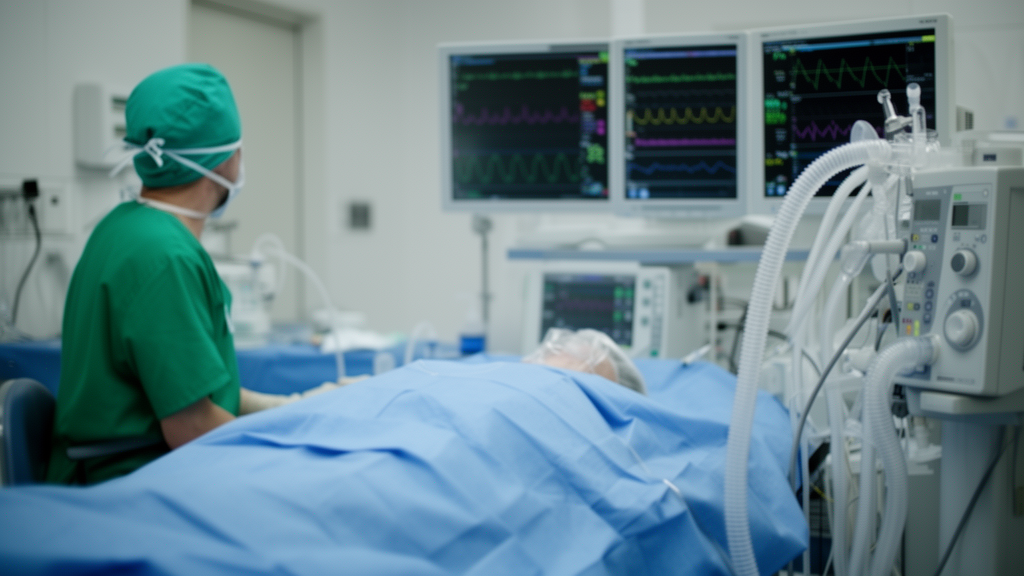
An interpretable machine learning approach has shown strong performance in identifying which thoracic surgery patients are likely to experience intraoperative oxygenation impairment during one-lung ventilation, according to a retrospective cohort study published in Scientific Reports. The condition, in which blood oxygen levels fall while a single lung is deliberately collapsed to give surgeons access to the chest, remains one of the more difficult challenges in thoracic anesthesia. Traditional statistical models often struggle to capture the complex, non-linear relationships between patient characteristics and ventilation settings that determine whether oxygenation holds up during the procedure.

The research team analyzed clinical data from 519 patients undergoing thoracic surgery and evaluated five machine learning algorithms for their ability to predict oxygenation impairment during one-lung ventilation. Model performance was measured using the area under the receiver operating characteristic curve. The random forest model achieved the highest score, at 0.924, clearly outperforming logistic regression, which reached 0.790. That gap suggests the non-linear patterns captured by tree-based methods carry meaningful predictive information that conventional linear models miss in this setting.

To make the model’s internal logic transparent, the researchers applied SHAP analysis, a technique that quantifies how each feature contributes to individual predictions. This identified positive end-expiratory pressure, preoperative arterial oxygen partial pressure, and body mass index as the primary predictors of intraoperative oxygenation impairment. The analysis also revealed potential U-shaped protective associations for positive end-expiratory pressure in the range of 4 to 6 centimeters of water and for tidal volume, alongside synergistic interactions between baseline pulmonary conditions and mechanical ventilation settings. In other words, the apparent benefit of these ventilation parameters was not uniform across their ranges, and the effect of any given setting appeared to depend on the patient’s underlying lung status.

The authors are careful to frame these findings as exploratory rather than definitive. SHAP analysis describes statistical associations and feature interactions within the data without implying biological causality, and the retrospective design means the model’s discriminative performance has not yet been tested prospectively. Even so, the study indicates that interpretable machine learning can generate hypothesis-generating insights into complex non-linear thresholds and interactions that may serve as preliminary reference information for future prospective studies on individualized anesthetic management. If such work confirms the identified thresholds, the approach could eventually help anesthesia teams anticipate which patients are at risk of oxygenation impairment during one-lung ventilation and adjust ventilatory strategies accordingly, rather than reacting to desaturation after it begins.

Subject of Research: Interpretable machine learning for predicting intraoperative oxygenation impairment during one-lung ventilation in thoracic surgery

Article Title: Interpretable machine learning for predicting intraoperative oxygenation impairment during one-lung ventilation in thoracic surgery: a retrospective cohort study

Article References: Deng, Y., Chen, J., Liu, W., & Zhu, F. (2026). Interpretable machine learning for predicting intraoperative oxygenation impairment during one-lung ventilation in thoracic surgery: a retrospective cohort study. Scientific Reports. https://doi.org/10.1038/s41598-026-74032-2

Image Credits: AI Generated

DOI: 10.1038/s41598-026-74032-2

Keywords: machine learning, one-lung ventilation, thoracic surgery, anesthesia, random forest, SHAP, oxygenation impairment, retrospective cohort study, Interpretable, machine, learning, predicting

Cite Scienmag News

Ophelia Keating. (October 26, 2026). Random forest model predicts oxygenation impairment during one-lung ventilation in thoracic surgery. Scienmag. https://scienmag.com/random-forest-model-predicts-oxygenation-impairment-during-one-lung-ventilation-in-thoracic-surgery/


Ophelia Keating. "Random forest model predicts oxygenation impairment during one-lung ventilation in thoracic surgery." Scienmag, 26 October 2026, https://scienmag.com/random-forest-model-predicts-oxygenation-impairment-during-one-lung-ventilation-in-thoracic-surgery/. Accessed 26 October 2026.

Ophelia Keating. "Random forest model predicts oxygenation impairment during one-lung ventilation in thoracic surgery." Scienmag. October 26, 2026. https://scienmag.com/random-forest-model-predicts-oxygenation-impairment-during-one-lung-ventilation-in-thoracic-surgery/

Tags: anesthesiaclinical data analysisinterpretableinterpretable machine learningintraoperative oxygenation monitoringlearningmachineMachine learningmachine learning algorithms comparisonmachine learning in thoracic surgerynon-linear relationship in medical predictionone-lung ventilationoxygenation impairmentPredictingprediction of oxygenation impairmentpredictive modeling in surgeryRandom Forestrandom forest modelretrospective cohort studySHAPSHAP analysisthoracic anesthesia challengesthoracic surgery
Share26Tweet16
Previous Post

High-resolution branch in YOLOv11n lifts tiny fabric defect detection

Next Post

Dentists in Yemen Show Moderate Awareness of Eco-Friendly Practice, Survey Finds

Related Posts

High-resolution branch in YOLOv11n lifts tiny fabric defect detection
Technology and Engineering

High-resolution branch in YOLOv11n lifts tiny fabric defect detection

October 26, 2026
When AI Inference Crosses Borders in Seconds, Who Can Legally Reconstruct What Happened?
Technology and Engineering

When AI Inference Crosses Borders in Seconds, Who Can Legally Reconstruct What Happened?

October 26, 2026
AI learns to hear emotion in solo violin through contrastive self-teaching
Technology and Engineering

AI learns to hear emotion in solo violin through contrastive self-teaching

October 26, 2026
Experts rank heat stress indices for cognitive performance assessment
Technology and Engineering

Experts rank heat stress indices for cognitive performance assessment

October 26, 2026
Open Data Machine Learning Framework Predicts Which Media Platform Users Will Stay
Technology and Engineering

Open Data Machine Learning Framework Predicts Which Media Platform Users Will Stay

October 26, 2026
Two Novel Silviavirus Phages Show Lytic Activity Against MRSA
Technology and Engineering

Two Novel Silviavirus Phages Show Lytic Activity Against MRSA

October 26, 2026
Next Post
Dentists in Yemen Show Moderate Awareness of Eco-Friendly Practice, Survey Finds

Dentists in Yemen Show Moderate Awareness of Eco-Friendly Practice, Survey Finds

  • Mothers who receive childcare support from maternal grandparents show more optimized

    Mothers who receive childcare support from maternal grandparents show more parental warmth, finds NTU Singapore study

    27656 shares
    Share 11059 Tweet 6912
  • University of Seville Breaks 120-Year-Old Mystery, Revises a Key Einstein Concept

    1061 shares
    Share 424 Tweet 265
  • Bee body mass, pathogens and local climate influence heat tolerance

    682 shares
    Share 273 Tweet 171
  • Researchers record first-ever images and data of a shark experiencing a boat strike

    546 shares
    Share 218 Tweet 137
  • Groundbreaking Clinical Trial Reveals Lubiprostone Enhances Kidney Function

    531 shares
    Share 212 Tweet 133
Science

Embark on a thrilling journey of discovery with Scienmag.com—your ultimate source for cutting-edge breakthroughs. Immerse yourself in a world where curiosity knows no limits and tomorrow’s possibilities become today’s reality!

RECENT NEWS

  • Dentists in Yemen Show Moderate Awareness of Eco-Friendly Practice, Survey Finds
  • Random forest model predicts oxygenation impairment during one-lung ventilation in thoracic surgery
  • High-resolution branch in YOLOv11n lifts tiny fabric defect detection
  • AI market swings track technology stocks more than clean energy

Categories

  • Agriculture
  • Anthropology
  • Archaeology
  • Athmospheric
  • Biology
  • Biotechnology
  • Blog
  • Bussines
  • Cancer
  • Chemistry
  • Climate
  • Earth Science
  • Editorial Policy
  • Marine
  • Mathematics
  • Medicine
  • Pediatry
  • Policy
  • Psychology & Psychiatry
  • Science Education
  • Science News
  • Social Science
  • Space
  • Technology and Engineering

Subscribe to Blog via Email

Enter your email address to subscribe to this blog and receive notifications of new posts by email.

Join 5,151 other subscribers

© 2025 Scienmag - Science Magazine

Welcome Back!

Login to your account below

Forgotten Password?

Retrieve your password

Please enter your username or email address to reset your password.

Log In
No Result
View All Result
  • HOME
  • SCIENCE NEWS
  • CONTACT US

© 2025 Scienmag - Science Magazine

Discover more from Science

Subscribe now to keep reading and get access to the full archive.

Continue reading