


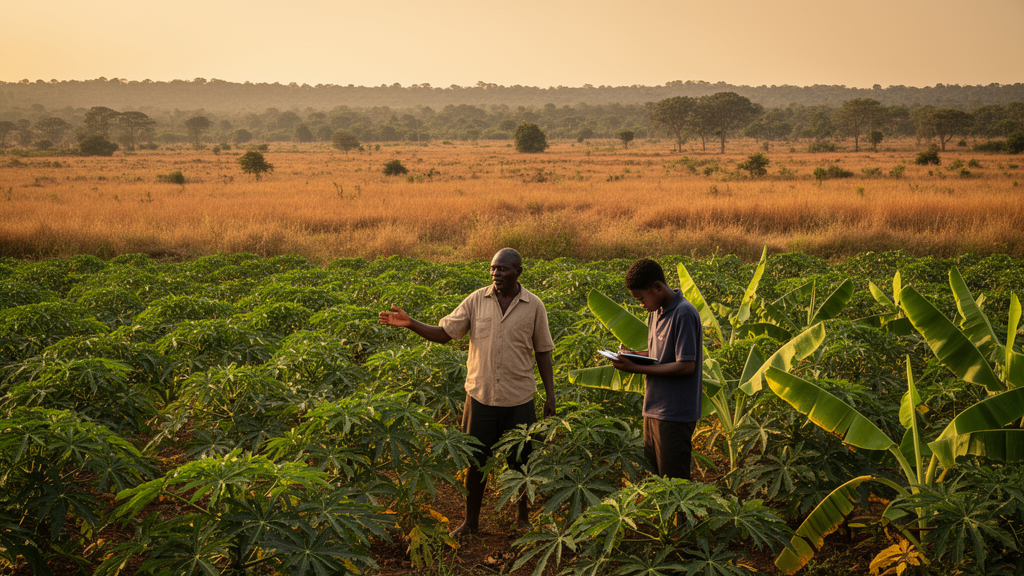
A mixed-methods study spanning Ghana’s Northern, Middle Belt, and Coastal ecological zones has found that communities’ use of Indigenous Knowledge Systems (IKS) is associated with more environmentally friendly behavior, stronger self-reported capacity to adapt to climate change, and more stable livelihoods. The research, published open access in Discover Sustainability, applied IKS Theory and combined surveys, focus groups, and interviews to examine how traditional knowledge interacts with technology adoption and community resilience across the country’s distinct ecological settings.
The quantitative results showed a strong positive correlation between IKS use and environmentally friendly behaviors (r = 0.61, p < 0.01), a moderate to strong correlation with the ability to adapt to climate change (r = 0.57, p < 0.01), and a moderate correlation with the stability of livelihoods (r = 0.49, p < 0.01). These are statistical associations measured within the study sample rather than demonstrated causal effects, but the authors report that the patterns were consistent across the three zones. The zone-level comparisons revealed notable geographic differences: the Northern Zone recorded the highest IKS index score (M = 4.22, SD = 0.63), which the study interprets as indicating strong management and care of indigenous knowledge, while the Middle Belt showed effective institutional collaboration (M = 3.85, SD = 0.71).
The Coastal Zone stood out for a different reason. It had the lowest IKS retention score (M = 3.44, SD = 0.84), a gap the researchers attribute largely to policy neglect and cultural erosion. The qualitative strands of the study, drawn from focus groups and interviews, reinforced the survey findings by highlighting three conditions the authors consider essential for sustaining IKS-driven innovation: intergenerational knowledge transfer, youth participation, and institutional cooperation. Where elders’ knowledge is not being passed to younger generations, or where institutions fail to engage communities, the knowledge base that underpins local climate adaptation appears to weaken.
On the basis of these results, the study proposes a new model called the IK-IT Framework, short for the Indigenous Knowledge for Innovation and Transformation Framework. The framework is described as a participatory, context-sensitive model that merges indigenous knowledge, youth-led innovation, and digital platforms to help communities become more resilient to climate change. Rather than treating traditional knowledge as a static archive, the framework employs a collaborative process to document, co-design, digitize, validate, and integrate policies, with the aim of embedding IKS into national climate and innovation strategies. The sequence matters technically: documentation precedes co-design, digital tools are used to preserve and share validated knowledge, and policy integration is the final step that connects community-level practice to national strategy.
The authors emphasize that IKS should be understood as a dynamic, living system capable of influencing Africa’s broader climate action efforts, not a fixed body of customs. Strengthening the connection between indigenous knowledge, technology, and policy, they argue, could help African communities combat climate change while fostering climate innovation that is inclusive, culturally relevant, and sustainable. The study’s scope is limited to Ghana’s three ecological zones, and the correlational design means the findings describe relationships within the surveyed communities rather than outcomes produced by IKS use. The authors also note that the published version was shared early as a peer-reviewed accepted manuscript carrying a permanent DOI, subject to further edits before the final Version of Record. Even with those caveats, the zone-level score differences and the qualitative evidence point to a concrete policy challenge: in places like the Coastal Zone, where retention is lowest, the erosion of indigenous knowledge may itself be a barrier to the community-level adaptation that Ghana’s climate strategies depend on.
Subject of Research: Indigenous Knowledge Systems and climate resilience in Ghana
Article Title: Indigenous knowledge systems for climate resilient innovation in Ghana
Article References: Dei, D.-G. J. (2026). Indigenous knowledge systems for climate resilient innovation in Ghana. Discover Sustainability. https://doi.org/10.1007/s43621-026-04694-5
Image Credits: AI Generated
DOI: 10.1007/s43621-026-04694-5
Keywords: indigenous knowledge, climate change, Ghana, climate adaptation, sustainability, IKS, Indigenous, knowledge, systems, climate, resilient, innovation
Cite Scienmag News
Sloane Callahan. (October 26, 2026). Indigenous Knowledge Systems Linked to Climate Resilience Across Ghana’s Ecological Zones. Scienmag. https://scienmag.com/indigenous-knowledge-systems-linked-to-climate-resilience-across-ghanas-ecological-zones/
Sloane Callahan. "Indigenous Knowledge Systems Linked to Climate Resilience Across Ghana’s Ecological Zones." Scienmag, 26 October 2026, https://scienmag.com/indigenous-knowledge-systems-linked-to-climate-resilience-across-ghanas-ecological-zones/. Accessed 26 October 2026.
Sloane Callahan. "Indigenous Knowledge Systems Linked to Climate Resilience Across Ghana’s Ecological Zones." Scienmag. October 26, 2026. https://scienmag.com/indigenous-knowledge-systems-linked-to-climate-resilience-across-ghanas-ecological-zones/


