


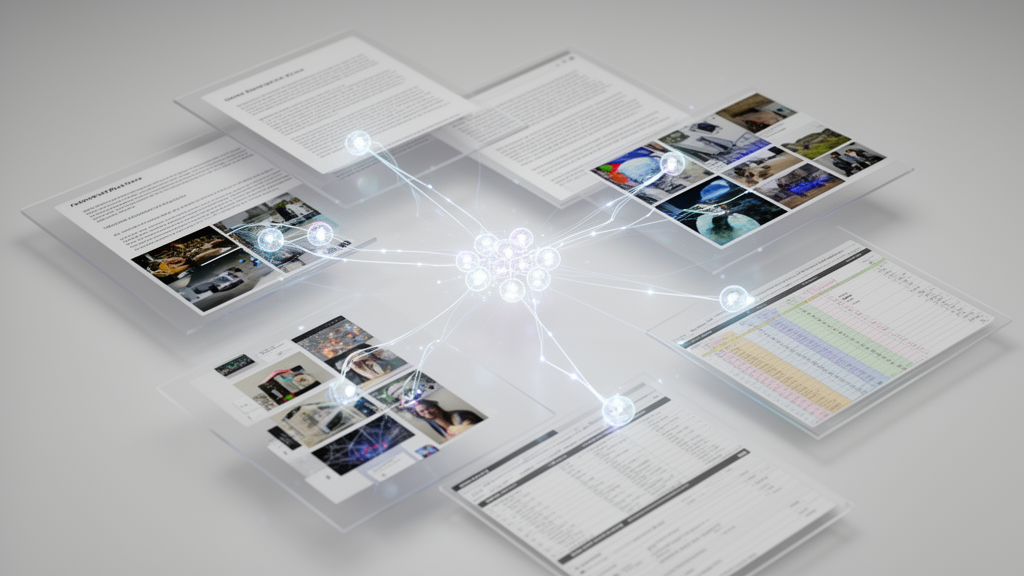
A graph-enhanced retrieval system that links text passages, image regions, and structured records before answering questions produced more accurate and traceable results than conventional vector retrieval in a study of electrical-equipment data. Its average end-to-end query time was 283 milliseconds. The results indicate that explicitly connecting evidence across modalities and ranking relationship paths can improve retrieval while keeping generated answers bounded by the available material.
The study by Chujing Liao, Peishan Ye, Anni Huang, Shiping Huang, and Xiaokai Yuan focuses on a weakness of retrieval-augmented generation: similarity-based search can identify relevant fragments while still leaving an evidence chain incomplete. Technical questions may require a statement in a manual, an object visible in an equipment photograph, and a field in a maintenance table. Conventional systems often retrieve these sources independently and combine them late.
The proposed system instead aligns individual entities across modalities, represents their relationships in a knowledge graph, expands a query along those relationships, and selects a compact evidence package before a language model generates an answer. This is a computational retrieval study rather than a human or clinical evaluation, and its results are confined to the tested corpus and technical domain. Its architecture has five stages: data ingestion, semantic encoding, graph construction, retrieval enhancement, and controlled generation.
Text is divided into 256-token segments with 64 tokens of overlap, images are resized to 224 by 224 pixels, and structured fields retain names, values, types, timestamps, and key constraints. A multilingual MiniLM model produces 384-dimensional text vectors, YOLOv8m identifies visual regions and CLIP ViT-B/32 encodes them, and an FT-Transformer represents structured fields. Modality-specific projection layers map all of them into a common 640-dimensional retrieval space.
A separate 896-dimensional cross-encoder representation is used only for reranking and does not replace that shared retrieval dimension. For a tri-modal association unit, the original modality vectors are concatenated into a 1,344-dimensional intermediate representation and compressed into the shared space. Entity linking supplies the graph with the connections needed for multistep retrieval.
The system uses a multilingual BERT–BiLSTM–CRF model to identify text entities, detection labels to identify image entities, and field constraints to identify structured entities. Mentions are merged only when their entity types are compatible, their alias score reaches 0.81, and no temporal or attribute contradiction is detected. The graph contains devices, components, metrics, events, image objects, and table fields, joined through relations for containment, cross-modal correspondence, provenance, time, metric constraints, image references, field mapping, evidence support, and semantic proximity.
When sources assign different values to the same entity attribute, they remain separate evidence nodes and are ranked by provenance authority, temporal freshness, cross-modal agreement, and extraction confidence. A conflict is resolved only when the higher-ranked evidence leads by at least 0.18; otherwise, both values are retained and the conflict is passed to the generation layer. Retrieval begins with the 120 most similar units from the vector index.
Query entities are then expanded through three graph hops by default, although four hops were also tested. Each query is restricted to 300 expanded nodes, and only paths containing two to five edges enter the evidence pool. Edges below a weight of 0.58 are removed, while a path score combines query similarity, edge strength, agreement across modalities, conflict penalties, and source reliability.
Context construction compresses retrieved material into text fragments, image objects, structured properties, and graph paths, with no more than six items from each category. A cross-encoder reranks 72 candidate packages, and the final generation context contains at most 12 evidence units within 4,096 tokens. Each retained unit receives an identifier, the generator must cite evidence for factual claims, and the system is instructed to return “Insufficient evidence” when no candidate passes the credibility threshold.
The experiment used a de-identified corpus drawn from six electrical-equipment domains: power transformers, switchgear, cables, protection devices, rotating auxiliary equipment, and condition-monitoring systems. Sources included technical manuals, maintenance work orders, inspection reports, equipment photographs, alarm and fault logs, sensor records, and asset-management tables. The corpus contained 18,640 Chinese and English technical text units, 7,820 equipment images, 42,300 structured table records, 96,500 normalized entities, 128,700 relation triples, and 3,600 manually constructed queries.
Three electrical-equipment engineers with six to 12 years of experience and one senior adjudicator annotated the data. Agreement was strong for entity identity, with a kappa of 0.91, relation labels at 0.86, and relevance labels at 0.88; the mean pairwise intersection over union for image-region annotation was 0.84. Queries covered text fact localization, image–text matching, structured-field lookup, and multihop relation inference.
They were divided into training, validation, and test sets in a 70%:10%:20% ratio, giving 2,520, 360, and 720 queries. Data were partitioned at the equipment or source-document-group level so that related text, image regions, structured records, and evidence paths did not cross from the test set into training or validation data. The 720-query test set comprised 210 text fact-localization queries, 170 image–text matching queries, 160 structured-field lookup queries, and 180 multihop relation-inference queries.
Three experts evaluated the test answers while blinded to the retrieval configuration, checking claim–evidence entailment, citation location, entity consistency, temporal consistency, and whether rejection was required. A large language model judge was used only as a secondary sensitivity check, not to determine the primary scores. Against the original dense-retrieval baseline, the median Precision@5 increased from 0.812 to 0.869 and median Recall@10 from 0.835 to 0.895.
Mean reciprocal rank rose from 0.803 to 0.851, NDCG@10 from 0.829 to 0.878, and the evidence hit rate from 84.1% to 89.7%. The proposed system also exceeded standard GraphRAG on the full test set, leading by 1.2 percentage points in Precision@5 and 1.5 points in Recall@10. On 170 image–text queries, aligned retrieval reached Recall@10 of 0.887, compared with 0.821 for CLIP and 0.842 for BLIP.
Direct alignment tests showed that the mean cosine similarity of positive cross-modal pairs rose from 0.54 ± 0.11 to 0.76 ± 0.08, while similarity for hard negatives fell from 0.31 ± 0.10 to 0.24 ± 0.09. Three-way joint retrieval achieved Precision@5 of 0.904 and Recall@10 of 0.928, with a reported average query latency of 268 milliseconds. Path reasoning was associated with more interpretable evidence.
For 360 complex test queries, evidence-chain completeness increased from 78.3% to 91.5%, entity coverage from 81.6% to 93.2%, path readability from 0.74 to 0.88, and conflict suppression from 69.4% to 86.7%. Three-hop expansion provided the best reported balance, producing Recall@10 of 0.893 at 283 milliseconds; two hops yielded 0.879 at 241 milliseconds, while four hops produced 0.887 at 342 milliseconds. Ablations also showed that removing cross-modal alignment reduced Precision@5 to 0.834 and Recall@10 to 0.858.
Removing graph expansion produced 0.842 and 0.861, respectively, while removing path-credibility constraints resulted in 0.851 and 0.876. Replacing the cross-encoder with the graph retrieval score lowered those measures to 0.849 and 0.874, although latency fell to 224 milliseconds. Evidence-bounded generation was particularly important for reliability.
Across the 720 standard test queries, the system recorded 94.1% citation accuracy, 93.2% answer fidelity, a 91.8% answer support rate, and a 6.8% atomic-claim hallucination rate. On 120 additional unanswerable or conflict-heavy queries, it correctly rejected 109, producing 90.8% no-answer accuracy. Disabling no-hit rejection raised the hallucination rate to 12.9%, while removing controlled-generation constraints reduced answer fidelity to 84.3% and increased hallucination to 15.7%.
In a worked transformer-alarm trace, the system joined a maintenance report, an image hotspot, an alarm record, and a graph path into a cited explanation. In a separate pump query, an incorrect alias match and a partially occluded image initially supported an unsupported positive answer; after entity-type, timestamp, and conflict controls reduced the evidence score below the threshold, the revised system returned “Insufficient evidence to confirm cavitation.” The authors identified alias collisions, stale evidence, and weak image regions as distinct remaining failure sources. The results remain bounded by the study’s electrical-equipment corpus and experimental setup.
Scalability tests with graphs from 10,000 to one million entities showed that average latency rose from 146 to 612 milliseconds and throughput fell from 6.8 to 1.6 queries per second; at 100,000 entities, corresponding to the main experimental graph, the figures were 283 milliseconds and 3.5 queries per second. Recall@10 declined from 0.902 at 10,000 entities to 0.879 at one million. The authors identify domain transfer, dynamic knowledge updates, adaptive path pruning, graph scale, and real-time inference cost as unresolved issues.
The dataset is available from the corresponding author on reasonable request, but the study does not establish that the same gains will hold across other industries, modalities, or deployment conditions.
Subject of Research: Evaluation of graph-enhanced retrieval across text, images, and structured electrical-equipment records.
Article Title: A study on the GraphRAG semantic retrieval algorithm for multimodal data
Article References: Liao, C., Ye, P., Huang, A., Huang, S., & Yuan, X. (2026). A study on the GraphRAG semantic retrieval algorithm for multimodal data. Discover Artificial Intelligence, 6(1), Article 1060. https://doi.org/10.1007/s44163-026-02023-3
Image Credits: AI Generated
DOI: 10.1007/s44163-026-02023-3
Keywords: multimodal retrieval, GraphRAG, knowledge graphs, retrieval-augmented generation, semantic alignment, evidence traceability, hallucination control, electrical equipment, path reasoning, cross-encoder reranking, semantic, retrieval
Cite Scienmag News
Denise Maddox. (October 26, 2026). GraphRAG improves traceable retrieval across text, images, and tables. Scienmag. https://scienmag.com/graphrag-improves-traceable-retrieval-across-text-images-and-tables/
Denise Maddox. "GraphRAG improves traceable retrieval across text, images, and tables." Scienmag, 26 October 2026, https://scienmag.com/graphrag-improves-traceable-retrieval-across-text-images-and-tables/. Accessed 26 October 2026.
Denise Maddox. "GraphRAG improves traceable retrieval across text, images, and tables." Scienmag. October 26, 2026. https://scienmag.com/graphrag-improves-traceable-retrieval-across-text-images-and-tables/


