


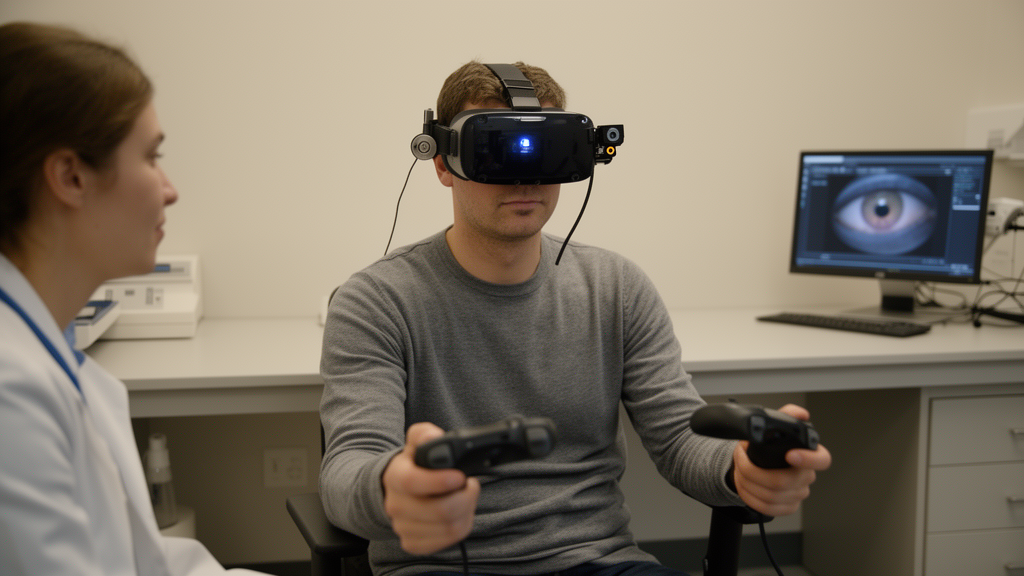
In an experimental study involving 84 volunteers, including 42 people with chronic musculoskeletal pain, researchers at the University of East Anglia found that pupil widening and increased blinking during increasingly demanding virtual-reality tasks tracked changes in mental workload. Artificial-intelligence models distinguished low from high cognitive load with up to 88% accuracy in healthy volunteers, but their accuracy was significantly lower among participants with chronic pain. The findings support eye tracking as a possible way to monitor cognitive demands during immersive activities; they do not show that workload-responsive virtual reality can reduce pain or is ready for clinical use.
Lead researcher Dr Jordan Tsigarides, from UEA’s School of Health Sciences, said the work could eventually help virtual-reality systems adjust experiences as a user’s mental effort changes. The goal is to balance challenge and comfort, particularly because pain and cognitive demands can fluctuate from moment to moment. Virtual reality has therapeutic potential for people with chronic pain through immersive environments, relaxation exercises, games and puzzles. The researchers said such experiences can draw attention away from pain, reduce pain-related stress and anxiety, and may help retrain how the brain processes pain over time. However, the present study tested eye signals and workload classification, not the therapeutic benefits of an adaptive virtual-reality program.
The study, published in Scientific Reports as “VR-FOCUS: evaluating eye tracking during a virtual reality N-back task as a marker of cognitive load in chronic pain,” was led by Tsigarides as part of his PhD at UEA. Participants wore a virtual-reality headset equipped with eye-tracking technology and completed a series of increasingly demanding memory challenges. The team analyzed subtle changes in pupil size and blinking patterns as task difficulty increased. The experimental design included healthy volunteers and people with chronic musculoskeletal pain conditions such as arthritis and fibromyalgia, allowing the researchers to compare workload-related eye responses across the two groups.
As the tasks became more mentally challenging, participants’ pupils widened and their blink rates increased. Models that analyzed these signals over time were able to distinguish low and high levels of mental workload with up to 88% accuracy in healthy volunteers. The virtual-reality tasks were also well tolerated, with participants reporting very low levels of motion sickness and discomfort. These observations indicate that eye behavior may provide a practical marker of cognitive load during immersive activity, but the reported classification accuracy does not establish that eye tracking can predict pain, treatment response or clinical benefit.
The main limitation was the difference in model performance between healthy volunteers and people with chronic pain. Stronger results in the healthy group do not mean that a standardized system would work equally well for all patients. The researchers propose that future systems may need individual calibration, learning how each person’s eyes respond to mental effort before making treatment decisions, although the study did not test such calibration in an adaptive therapy. Larger studies would also be needed to determine whether adaptive virtual-reality therapies improve real-world outcomes. The project was supported by UEA and Revolve Labs Ltd., and its results provide a proof of concept for monitoring workload rather than evidence of an effective personalized pain-treatment system.
Subject of Research: Experimental evaluation of eye tracking and artificial intelligence for detecting cognitive workload during virtual-reality tasks in people with chronic musculoskeletal pain
Article Title: How the eyes could unlock personalized pain relief with virtual reality
Article References: How the eyes could unlock personalized pain relief with virtual reality. Original publication (Bibliographic details unavailable.)
Image Credits: AI Generated
DOI: Not provided
Keywords: virtual reality, chronic pain, eye tracking, artificial intelligence, cognitive load, pupil dilation, blinking, adaptive therapy, fibromyalgia, digital health, eyes, unlock
Cite Scienmag News
Ophelia Keating. (October 26, 2026). Eye tracking identifies VR workload, less accurately in chronic pain. Scienmag. https://scienmag.com/eye-tracking-identifies-vr-workload-less-accurately-in-chronic-pain/
Ophelia Keating. "Eye tracking identifies VR workload, less accurately in chronic pain." Scienmag, 26 October 2026, https://scienmag.com/eye-tracking-identifies-vr-workload-less-accurately-in-chronic-pain/. Accessed 26 October 2026.
Ophelia Keating. "Eye tracking identifies VR workload, less accurately in chronic pain." Scienmag. October 26, 2026. https://scienmag.com/eye-tracking-identifies-vr-workload-less-accurately-in-chronic-pain/


