


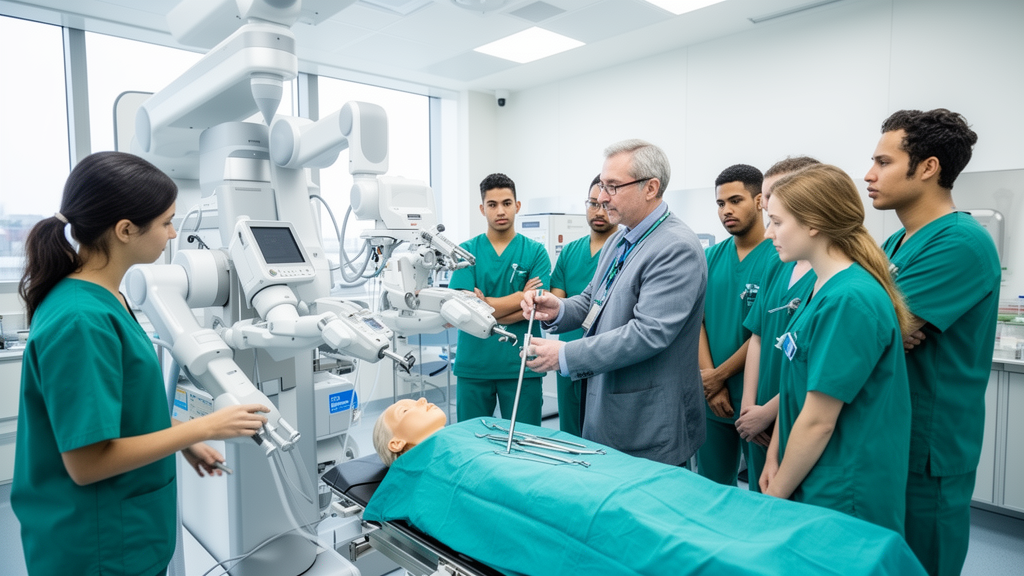
First-year medical students who attended pilot hands-on robotic surgery workshops reported greater interest in robotic surgery and urologic surgery, according to a retrospective survey study published in BMC Medical Education. The study found that students perceived the workshops as novel, valuable and desirable learning experiences, while also expressing interest in additional exposure to robotic surgery and urology. Its findings describe students’ retrospective perceptions rather than measured changes in knowledge, technical skill or career decisions.
A Urology Interest Group hosted three separate workshops for first-year medical students and administered surveys after participation. The investigators analyzed the numerical responses with descriptive statistics and the Wilcoxon signed-rank test, while open-ended questions were examined through constant-comparative open coding. Interest was assessed on Likert scales with a neutral midpoint of 3.
The median response was 4 for urologic surgery, with an interquartile range of 3.75–5, and 5 for robotic surgery, with an interquartile range of 4–5. Both sets of responses exceeded the neutral midpoint, with p-values below 0.001. Direct responses to the question of whether interest had increased produced a similar pattern: 92% of participants retrospectively endorsed increased interest in robotic surgery, while 75% endorsed increased interest in urologic surgery.
The open-ended analysis identified three recurring themes: hands-on practice, career exploration and knowledge acquisition. Together, these responses indicate that participants associated the workshops with practical experience, consideration of urology as a career path and introductory learning about the field. The researchers interpreted the results as supporting the feasibility and acceptability of similar educational initiatives.
The evidence is limited by the pilot design and retrospective, self-reported evaluation. Without a reported comparison group or prospective outcome measurements, the study cannot establish that workshop participation caused durable gains in surgical knowledge, technical competence, clinical performance or specialization choices. The authors consequently called for prospective studies to assess educational and career-related outcomes.
Within those boundaries, the clearest finding is that participating first-year medical students associated hands-on robotic workshops with stronger retrospective interest in urology and robotic surgery.
Subject of Research: Retrospective pilot study of first-year medical students’ perceptions of hands-on robotic surgery workshops
Article Title: First-year medical student perceptions of urologic and robotic surgery following pilot hands-on robotic workshops
Article References: Konopaski, A., Kovvur, M., Ding, S., Shannon, C., & Tarin, T. (2026). First-year medical student perceptions of urologic and robotic surgery following pilot hands-on robotic workshops. BMC Medical Education. https://doi.org/10.1186/s12909-026-10301-y
Image Credits: AI Generated
DOI: 10.1186/s12909-026-10301-y
Keywords: medical education, robotic surgery, urology, first-year medical students, hands-on workshops, student perceptions, survey research, career exploration, surgical training, First-year, medical, student
Cite Scienmag News
Courtney Benton. (October 26, 2026). Pilot robotic workshops linked to higher student interest in urology. Scienmag. https://scienmag.com/pilot-robotic-workshops-linked-to-higher-student-interest-in-urology/
Courtney Benton. "Pilot robotic workshops linked to higher student interest in urology." Scienmag, 26 October 2026, https://scienmag.com/pilot-robotic-workshops-linked-to-higher-student-interest-in-urology/. Accessed 26 October 2026.
Courtney Benton. "Pilot robotic workshops linked to higher student interest in urology." Scienmag. October 26, 2026. https://scienmag.com/pilot-robotic-workshops-linked-to-higher-student-interest-in-urology/


