


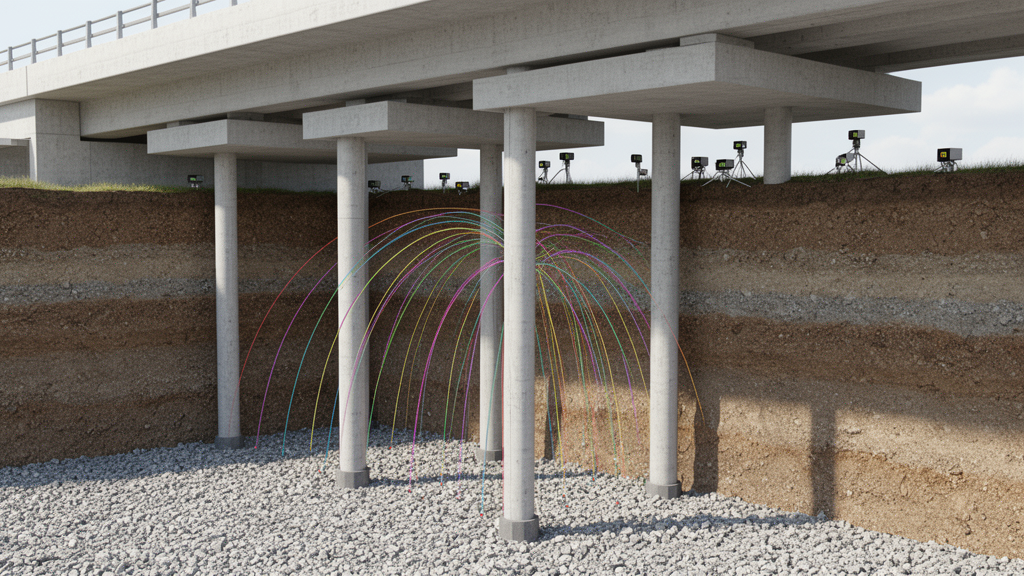
A genetically optimized weighted ensemble of machine-learning models can predict continuous load–settlement trajectories for bored piles while preserving the physical consistency of their forecasts. The study combined linear regression, random forest, XGBoost and a multilayer neural network, then used random search followed by a genetic algorithm to determine each model’s contribution to the final prediction. Tested against 563 field static load-test records, the resulting GA-Ensemble achieved an R² of 0.958 on an independent test set, with a normalized root mean square error of 5.27%, a root mean square error of 0.380 and a mean absolute error of 0.2322.
Tree-based models can generate abrupt, “ladder-like” errors in otherwise smooth load–settlement curves, according to the study. By blending predictions from models with different response patterns, the ensemble was designed to suppress those discontinuities and reconstruct a smoother, mechanically compliant trajectory. The reported test metrics show strong predictive performance, but they apply to the study’s field-record database and evaluation rather than guaranteeing equivalent accuracy for every pile, loading condition or soil profile.
The framework also applies SHAP, or SHapley Additive exPlanations, to make the ensemble’s reasoning more transparent. The investigators converted SHAP contributions onto a physical scale expressed in millimeters, allowing individual predictions to be interpreted in engineering terms rather than as model outputs alone. Dependency analysis indicated that the model captured the interaction between applied force, denoted P, and the pile’s free length, Lf. The authors interpreted this interaction as evidence that the framework represented the coupling of elastic compression and geometric nonlinearity in the load–settlement response.
Local diagnostic decompositions were used to isolate particular failure mechanisms within individual predictions. According to the study, these analyses quantified the “systemic penalty” associated with elastic shortening of structures and foundation puncture, including cases involving very stiff soil layers. The approach therefore treated explainability as a means of connecting numerical predictions with reported geotechnical behavior, rather than merely identifying influential input variables. It remains a modeling and interpretation study based on static load-test records; the supplied evidence does not establish long-term performance, construction outcomes or universal applicability. Within those limits, the framework combines high reported predictive accuracy, continuous curve generation and physically interpretable diagnostics in a single system for bored-pile settlement prediction.
Subject of Research: Machine-learning prediction of continuous bored-pile load–settlement trajectories from field static load-test records
Article Title: Predicting continuous load-settlement trajectories of bored piles: A GA-optimized weighted ensemble framework with explainable AI
Article References: Giap, L. V., Nguyen, T. L., & Pham, T. A. (2026). Predicting continuous load-settlement trajectories of bored piles: A GA-optimized weighted ensemble framework with explainable AI. PLOS One, 21(10), e0360945. https://doi.org/10.1371/journal.pone.0360945
Image Credits: AI Generated
DOI: 10.1371/journal.pone.0360945
Keywords: bored piles, settlement prediction, load–settlement trajectories, genetic algorithm, weighted ensemble, machine learning, SHAP explanations, geotechnical engineering, foundation design, field load testing, Predicting, continuous
Cite Scienmag News
Teresa Odom. (October 26, 2026). GA-Optimized Ensemble Predicts Continuous Bored-Pile Settlement Trajectories. Scienmag. https://scienmag.com/ga-optimized-ensemble-predicts-continuous-bored-pile-settlement-trajectories/
Teresa Odom. "GA-Optimized Ensemble Predicts Continuous Bored-Pile Settlement Trajectories." Scienmag, 26 October 2026, https://scienmag.com/ga-optimized-ensemble-predicts-continuous-bored-pile-settlement-trajectories/. Accessed 26 October 2026.
Teresa Odom. "GA-Optimized Ensemble Predicts Continuous Bored-Pile Settlement Trajectories." Scienmag. October 26, 2026. https://scienmag.com/ga-optimized-ensemble-predicts-continuous-bored-pile-settlement-trajectories/


