


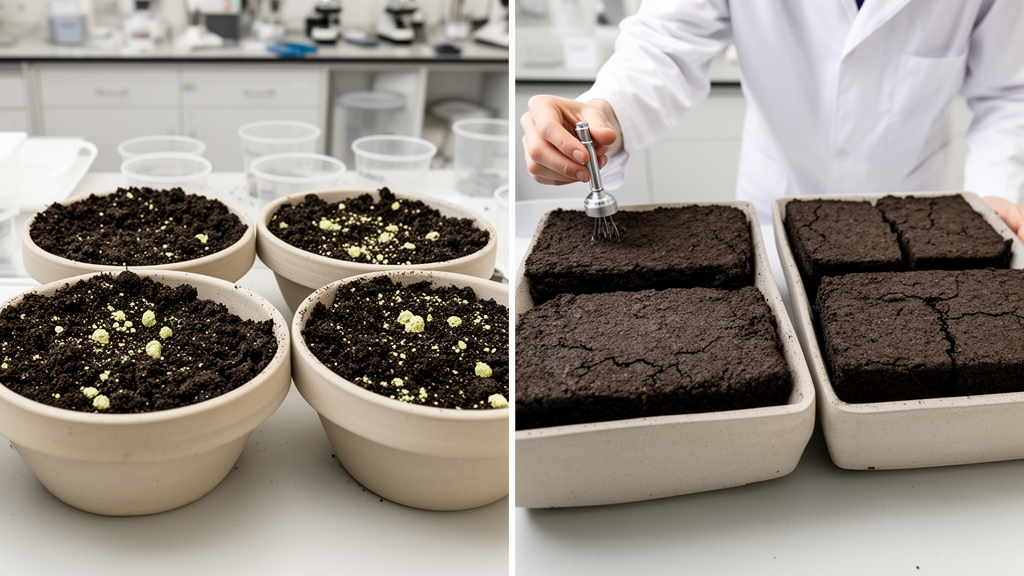
Stabilized construction-generated soil became less alkaline when exposed to air, but the best time to begin that exposure depended on whether neutralization or strength was the priority. An experimental study led by Shinya Inazumi at Shibaura Institute of Technology found that sealing soil after mixing could improve its unconfined compressive strength, while the duration of that seal generally did not increase its ultimate capacity to neutralize alkalinity through aeration. The results point to a simple scheduling principle: start aeration promptly when lowering pH is the main objective, but allow a short sealed-curing period when additional strength is required.
The work addresses a reuse problem created by cement- and lime-based soil stabilization. Such binders improve the workability and strength of construction-generated soil, but they also produce calcium hydroxide, which raises the pH of the soil’s pore solution to strongly alkaline levels. That alkalinity can inhibit plant growth and threaten surrounding water quality. Aeration offers a comparatively low-cost treatment because atmospheric carbon dioxide can convert calcium hydroxide into calcium carbonate, allowing pH to fall. Before this study, however, operators lacked quantitative guidance on how long treated soil should remain sealed between binder mixing and the start of aeration.
The researchers examined that interval using two binders with different reaction kinetics. The first was a quicklime-rich lime-based material that generates most of its calcium hydroxide rapidly through slaking. The second was ordinary Portland cement, which releases calcium hydroxide progressively as cement hydrates. This contrast allowed the team to test whether the optimal delay before aeration depended on how quickly each binder made alkalinity available. The study was made available online on August 13, 2026, and is scheduled to appear in Volume 32 of Results in Engineering on December 1, 2026.
For the experiments, the team prepared an adjusted mixture containing construction sludge and dewatered water-treatment sludge cake at a 2:1 volume ratio. The lime-based binder was added at 89.0 grams per liter, while ordinary Portland cement was added at 95.0 grams per liter. Lime-treated samples were sealed for 0, 1, 3, 5, 7, or 14 days. Cement-treated samples were sealed for 0, 1, 4, or 7 days. Each sample then underwent 28 days of aeration, allowing the researchers to compare both pH change and final mechanical performance across a range of curing schedules.
Soil-suspension pH was measured at 48-hour intervals, with an additional final measurement on day 28. Mechanical strength was assessed through unconfined compressive strength testing, using three specimens for each condition. The quicklime-rich binder showed essentially no effect of sealing duration on either the rate or magnitude of pH reduction. Regardless of how long those samples remained sealed before aeration, their pH trajectories converged near a terminal value of approximately 11.4. Under the tested conditions, delaying aeration therefore did not materially change how much the lime-treated soil neutralized.
Ordinary Portland cement produced a different pattern at first. Longer sealed periods were associated with a faster decline in pH during the opening days of aeration. But when the pH measurements were plotted against total elapsed time since mixing rather than time since aeration began, the separate cement treatments collapsed onto essentially the same trajectory. They converged near a terminal pH of approximately 9.9. The result indicates that sealing did not add neutralizing capacity; it shifted part of the treatment process in time. It also means that comparing pH only by the duration of aeration can give a misleading impression of the effect of curing schedules.
Mechanical strength showed the opposite response to sealing. For both binder systems, 28-day unconfined compressive strength rose monotonically as the sealed-curing period increased. A seven-day seal produced an increase of approximately 15–18% relative to the corresponding no-seal condition. Across the tested range from zero to seven days, the increase amounted to an apparent gain of roughly 2% of the no-seal strength for each additional day of sealing. The researchers cautioned that this preliminary relationship should not be extrapolated beyond the tested conditions, so the pattern should not be treated as a universal dosing or curing rule.
The experiments also revealed a lower limit on what aeration alone could achieve. Terminal pH values for the two binders were consistent with calcium carbonate–bicarbonate buffering, a chemical regime that resists further declines in pH. As a result, extending either the sealed period or the aeration period could not necessarily take the soil below its binder-specific pH plateau. If a proposed reuse requires a pH lower than that plateau, the findings indicate that operators may need to change the binder or its dosage instead of adding curing time. This distinction separates the controls on final pH from the controls on strength development.
That decoupling supports a compact process-selection framework based on the desired performance target. When rapid neutralization is the main goal, the framework favors immediate aeration because additional sealing does not add neutralizing capacity and can delay treatment. When greater strength is needed, a defined sealed period before aeration may be useful. The study does not establish a single optimum for every soil-processing yard: its evidence comes from one adjusted soil mixture, two specified binders, particular dosages, a laboratory-scale aeration treatment and the tested sealing intervals. Nevertheless, the findings offer practical guidance for scheduling the two treatment stages rather than treating them as a single inseparable step.
Inazumi said the most direct application is at yards that receive construction sludge and excavated soil stabilized with cement or lime. Demonstrating that a post-mixing seal adds no neutralizing capacity could allow such facilities to remove an unnecessary step, shorten processing time and free land in densely populated urban areas. The approach may also support greater reuse of construction-generated soil, reduce reliance on virgin fill and disposal, and make low-cost atmospheric carbonation more practical within circular construction workflows. The study presents a measured laboratory result rather than a field trial or demonstrated environmental outcome, but it provides a quantitative basis for deciding when aeration should begin when operators must balance soil strength against residual alkalinity.
Subject of Research: Optimizing aeration timing for alkalinity reduction and strength development in stabilized construction-generated soil
Article Title: Balancing alkalinity and strength in construction soil by optimizing aeration timing
Article References: Balancing alkalinity and strength in construction soil by optimizing aeration timing. Original publication (Bibliographic details unavailable.)
Image Credits: AI Generated
DOI: Not provided
Keywords: construction soil, aeration curing, soil neutralization, unconfined compressive strength, ordinary Portland cement, lime stabilization, calcium hydroxide, calcium carbonate, circular construction, geotechnical engineering, Balancing, alkalinity
Cite Scienmag News
Bethany Barker. (October 26, 2026). Aeration timing separates soil neutralization from strength gains. Scienmag. https://scienmag.com/aeration-timing-separates-soil-neutralization-from-strength-gains/
Bethany Barker. "Aeration timing separates soil neutralization from strength gains." Scienmag, 26 October 2026, https://scienmag.com/aeration-timing-separates-soil-neutralization-from-strength-gains/. Accessed 26 October 2026.
Bethany Barker. "Aeration timing separates soil neutralization from strength gains." Scienmag. October 26, 2026. https://scienmag.com/aeration-timing-separates-soil-neutralization-from-strength-gains/


