


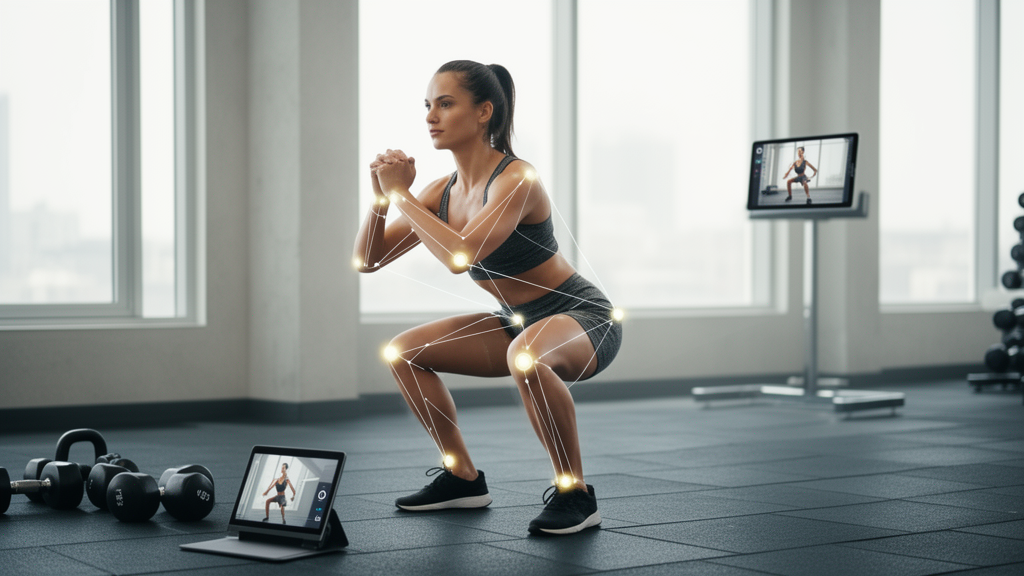
A computer-vision study reports that a lightweight version of OpenPose can recognize six fitness actions and count repetitions of four exercises with greater accuracy than several comparison methods. The model, called LW-OpenPose, achieved 94.37% repetition-counting accuracy across 200 manually annotated videos of sit-ups, pull-ups, push-ups and squats. Its mean absolute error was 1.12 repetitions, and the reduction in error compared with each baseline was statistically significant after correction for multiple comparisons. The results provide preliminary evidence that accurate, task-specific fitness tracking can be achieved without relying on a large pose-estimation network.
The researchers built their system around OpenPose, a bottom-up framework that detects body keypoints and links them into individual skeletons. They replaced the original VGG19 backbone with MobileNet V1 and changed the network’s 5 × 5 convolution kernels to 3 × 3 kernels, while retaining the heatmap and Part Affinity Field mechanism used to locate and connect joints. The resulting model contained 4.90 million parameters, required 7.20 gigaflop operations, occupied 19.80 megabytes and used 860 megabytes of peak GPU memory. Relative to the original OpenPose, the authors reported reductions of 90.63% in parameters, 95.51% in computational operations, 90.54% in model size and 69.93% in peak GPU-memory use.
Video frames first passed through bilateral filtering, which smooths noise while retaining edges, and were then converted into standardized two-dimensional keypoint coordinates. The system analyzed those coordinates over time rather than treating each frame independently. For pull-ups, it averaged the vertical positions of three body points and constructed a height curve whose peaks and troughs marked possible repetitions. A peak-height difference of 150 pixels was selected as the action-segment threshold during preliminary validation. Candidate sequences were then examined for evidence that a complete and technically valid repetition had occurred, rather than simply counting every rise and fall in body position.
Exercise-specific geometry formed an important part of this filtering. For pull-ups, the system assessed whether the lower jaw crossed the horizontal bar, measured elbow angles around the start and end of a candidate repetition and checked whether the feet left the ground. Frames surrounding the highest point of an action segment were included in the assessment, and segments whose combined penalty exceeded the preset threshold were discarded. For sit-ups, the authors calculated angles involving the torso, knees, ankles, wrists and upper body, then combined wrist, knee and ankle losses with weights of 0.40, 0.35 and 0.25. A total penalty threshold of 80 was adopted after tests of counting accuracy, misjudgment rate and filtering stability.
Action recognition was evaluated with the public UCF11 video dataset, which was divided 70:30 into training and testing sets. The models were trained for 200 epochs with a batch size of 16 and an initial learning rate of 0.001; the learning rate was reduced by a factor of 0.1 when validation loss did not improve for 10 consecutive epochs. In the reported final-iteration results, LW-OpenPose reached 87% accuracy on the training set and 89% on the test set. Five-fold cross-validation gave the model an average training accuracy of 0.93, with precision of 0.92, recall of 0.91 and an F1 score of 0.91. On the test set, accuracy was 0.89 and precision, recall and F1 were each 0.88.
The model also produced the lowest average running time among the three methods compared on UCF11, at 0.19 seconds, versus 0.21 seconds for PCFN and 0.24 seconds for R-WAA. In a separate efficiency assessment, LW-OpenPose processed 23 frames per second, required 60.16 milliseconds per frame and had an inference time of 75.26 milliseconds. Its reported GPU utilization was 78%, below 83% for R-WAA and 85% for PCFN. These figures were obtained on a workstation with an Intel Core i5-9400F processor, an NVIDIA RTX A4000 GPU with 16 gigabytes of memory and 32 gigabytes of RAM, rather than on a mobile or embedded device.
Tests with six UCF11 actions—sit-ups, pull-ups, plank supports, push-ups, squats and “Boby jumps,” as the source labels them—gave LW-OpenPose an average recognition accuracy of 0.93. Its class-specific accuracies were 0.90, 0.92, 0.93, 0.89, 0.97 and 0.98, respectively. The reported misclassification rate was 8.49% for sit-ups misclassified as pull-ups and 7.46% for push-ups misclassified as pull-ups; the abstract also reports a third rate of 6.46% without clearly identifying the corresponding case. These results concern classification of selected video clips and should not be treated as equivalent to the separate repetition-counting evaluation.
For repetition counting, the researchers collected 200 videos—50 each of sit-ups, pull-ups, push-ups and squats. Every clip lasted 30 to 60 seconds and contained five to 25 complete cycles, and recordings were made indoors, in dormitories, laboratories and outdoor playgrounds. Two annotators independently reviewed the videos frame by frame, defining complete repetitions from keypoint displacement, joint-angle changes and action-completion states; disagreements were resolved through further review, and annotation consistency was reported as 0.91. OpenPose, PoseNet, MoveNet, ST-GCN, R-WAA and PCFN were adapted to the same counting framework and evaluated on the same videos. LW-OpenPose achieved 94.37% accuracy, with a root mean square error of 1.46 repetitions and mean absolute percentage error of 5.63%.
The practical sit-up test involved five students from a sports college who recorded five-minute videos in four environments. Average counting accuracy exceeded 90% overall. It was generally above 95% outdoors, mostly above 90% in the laboratory, mostly above 85% in dormitories, and more variable at the playground, where the lowest result was 85%. The study therefore supports feasibility in a limited set of controlled and semi-controlled settings, but not broad claims about performance across populations. Its counting dataset was manually assembled and relatively small, the real-world sample included only five participants from one institution, and the camera was positioned frontally because oblique views could distort two-dimensional angle calculations. Mobile-device deployment, power use, long-term stability and performance under occlusion, changing illumination, complex backgrounds and multiple camera views were not tested and remain future research questions.
Subject of Research: Evaluation of a lightweight pose-based system for fitness action recognition and repetition counting
Article Title: Lightweight pose-based fitness action recognition and repetition counting method
Article References: Wang, Y., & Qian, L. (2026). Lightweight pose-based fitness action recognition and repetition counting method. Discover Artificial Intelligence, 6(1), Article 1157. https://doi.org/10.1007/s44163-026-02200-4
Image Credits: AI Generated
DOI: 10.1007/s44163-026-02200-4
Keywords: fitness action recognition, repetition counting, pose estimation, OpenPose, MobileNet V1, computer vision, exercise monitoring, lightweight neural networks, Lightweight, pose-based, fitness, action
Cite Scienmag News
Blake Davidson. (October 26, 2026). Lightweight pose model recognizes fitness actions and counts repetitions accurately. Scienmag. https://scienmag.com/lightweight-pose-model-recognizes-fitness-actions-and-counts-repetitions-accurately/
Blake Davidson. "Lightweight pose model recognizes fitness actions and counts repetitions accurately." Scienmag, 26 October 2026, https://scienmag.com/lightweight-pose-model-recognizes-fitness-actions-and-counts-repetitions-accurately/. Accessed 26 October 2026.
Blake Davidson. "Lightweight pose model recognizes fitness actions and counts repetitions accurately." Scienmag. October 26, 2026. https://scienmag.com/lightweight-pose-model-recognizes-fitness-actions-and-counts-repetitions-accurately/


