


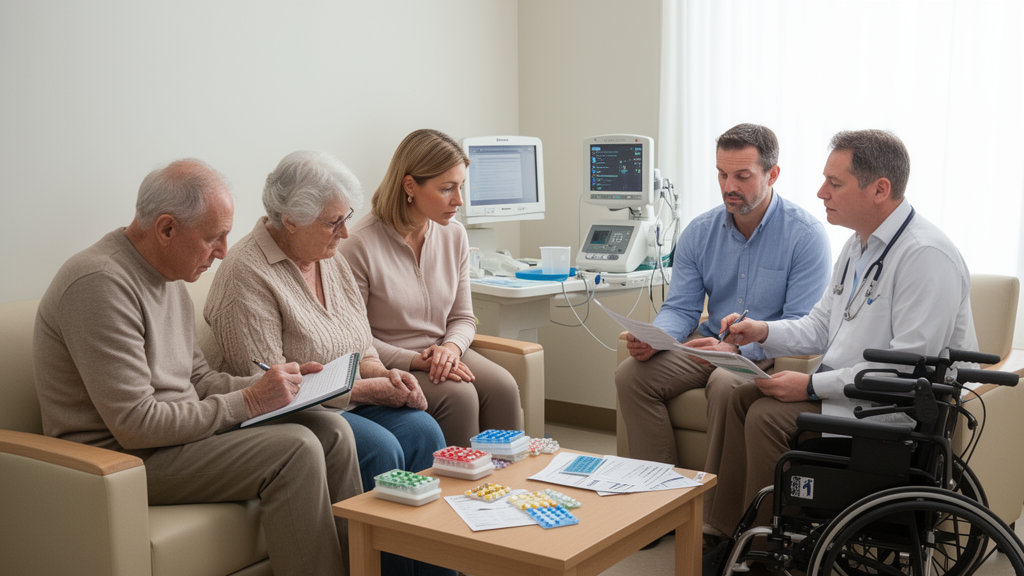
Heart failure patients and their family caregivers can be assigned to three distinct discharge-readiness profiles, according to an analysis of 533 patient–caregiver dyads. The largest group, representing 44.8% of the sample, had low discharge readiness; 37.9% had moderate readiness, and 17.3% had high readiness. The analysis also linked greater family resilience with a higher likelihood of membership in the moderate and high profiles, while stronger caregiver anxiety and depressive symptoms were associated with a lower likelihood of those profiles.
The study examined discharge readiness as a shared feature of the patient–caregiver pair. In the research, the concept encompasses the physical, psychological and social preparedness of both patients and their family caregivers for discharge. Rather than evaluating either person in isolation, the investigators sought to identify combinations of readiness within each dyad and relate those combinations to family and caregiver characteristics.
To identify the profiles, the researchers used latent profile analysis, or LPA, based on established instruments for assessing discharge readiness. They then applied multinomial logistic regression with the R3STEP approach to examine associations between profile membership, family resilience, caregiver anxiety and depressive symptoms. The low-readiness profile served as the reference in these multivariable analyses, allowing the likelihood of belonging to either of the two more prepared profiles to be assessed in relation to the measured family and emotional factors.
Family resilience had a consistent statistical relationship with discharge readiness. Dyads reporting higher family resilience were more likely to be in the moderate-readiness or high-readiness group than in the low-readiness group. The source reports these relationships as associations from multivariable models; it does not establish that family resilience produces greater readiness or that changing resilience would change a patient’s discharge profile.
Caregiver emotional distress showed the opposite pattern. Higher levels of caregiver anxiety and depressive symptoms were associated with a lower likelihood of belonging to either the moderate or high discharge-readiness profiles, relative to the low-readiness profile. The findings therefore connect caregiver psychological distress with readiness within the dyad, but they do not determine the direction or mechanism of that relationship.
Distress, readiness and other circumstances could potentially be related in ways that this analysis cannot resolve. The researchers also used the BCH approach to compare patient self-care ability and caregiver caregiving ability across the three profiles. Both capacities differed significantly among the low, moderate and high groups.
In practical terms, the profiles were not restricted to a shared readiness score: they also corresponded to measurable differences in what patients could manage for themselves and what caregivers could provide. The supplied results do not give the size or direction of every individual pairwise comparison, so they support the overall finding of significant differences rather than a complete ranking of all group combinations. These results reveal substantial heterogeneity in readiness at the point of discharge from hospital.
Most dyads fell into the low or moderate groups, and fewer than one in five were placed in the high-readiness profile. The authors’ conclusion calls for discharge assessment and planning that take the patient–caregiver dyad into account, with particular attention to family resilience and caregiver psychological distress. The study identifies three readiness profiles and their associations; it does not demonstrate clinical or health-service benefits from a new discharge program, nor does it show that strengthening family resilience or addressing distress would improve post-discharge outcomes.
Its contribution is instead to show that discharge readiness varies meaningfully between families and that caregiver distress and family strengths accompany those differences.
Subject of Research: Associations of discharge-readiness profiles with family resilience, caregiver distress and care abilities in heart failure patient–caregiver dyads.
Article Title: Latent profiles of heart failure patient–caregiver dyadic discharge readiness: associations with family resilience, caregiver distress, and dyadic care ability
Article References: Yang, R., Zhu, Z., Li, S., Ji, S., Wang, W., & Hou, Y. (2026). Latent profiles of heart failure patient–caregiver dyadic discharge readiness: associations with family resilience, caregiver distress, and dyadic care ability. BMC Health Services Research. https://doi.org/10.1186/s12913-026-15632-6
Image Credits: AI Generated
DOI: 10.1186/s12913-026-15632-6
Keywords: heart failure, discharge readiness, patient–caregiver dyads, family resilience, caregiver anxiety, depressive symptoms, latent profile analysis, self-care ability, caregiving ability, family-centered care, Latent, profiles
Cite Scienmag News
Glenn Wilkins. (October 26, 2026). Heart failure discharge readiness takes three distinct family profiles. Scienmag. https://scienmag.com/heart-failure-discharge-readiness-takes-three-distinct-family-profiles/
Glenn Wilkins. "Heart failure discharge readiness takes three distinct family profiles." Scienmag, 26 October 2026, https://scienmag.com/heart-failure-discharge-readiness-takes-three-distinct-family-profiles/. Accessed 26 October 2026.
Glenn Wilkins. "Heart failure discharge readiness takes three distinct family profiles." Scienmag. October 26, 2026. https://scienmag.com/heart-failure-discharge-readiness-takes-three-distinct-family-profiles/


